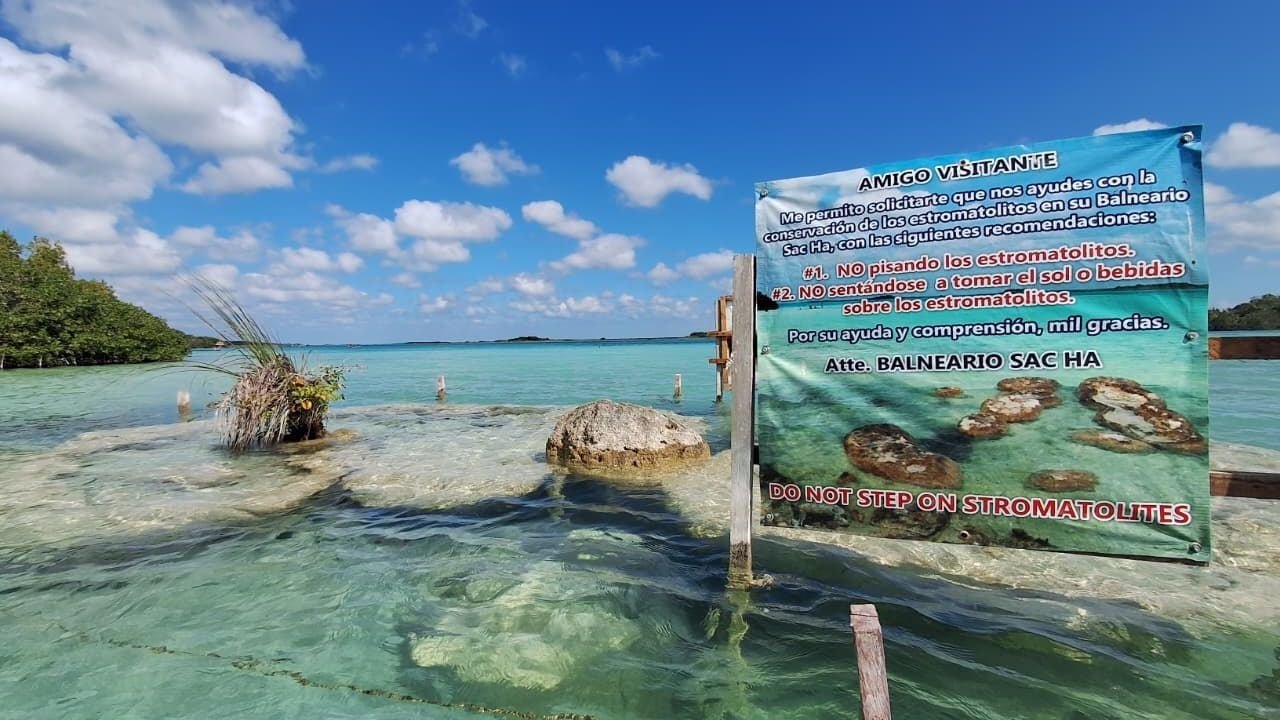
Chetumal, Quintana Roo — A researcher has challenged prevailing narratives about the so-called “stromatolites” of Bacalar Lagoon, arguing that misconceptions have hindered effective conservation of this ecosystem. María Luisa Villarreal presented her books Microbialitos de Bacalar and El mito que gobierna a la laguna, which question dominant scientific and public discourse about the lagoon’s formations.
Villarreal contends that much of the discussion surrounding these structures relies on myths that have created social polarization and paralysis rather than aiding preservation. She explained that Bacalar does not have stromatolites in the strict sense, but rather microbialites—a broader, scientifically accurate term for rocks formed by microorganisms.
“The microbialite is the general concept. It’s like saying all Ferraris are cars, but not all cars are Ferraris,” Villarreal said. “Within that group there are many forms: thrombolites, mixed microbialites, structures with laminations, others with broccoli or onion shapes. Calling them all stromatolites is incorrect.”
The researcher noted that even world-renowned geobiology specialists have been misquoted, with statements attributed to them that don’t appear in their original articles, further reinforcing misconceptions about the lagoon.
A central point of her research demystifies the ecological function of these formations. Villarreal explained that microbialites’ water-cleaning effect is local and limited to their immediate surroundings, insufficient for a lagoon nearly 60 kilometers long.
She clarified that while microbialites played a crucial historical role in oxygen production during Earth’s early life stages, they became less significant when plants and trees emerged. “Today their importance isn’t the same as billions of years ago, though they remain fundamental to geological and biogeochemical processes,” she explained.
Villarreal detailed how microbialites grow laterally by capturing carbon dioxide as carbonate, generating soil through what she calls “hydrological succession.” This phenomenon, along with positive feedback between sediments, light, and microorganisms, explains the formation of estuaries, swamps, and the lagoon’s current configuration.
According to Villarreal, giant microbialites concentrate in southern Bacalar because of greater water contributions and sedimentation from springs, not because the entire lagoon has the same conditions.
Another widespread myth, she noted, is the idea that microbialites “die” when stepped on. “You can’t kill them—they’re stones. What’s alive is a layer of microorganisms on top, the microbial mat, which is very resistant and has survived mass extinctions, even the Chicxulub meteor impact,” she explained.
However, she warned that these structures are fragile and can break, so their protection should be based on clear information rather than alarmist narratives.
Villarreal emphasized that obsession with the stones has diverted attention from more serious problems like sedimentation and water stagnation in the lagoon’s northern zone, where water residence time can reach up to 10 years. The closure of channels and lack of maintenance have worsened water stagnation, affecting the entire ecosystem’s health.
“The lagoon needs management and maintenance, like the Maya used to do—they cleaned, dug, and built dikes. The myth has paralyzed us,” she concluded.
Through her books, the researcher aims to provide tools for understanding the lagoon as an integrated system and promote informed debate to overcome polarization. “When a myth governs, we stop seeing complete reality. And Bacalar can’t wait any longer,” she said.
Discover more from Riviera Maya News & Events
Subscribe to get the latest posts sent to your email.