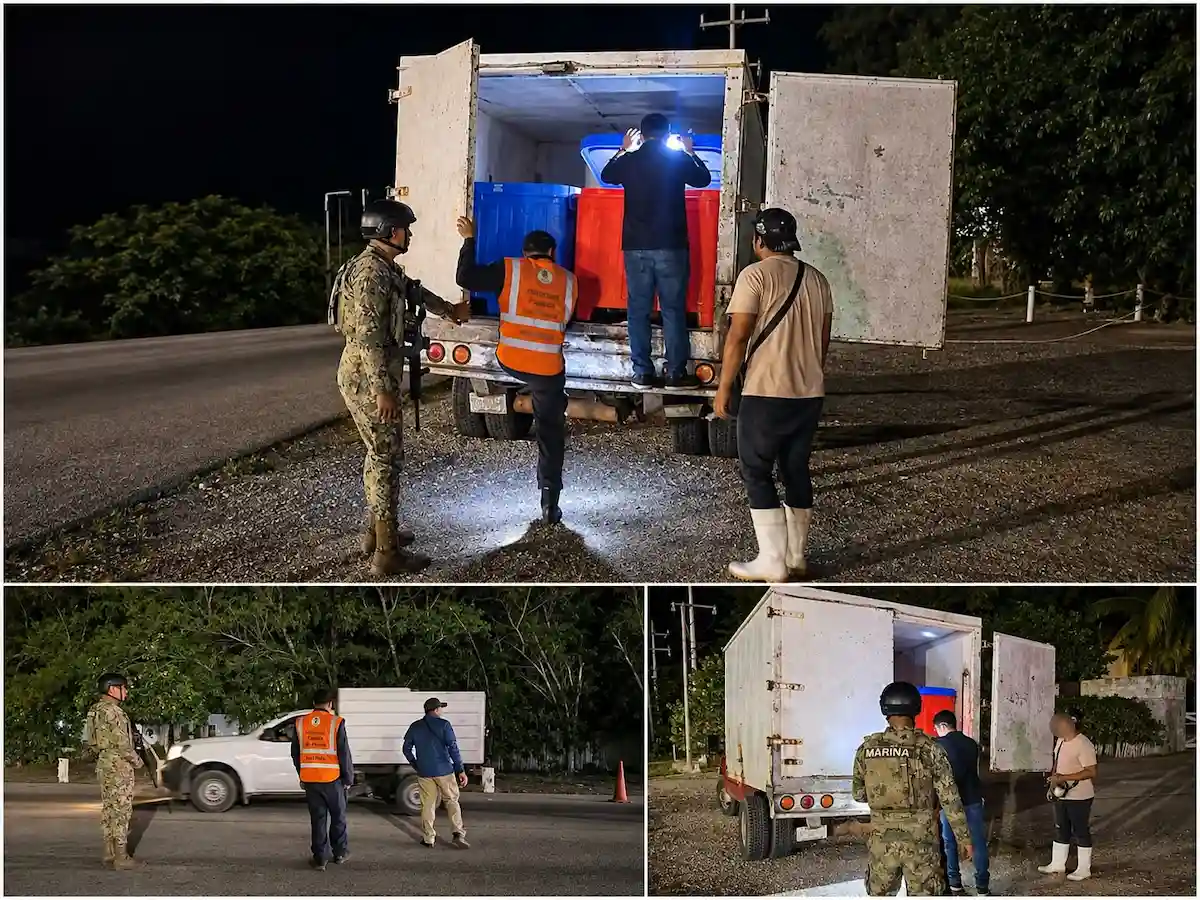
Progreso, Yucatán — Mexican Navy personnel and federal fisheries inspectors seized 1,834 kilograms of seafood, including about 1.8 metric tons of octopus, from two private vehicles on the coastal highway linking the ports of Progreso and Telchac Puerto after the drivers failed to produce paperwork proving the catch was legally sourced.
The inspections were carried out by personnel from the Navy’s Ninth Naval Zone working with inspectors from Conapesca, the national aquaculture and fisheries commission, during ground patrols along the northern Yucatán coast in recent days, the Navy said in a statement.
Two Vehicles Stopped at the Same Checkpoint
In the first inspection, officers stopped a stake-bed truck and found 600 kilograms of octopus, 17 kilograms of white grunt and 17 kilograms of red snapper, a combined 634 kilograms of seafood.
The occupants could not show documents proving the legal origin of the load, so fisheries officials ordered the vehicle and its contents held on a precautionary basis.
Later the same day, at the same checkpoint, inspectors stopped a second vehicle carrying 1,200 kilograms of octopus, also without supporting paperwork. That vehicle and its cargo were also seized.
- Octopus, first vehicle: 600 kg
- Octopus, second vehicle: 1,200 kg
- White grunt: 17 kg
- Red snapper: 17 kg
- Total seized: 1,834 kg
Octopus accounted for roughly 98.1 percent of the total volume retained.
No Arrests Reported
The Navy said the vehicles and the seafood were placed under deposit and turned over to the competent authorities for administrative proceedings.
The information released so far does not report any detentions, identify the owners of the vehicles, specify where the cargo was headed or say where the seafood was caught. No final sanctions have been announced, and it will be up to the authorities to determine any administrative responsibility arising from the missing documentation.
Octopus Season Runs Through Dec. 15
The seizure occurred during the legal octopus season on the Yucatán coast, which opened Aug. 1 and closes Dec. 15, 2026.
Federal rules set fishing and closed seasons for octopus in Campeche, Yucatán and northern Quintana Roo to protect the species’ reproduction and availability. Transporting octopus in November is therefore not an offense in itself; the violation detected in this case was the inability to document where the catch came from.
Articles 75 and 76 of Mexico’s General Law for Sustainable Fisheries and Aquaculture set out how the origin of fishery products must be proven and regulate their transport through documents including the fishing guide, depending on the case. The rules are intended to guarantee traceability, identify where marine resources originate and keep unauthorized catches out of formal sales channels.
Refuge Zones Nearby
The operation took place on a stretch of coastline where special protection and fisheries management measures apply.
In September 2025, Conapesca established a five-year fishing refuge zone at Telchac Puerto to protect populations of Maya octopus, lobster, red grouper and sea cucumber. Inside that zone, commercial Maya octopus fishing is allowed only with the traditional gear known as jimba, between Aug. 1 and Dec. 15 each year, and only under the applicable rules.
The same agency decreed another refuge zone at El Cerrito, Chuburná, in the municipality of Progreso, as part of a strategy to conserve commercially important species and promote sustainable harvesting.
Officials have not said, however, that the seized cargo came from either protected area, so the seizures cannot be directly linked to violations of the refuge zones’ specific restrictions.
Yucatán Leads National Octopus Production
The economic weight of the fishery helps explain the emphasis on transport checks. According to figures published Oct. 8, 2026, by the Secretariat of Agriculture and Rural Development, Mexico recorded preliminary octopus production of 40,710 metric tons in 2025, placing the fishery among the country’s ten largest.
Yucatán led with 28,789 metric tons, followed by Campeche with 8,951 and Baja California Sur with 1,258 — meaning Yucatán accounted for about 70.7 percent of the national total.
Conapesca also reported that for the 2025 season the allowable Maya octopus catch in Campeche and Yucatán was raised from 28,000 to 32,000 metric tons, based on technical assessments by IMIPAS (the Mexican Institute for Research on Sustainable Fisheries and Aquaculture). That figure applied to the previous season and is not a quota authorized for 2026.
Missing Paperwork Can Bring Sanctions
The fisheries law lists the failure to document the legal origin of fishery products as an infraction for anyone who possesses, stores, transports or sells them. It allows authorities to carry out inspections and adopt precautionary measures while proceedings unfold, without that automatically deciding final responsibility.
Conapesca keeps the phone line 669 915 6913 open to receive reports of illegal fishing.
More Crime
- Cancún Police Knock on Doors, Reaching 3,537 Families in 61 Neighborhoods
- Six Detained as Four Drug Raids Target Three Quintana Roo Municipalities
- Former Puerto Aventuras Official Faces New Charges Over Kidnapping of Journalist
- Cancún Police Recover Up to 25 Stolen Vehicles in Two Weeks and Arrest Drug Suspect
- Speeding Driver Causes Crash on Playa del Carmen’s Luis Donaldo Colosio Boulevard