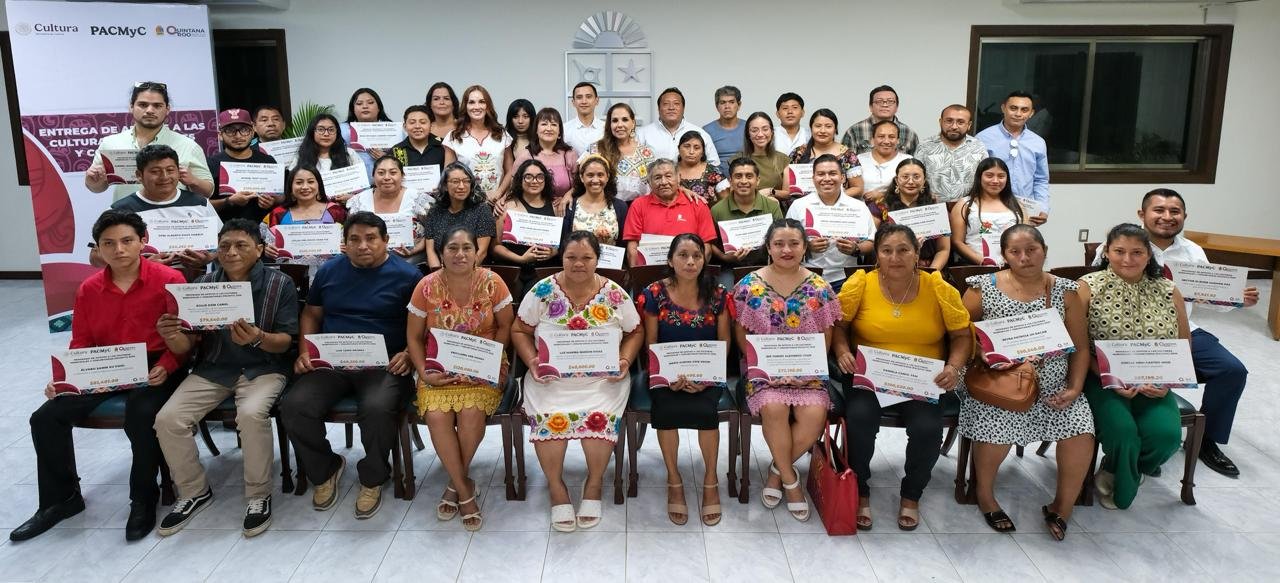
Chetumal, Quintana Roo — Quintana Roo Governor Mara Lezama Espinosa handed out 4.25 million pesos in cultural grants to 40 community projects across the state, money officials said is meant to keep traditional crafts and ancestral knowledge alive.
The funding came through the 2026 edition of the Program of Support for Municipal and Community Cultures (PACMyC), administered by the state Institute of Culture and the Arts (ICA) together with Mexico’s federal Culture Secretariat. The ceremony was held in the Cuna del Mestizaje hall at the Government Palace.
The 40 approved projects — the fourth consecutive round under the current administration — are led by 22 women and 18 men. The package combines 2.25 million pesos from the federal government with 2 million pesos from the state.
The grants cover a range of cultural expressions, including traditional music, Maya medicine, gastronomy, pottery, embroidery, weaving, the passing down of ancestral knowledge and the strengthening of community practices.
Lezama frames grants as ‘shared prosperity’
Lezama said the goal is to preserve the trades and knowledge that families transmit from one generation to the next, and to reinforce the identity and cultural roots of communities.
“I want you to be convinced that these supports turn into shared prosperity, into wellbeing for many people,” she said.
The governor thanked President Claudia Sheinbaum Pardo and Diego Prieto Hernández, head of the federal Unit for Living Cultures, Intangible Heritage and Interculturality, for their backing of Maya culture.
“Today, in this different government, in a government of the Fourth Transformation, in a humanist government with a feminist heart, this is a recognition of your knowledge, but it is also social justice and opportunity for our Indigenous peoples,” Lezama said. “Let no one dare forget them, let no one dare erase us from the map; they are more alive than ever with the support of our President and with this government that sees them, that makes them visible, and that feels deeply proud of who they are.”
Paz Georgina Salvador Almazán, who directs the regional and municipal development office within the federal unit, said each of the 40 projects represents a collective effort to safeguard traditions, artistic expression, languages and cultural practices that shape the identity of towns and communities.
“Their work is proof that culture remains a fundamental element for social cohesion, community participation and building a future with solid roots in our history and heritage,” she said.
128 projects funded statewide, ICA says
Lilian Villanueva, director of the ICA, said the current administration has financed 128 projects statewide with more than 11.4 million pesos, spanning traditional midwifery, musical and dance heritage, embroidery, wood carving, food culture and the Maya language, among other expressions.
Yensunni Martínez Hernández, municipal president of Othón P. Blanco, attended the ceremony alongside the grant recipients.
More Culture
- UADY Presents ‘Wáay Chivo,’ a Wordless Graphic Novel Reinterpreting a Yucatecan Legend
- Cancún’s Tardes de Lucha Libre Wraps 2026 Season with 6,400 Fans
- Aurora, Andrómeda, Chapo Albury and 319 Take Top Honors at World Brahman Congress in Yucatán
- Isla Mujeres Vies to Keep Its Pueblo Mágico Status as Federal Review Nears
- Religious Divides Thwart Maya Traditions at Quintana Roo Intercultural University
More Quintana Roo
- Six Detained as Four Drug Raids Target Three Quintana Roo Municipalities
- Quintana Roo Updates Studies for 60-Kilometer Sargassum Barrier
- Puerto Morelos Brings Free Health and Welfare Services to 109 Residents in Rural Communities
- More Than 480,000 Quintana Roo Students Get Long Weekend for Revolution Day
- Sargassum Eases on Northern Quintana Roo Beaches, but Southern Stretches Still Overwhelmed