
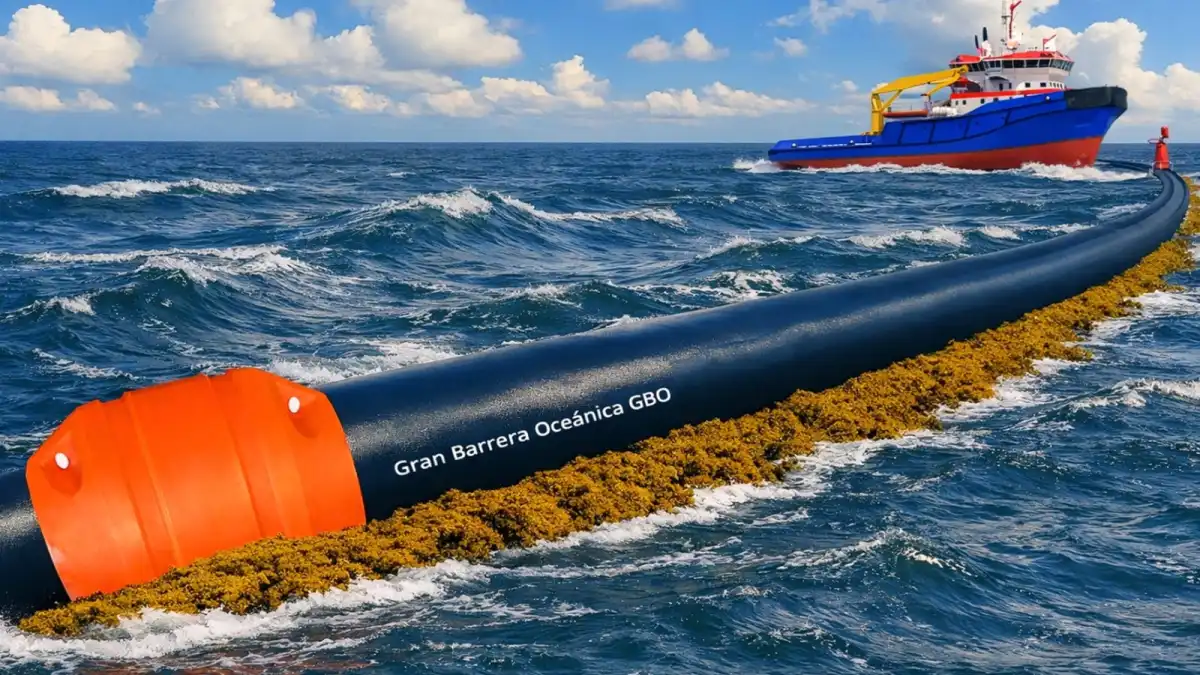
Cancún, Quintana Roo — Quintana Roo has entered a new phase of technical studies and financing work for the Gran Barrera Oceánica GBO 60×60, a project to install a 60-kilometer floating sargassum barrier off the state’s coastline at an estimated cost of $96 million.
The structure is designed to intercept the seaweed in open water and protect seven municipalities, but officials still need to define where each segment would go, what materials and dimensions it would use, how it would be anchored, and what maintenance would cost. State authorities expect it to begin operating in 2028, with Mexican companies taking part in its manufacture.
The current phase does not include installation. It covers updated studies that will determine the barrier’s location, its specifications, an anchoring system that avoids damaging the seabed and reefs, and the cost of operating and maintaining it. The financing model and construction timetable will be set once those analyses are complete.
How the barrier would work
The proposal calls for a floating barrier placed before the sargassum reaches the beaches, intercepting it in shallow water and steering it toward collection points. The goal is to reduce the accumulation and decomposition of seaweed on the sand, a process that produces odors and gases, creates health risks and damages seagrass, reefs and tourism.
The project first emerged in 2022 but was suspended because of the economic fallout from the pandemic. The state Environment Secretariat (SEMA) now considers the studies out of date given shifts in ocean currents, global warming and changes to the federal government’s strategy for tackling the problem in the Mexican Caribbean.
Among the proposed changes is the size of the structure. Barriers in use today rise about 20 centimeters above the waterline, while the new design calls for one to 1.5 meters, with most of the structure at the surface. That would reduce the amount of seaweed passing underneath, though authorities acknowledge some would still slip through.
According to the project’s design, sargassum arriving on the Quintana Roo coast travels through the Cozumel channel. The barrier would therefore start at the southern tip of Cozumel island and run to Boca Paila in Tulum. It would be laid out with a 60-degree opening — the source of the 60×60 name — and would include gaps to let boats pass. Installation could be staggered to keep navigation flowing.
Cost and record seaweed volumes
The preliminary estimate is about $1.6 million per kilometer of barrier, which comes to roughly $96 million for the planned 60 kilometers.
The update comes after a record season. SEMA reported that more than 153,000 tonnes of sargassum were collected in 2026, a 59.3 percent increase over the 96,000 tonnes recorded in 2025. Final figures for the season put the accumulated total at 156,631 tonnes, of which only 16.4 percent was removed at sea. The remaining 83.6 percent was cleared from beaches by crews from the three levels of government — meaning most of the seaweed washed ashore before it could be collected, one of the problems the offshore structures are meant to address.
At the season’s peak, as much as 90,538 tonnes of sargassum circulated in the Mexican Caribbean in a single day, 27 times the historical average. An estimated 10 percent of it reaches the Quintana Roo coast.
The state currently has 13,560 meters of barriers in place against the 15,465 meters deemed necessary, leaving 1,905 meters still to be installed.
In Cancún, the sargassum response cabinet reported on October 20 that 345 meters of barrier had been placed at Playa del Niño in Benito Juárez. Studies are also under way on whether to extend the systems along the 12 kilometers between Punta Nizuc and Punta Cancún, one of the destination’s main tourist areas. Statewide, the length of containment structures was expanded by 15 kilometers and dynamic barriers were designed to make offshore collection easier.
Federal spending
The Gran Barrera Oceánica is part of the Mexican government’s comprehensive strategy for managing sargassum. President Claudia Sheinbaum announced a 2 billion peso investment split into two stages. The first, 768.7 million pesos, is meant to raise daily collection capacity from 1,227 to 1,870 tonnes. The second, planned for 2027, would lift it to 4,000 tonnes per day.
Officials have also reported a federal investment of 2.6356 billion pesos covering two ocean-going sargassum vessels, six semi-oceanic vessels, six tugboats, 1,500 meters of dynamic barriers and 35 kilometers of containment and redirection systems.
The National Tourism Development Fund (Fonatur) will coordinate part of the strategy and earmark about 500 million pesos to mechanize beach collection ahead of the 2027 season. The money would go toward machinery that separates seaweed from sand and toward collection centers equipped with leachate control systems.
The $96 million sought for the Gran Barrera Oceánica would be added to this federal and state framework once the studies are finished and a financing model is chosen.
More sargassum forecast for 2027
While the studies are updated, SEMA secretary Óscar Rébora Aguilera warned that sargassum in the Atlantic Ocean could increase in 2027. Floating sargassum in the Atlantic is projected to rise from about 60 million tonnes in 2026 to around 80 million tonnes next year, an increase of 20 million tonnes in open water.
Rébora Aguilera said that if the roughly 1 percent of that total that reached state shores in 2026 is used as a reference, the potential volume for 2027 could reach 800,000 tonnes. He cautioned that it is impossible to guarantee that share will actually arrive, because the seaweed’s movement depends on winds, currents and tides.
“We are talking about 20 million more tonnes of sargassum floating in the Atlantic. Whether it washes ashore or not will depend on three criteria — winds, currents and tides. But that there will be more sargassum in the Atlantic is a reality,” he said.
Against that backdrop, the Quintana Roo government plans to seek international financing and multilateral agreements to deal with the environmental and economic consequences. Rébora Aguilera argued that developed countries and international cooperation agencies should direct resources to developing nations facing the effects, since the problem crosses borders and exceeds national budgets.
He linked the seaweed’s proliferation to global factors including the discharge of wastewater and nutrients into the oceans, noting that more than 66 percent of countries release wastewater directly into the sea, contributing to the deterioration of marine ecosystems.
More Environment
- Crisanto Grajales and Regina Michel Win 16th Xel-Há Triathlon
- Playa del Carmen Withholds CFE Permits for Cozumel Power Line Pending Environmental Ruling
- Playa del Carmen Keeps Storm Operation Running as Heavy Rain Persists
- Reported Snail Collection Raises New Concern for Bacalar Lagoon
- Heavy Rain Floods Streets and Catches Pedestrians Off Guard in Playa del Carmen
More Quintana Roo
- Puerto Morelos Brings Free Health and Welfare Services to 109 Residents in Rural Communities
- More Than 480,000 Quintana Roo Students Get Long Weekend for Revolution Day
- Sargassum Eases on Northern Quintana Roo Beaches, but Southern Stretches Still Overwhelmed
- Fonatur Prepares Two-Stage, $108 Million Sargassum Plan for 2027
- Buen Fin 2026 in Quintana Roo: Property Tax Fines Waived, but No Driver’s License Discounts