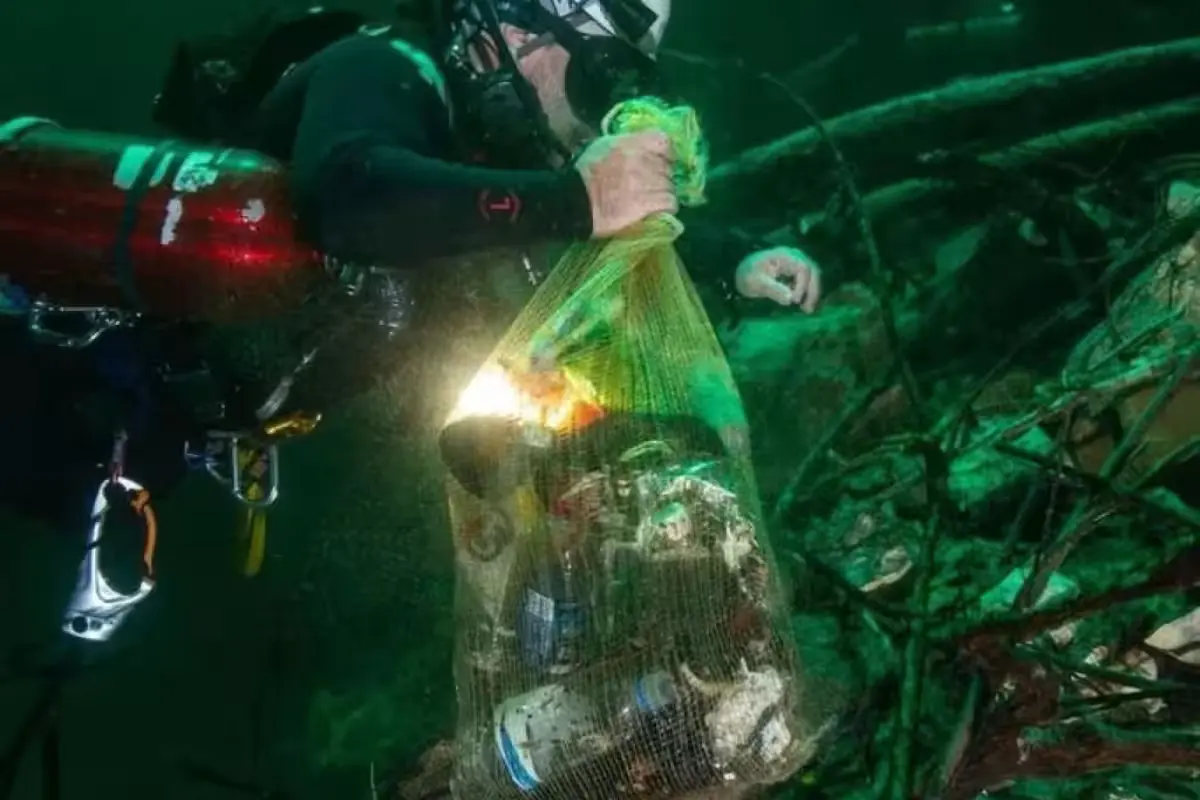
Mérida, Yucatán — Twenty-four years after someone dropped a potato chip wrapper into the Chankom cenote, divers found the bag nearly intact at the bottom during a cleanup operation, a stark reminder that in Yucatán whatever is discarded above ground eventually ends up in the same underground system that supplies the state’s drinking water.
The state is estimated to have between 7,000 and 8,000 cenotes, but the Secretariat for Sustainable Development (SDS) has registered only 3,050, according to researchers at the Autonomous University of Yucatán’s (UADY) Faculty of Chemical Engineering. That means fewer than half of these water bodies have any official diagnosis; for the rest, their condition is unknown.
The information gap is significant in a state with no rivers or surface lakes, where all fresh water comes from beneath the ground. The Yucatán Peninsula sits on highly porous limestone, crossed by cracks, caves and conduits through which water — and anything that filters into it — circulates rapidly. Academic studies estimate that 71 percent of the Yucatán aquifer has high, very high, or extreme vulnerability to contamination. Adding to that natural fragility, only 2.7 percent of the state’s wastewater receives any treatment before returning to the subsurface.
A geographic information system study on aquifer contamination risk identified the Mérida metropolitan area as the most dangerous zone in the state, precisely because it concentrates the highest density of homes without sewer connections, along with roads, gas stations, livestock farms and intensive agriculture using fertilizers and pesticides. The highest risk, researchers found, is not in the countryside but where most Yucatecans live.
The state government has launched a response. Since 2025, the SDS has operated the Strategy for the Conservation of Karst Systems, which in its first year targeted 20 priority cenotes: 15 under direct management of the agency and five in collaboration with the Bepensa Foundation. The cleanups have produced measurable results. At the X’Pakay cenote in Tekit, divers removed 102 kilograms of waste, 38 of them from the bottom. In Dzityá, six divers pulled 109 kilograms of trash from the Chen Ha cenote, including a tire, a toilet and fragments of kitchen cabinets. In Homún, the Pedz Can cenote yielded another 47.5 kilograms, and a recent joint effort with the Popolá town council and the company Empaques Nova in Yaxcabá removed 104.3 kilograms more.
These are real operations, not simulations. But they remain drops in a problem measured in thousands of undiagnosed cenotes and an aquifer that constantly receives nitrates, pesticides, hydrocarbons, pharmaceuticals and personal care products filtering down from the surface. The UNAM Faculty of Chemistry monitors these compounds in cenotes and supply wells across the peninsula and even uses caffeine in the water as a marker for human wastewater. It is a way of stating plainly that contamination of the Yucatán aquifer is no longer a hypothesis but an ongoing phenomenon under permanent scientific surveillance.
The problem is not limited to visible trash. In July 2025, the state government published Decree 88/2025, expanding the number of municipalities covered by the Ring of Cenotes State Geohydrological Reserve from 13 to 24. On the surface, that appears to be progress. Yet the total protected area shrank, from the 219,207.83 hectares originally decreed in 2013 to 213,737 hectares. The new decree also left out municipalities where urban and industrial pressure is highest, including Mérida, Kanasín and Umán — exactly the areas where aquifer recharge faces the greatest risk.
Environmental organizations have noted that the Ring of Cenotes, as officially recognized by the National Water Commission and the National Commission for Knowledge and Use of Biodiversity, crosses between 27 and 54 municipalities depending on the source, far more than the 24 covered by the current decree. The groundwater running beneath those municipalities is not an abstract issue: it is the only supply source for practically the entire population of Yucatán and supports a tourism economy that collects entry fees at cenotes across the Ring, many of which are part of an 891-hectare Ramsar site recognized for its international value as a wetland. Every cenote closed because of contamination is not just an ecological loss; it is also a direct blow to Maya families who depend on community tourism in municipalities such as Homún, Cuzamá and Tecoh.
Neither is this a new issue. Since the reserve was declared a protected natural area in 2013, the state took a decade to even put out to bid the preparation of its management program, the technical document that should define precisely what is allowed, prohibited and monitored within the zone. By the time the tender was published in 2023, environmental law specialists were already warning that the delay had allowed ecological imbalances that a timely regulatory framework could have contained.
The contrast, then, is not between cleaning cenotes or not cleaning them. It is between a real operational effort — hundreds of kilograms of waste removed cenote by cenote — and a legal and monitoring framework that continues to arrive late, with gaps, and without covering most of the more than 7,000 water bodies on which Yucatán’s drinking water literally depends. Until that gap is closed, every cleaned cenote risks filling up again, because what is not registered is not monitored, and what is not monitored keeps receiving, without anyone immediately noticing, what was already discarded above ground.
More Environment
- Deer at Calle 88 Raises Alarm Over CFE Cozumel Cable Plan
- Yucatán Leads Mexico’s Octopus Production With More Than 28,000 Tons
- Xcalak Residents Warn of Dead Fish and Contaminated Water as Sargassum Piles Up
- Mexico Seizes Three Boats at Arrecife Alacranes Over Illegal Activities
- Pink Flamingos Find Refuge in Cancún’s Nichupté Lagoon, Officials Say