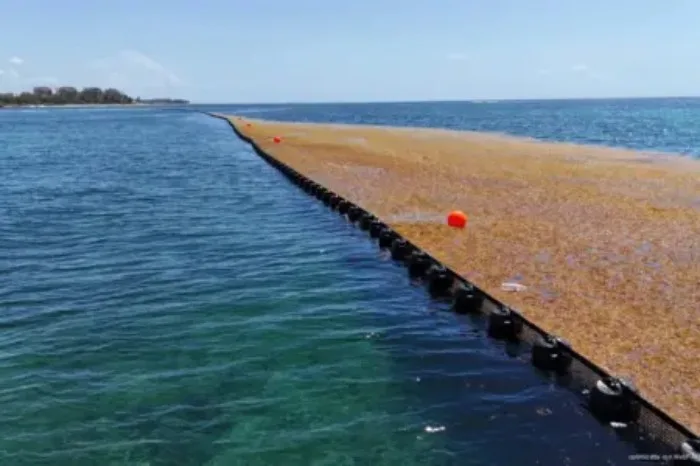
Playa del Carmen, Quintana Roo — Federal efforts to contain sargassum in Playa del Carmen could expand significantly in the coming months, with authorities considering the installation of 8 to 10 additional kilometers of marine barriers. The Mexican Navy is currently placing 5 kilometers of barriers as part of the first phase.
The project is still in technical evaluation following a tour this week by federal, state, and municipal officials who inspected the coastline and reviewed conditions for the new Comprehensive Sargassum Response Plan.
Irvin Madrigal, director of the Federal Maritime-Terrestrial Zone (Zofemat) in Playa del Carmen, said the visit was meant to show federal officials how sargassum arrives on this municipality’s beaches, noting that each coastal destination has different characteristics.
“They want to understand the morphology and condition of each municipality,” Madrigal said. “Puerto Morelos is not the same as Playa del Carmen or Cancún. Each strategy has to adapt to the needs of its coastline.”
During the tour, officials met with beach concessionaires, tourism entrepreneurs, and small hotel owners, and visited priority sites where sargassum accumulation is constant. One of those stops was Playa El Recodo, where authorities reviewed coastal erosion and the pattern of sargassum landings.
Madrigal said that beach has faced problems for approximately nine years because of the natural shape of the coast. “We explained the morphology of why we see that constant beaching and the negative images that are generated at El Recodo,” he said.
The delegation also traveled to Puerto Aventuras, where they evaluated work done by the private sector and the upcoming installation of new containment barriers.
According to Madrigal, the proposal under review would significantly expand the anti-sargassum infrastructure. “The Navy is finishing the five kilometers planned for the first stage, and the goal is to extend coverage. We are talking about 8 to 10 additional kilometers,” he said.
While the project has not been officially approved, the new barriers could be installed both north and south of the municipality. Areas under consideration include Playacar, Corasol, Xcalacoco, and Puerto Aventuras, where sargassum has historically piled up in large amounts and where much of the area’s tourism activity is concentrated.
The final location will depend on technical studies by the federal government and the Mexican Navy. In addition to floating barriers, the strategy calls for strengthening the use of specialized vessels to intercept sargassum before it reaches shore.
Madrigal said those vessels must be designed specifically for Playa del Carmen’s oceanographic conditions. “It’s not a boat you can buy right away. It has to be built considering the coastal dynamics of our municipality,” he explained.
During the meeting with federal zone concessionaires, officials also collected feedback on how current measures are working. Madrigal acknowledged there were mixed opinions among business owners and tourism operators. “There were positive comments and also suggestions for improvement. Everything can be improved, and those proposals were included in the strategy analysis,” he said.
The findings from the tour will be used to refine the final plan, which federal and state authorities are expected to present later.
More Environment
- Isla Contoy Cleanup Removes 249 Kilos of Waste From Marine Park
- Cancún Ranks Second in Mexico for Food Waste as Residents Discard 260 Grams Daily
- Quintana Roo Reports 33 New Dengue Cases, Reinforces Prevention Efforts
- Tropical Wave 40 Lashes Quintana Roo, Toppling CFE Pole and Cutting Power in Cancún
- Coastal Erosion Topples Palm Trees at Playa Coral as Quintana Roo Beach Recovery Slips to 2027
More Playa del Carmen
- Playa del Carmen Mayor Delivers Second Government Report, Touts 46% Drop in Homicides
- Grupo Xcaret President Touts Mexico’s Culinary Diversity at Apapaxoa 2026
- Playa del Carmen Expects Strong Credit Rating, Higher Revenue in 2026
- Playa del Carmen Vacation Rental Registration Voluntary Through 2026
- Canaco-Servytur Seeks Tax Incentives for Sargassum Management in Quintana Roo