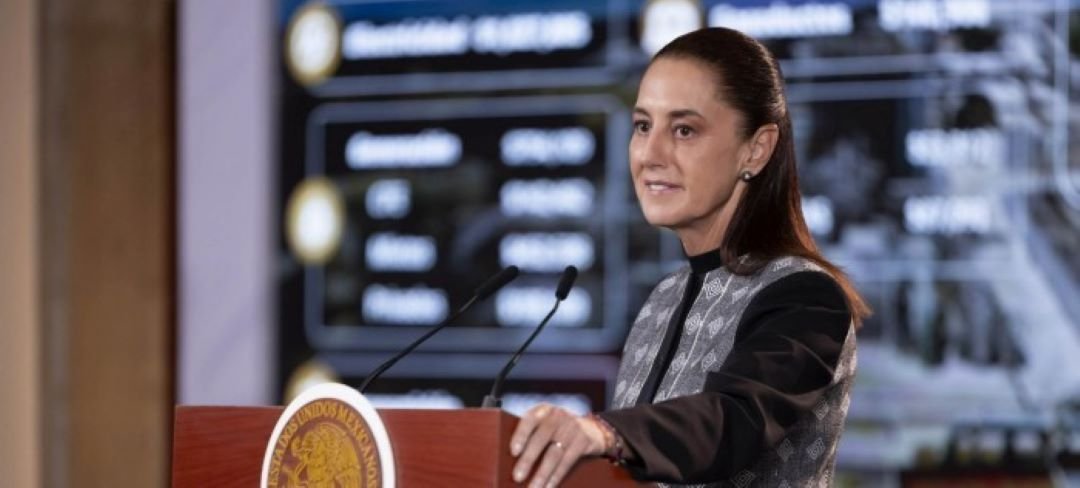
Mexico City — President Claudia Sheinbaum acknowledged Wednesday that negotiations between her government and U.S.-based Vulcan Materials over the future of the Calica quarry lands and the Punta Venado port have yet to yield substantial progress.
Speaking at her daily morning press conference, Sheinbaum was asked about the state of the talks following a recent international ruling tied to the long-running dispute between the two sides.
“We haven’t made much progress on that yet, but we are in those talks,” she said.
The president said one of Vulcan’s main interests is removing the stone material that was extracted from the site and remains stored there. In exchange, the Mexican government wants the company to take charge of environmental remediation in the area and to allow the Punta Venado port to serve a broader range of users, given its strategic importance to the southeast region.
Government Seeks to Open Punta Venado to Other Users
Sheinbaum described the maritime terminal as key infrastructure for regional trade and said it should not remain limited to Vulcan’s operations.
“It’s a very important deep-water port for the southeast,” she said, adding that her administration wants it used for other purposes that could benefit a wider range of economic activity.
She also clarified that the recent ruling in the Calica case is not directly linked to the protected natural area decreed in the zone, but rather to matters dating back to earlier stages of the conflict.
Mexico-Vulcan Dispute Reached International Arbitration
The confrontation between Mexico and Vulcan Materials escalated in recent years and ended up before international tribunals. On July 27, a tribunal at the International Centre for Settlement of Investment Disputes (ICSID), part of the World Bank, issued its final award in the arbitration brought by the company’s subsidiary, Legacy Vulcan, against Mexico.
The company had sought more than $1.7 billion in compensation. The tribunal instead awarded $15.88 million, tied to the closure of one of its properties in January 2018.
The conflict intensified under former President Andrés Manuel López Obrador. In May 2022, the Federal Attorney’s Office for Environmental Protection (Profepa) shut down Calica’s limestone extraction operations after López Obrador accused the company of causing environmental damage and operating outside its authorized permits.
López Obrador later offered to buy the land for 6.5 billion pesos, a proposal the company rejected.
In March 2023, Mexican Navy personnel and police entered the Punta Venado terminal to allow a Cemex vessel to unload, an operation Vulcan called illegal.
Protected Area Blocks New Mining Activity
In September 2024, just days before leaving office, López Obrador decreed the Felipe Carrillo Puerto Flora and Fauna Protection Area, which includes company land and restricts new mining activity in the zone. Vulcan described the decree as an expropriation of its properties.
For nearly four decades, Calica extracted limestone along the strip between Playa del Carmen and Puerto Aventuras, shipping the material to the United States through Punta Venado.
The port terminal’s concession remains in Vulcan’s hands for several more years, according to earlier statements by the president.
Since June, Sheinbaum has confirmed that her administration is holding talks with the company in search of an agreement that would include environmental remediation of the land by Vulcan and a plan to broaden the use of the maritime terminal. So far, however, the president herself concedes that the negotiations have produced no meaningful breakthroughs.
More Government
- Fitch Downgrades, Then Upgrades Playa del Carmen Credit Rating Over Missed Payment
- Quintana Roo Port Authority Reports 254 Million Peso Budget Underspend
- Mexico’s Senate Votes 96-0 to Curb Telemarketing Harassment With New Do-Not-Call Registry
- Tulum Airport Operating Normally Despite Flight Cuts, Grupo Mundo Maya Says
- Playa del Carmen Traffic Police Run No Operations Targeting Bike Lane Violations
More Playa del Carmen
- Playa del Carmen Merchants Pin Hopes on Buen Fin, Winter Season to Salvage Weak Year
- Scooter Users Demand Say in Playa del Carmen Micromobility Rules
- Playa del Carmen Mayor Lights Municipal Palace Pink to Promote Breast Cancer Prevention
- Police Shoot and Wound Man in Playa del Carmen’s Misión de las Flores
- Playa del Carmen Residents Blast Six-Year Illegal Dump