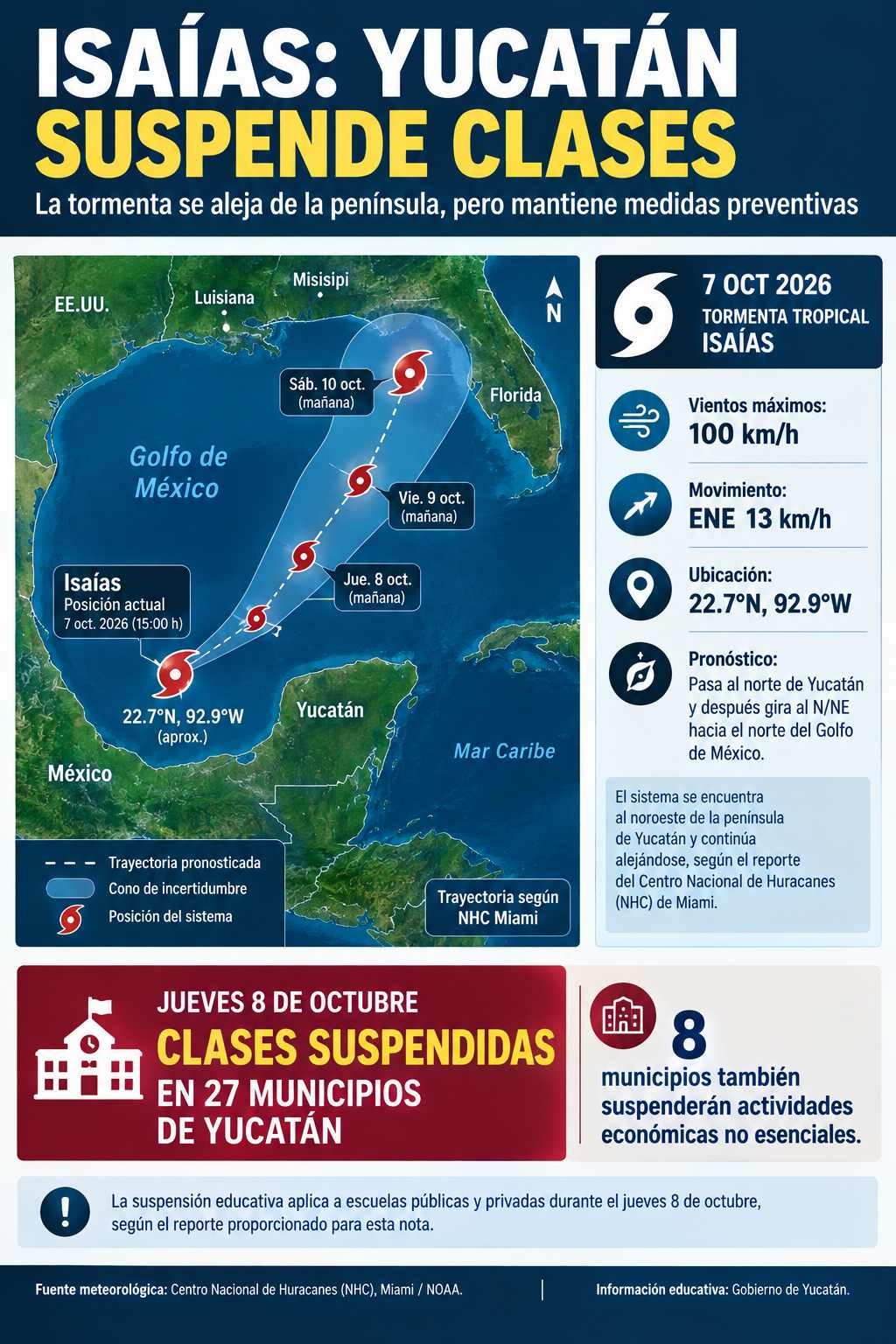
Mérida, Yucatán — Authorities in Yucatán canceled classes across 27 municipalities, including Mérida, for Thursday, Oct. 8, and ordered non-essential businesses to shut in eight coastal communities as Tropical Storm Isaías churned in the Gulf of Mexico.
Gov. Joaquín Díaz Mena said the measures were approved unanimously by the Emergency Committee of the State Civil Protection Council. In the eight coastal municipalities, all educational levels and non-essential economic activities will be suspended; elsewhere on the list, only schools will close.
The municipalities halting both school and non-essential economic activity are Hunucmá, Telchac Puerto, Celestún, Sinanché, Yobaín, Progreso, Tixcancún and Ixil.
Closures Expanded as Forecasts Shifted
The Yucatán Education Department (Segey) initially announced the suspension of classes in nine coastal municipalities: Celestún, Dzidzantún, Dzilam de Bravo, Hunucmá, Ixil, Progreso, Sinanché, Telchac Puerto and Yobaín. It later extended the measure to 18 more municipalities, including Mérida, Kanasín, Umán and Conkal, after updated weather forecasts.
Díaz Mena said the latest meteorological report showed Tropical Storm Isaías had moved another 20 kilometers (about 12 miles) away from the Yucatán Peninsula, a favorable shift in its track. He said the state government would keep preventive measures in place while it continues to monitor the storm.
“Although the projected track is favorable because it will gradually move away, these measures are strictly preventive,” he said.
Education officials said the closures apply to both public and private institutions and cover only the Thursday, Oct. 8 school day. The governor urged residents to follow official channels for updates.
“For us, the most important thing will always be safeguarding the life and security of Yucatecan families,” Díaz Mena said.
More Environment
- Sheinbaum Acknowledges Little Progress in Talks With Vulcan Over Calica
- Quintana Roo Plans 4.4 Billion Peso Wind Farm in Othón P. Blanco
- Tulum Ranks Second as Mexico Claims Six Spots on Best Beaches List
- University of the Caribbean Unveils Crocodile Coexistence Manual in Cancún
- Quintana Roo Braces for Record Sargassum Season as 2027 Forecast Tops 86 Million Tons