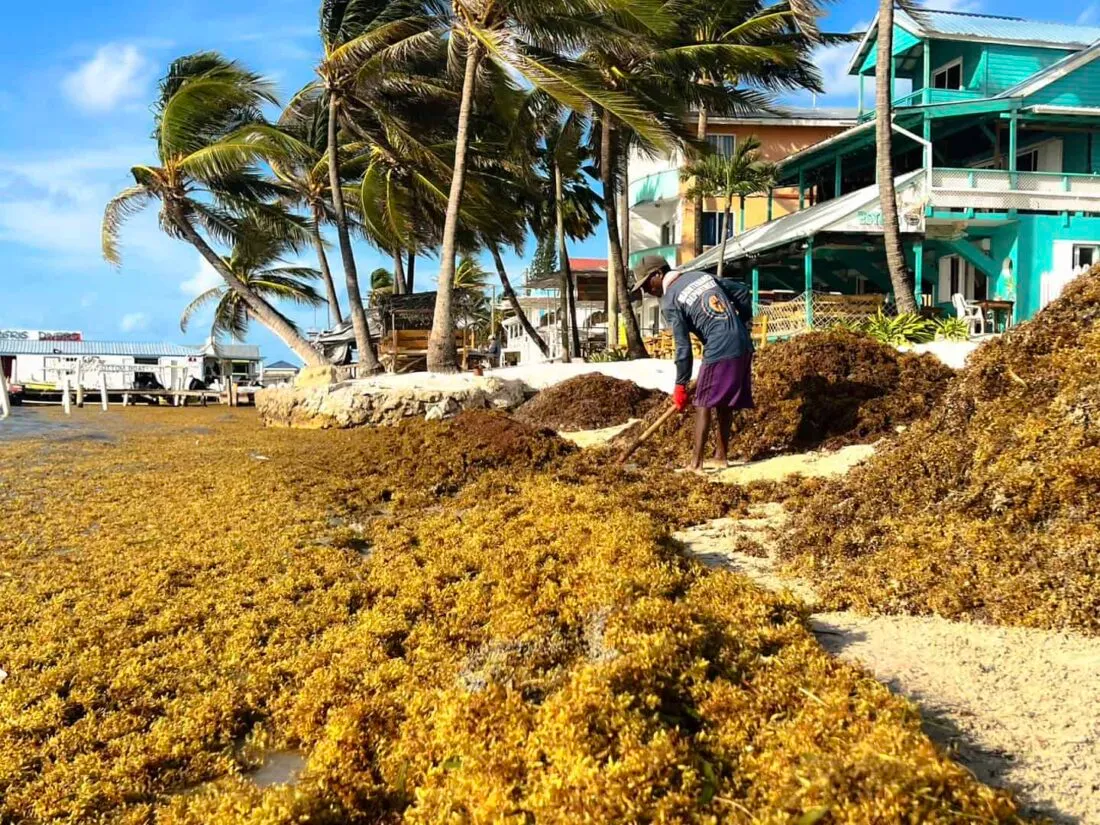
Cancún, Quintana Roo — Mexico’s Environment and Natural Resources Ministry (SEMARNAT) has called on Caribbean nations to adopt coordinated measures against sargassum, warning that during the peak of each season between 40,000 and 90,000 tonnes of the macroalgae circulate daily in the Mexican Caribbean.
About 10 percent of that biomass washes ashore on Mexican coasts, mainly in Quintana Roo, damaging the ecosystem and hurting the region’s economy and tourism, Environment Secretary Alicia Bárcena said.
Bárcena said the federal government is working with Quintana Roo authorities on a “very important” effort to speed up collection in the open sea and keep sargassum off the beaches, but she acknowledged those efforts remain insufficient and require coordinated action with Caribbean countries.
Sargassum Conference Set for Cancún
Mexico and the European Union will co-host a sargassum conference in Cancún on October 1 and 2 to address the problem. Bárcena said all Caribbean nations have been invited and that the Dominican Republic — one of the countries hardest hit by the algae — has expressed the greatest concern.
“It is a very important conference because this issue is not only Mexico’s, it belongs to the entire Caribbean,” she said. “We have invited the Caribbean countries. One of them, for example, is extremely worried: the Dominican Republic. And as you know, we have carried out a very clear analysis of how much sargassum is traveling through the Caribbean Sea.”
According to SEMARNAT records, the volume of sargassum registered in Mexico during 2026 was four times higher than in 2025 and 27 times above the historical average. Between January and June of this year, the Greater Caribbean and the waters around the Dominican Republic received close to 9 million metric tonnes of the algae.
“In total, between 40,000 and 90,000 tonnes circulated each day at the peak of the season,” Bárcena said.
The secretary spoke after attending the opening of public hearings on a proposed General Law on Ecological Balance and Environmental Protection. She said collection efforts are currently focused on shallow waters, and that additional funding will be allocated to the Mexican Navy next year to expand its capacity to collect sargassum in the open sea and on beaches. Authorities are also working with hotel operators to gather the algae once it reaches the sand.
“What we want to avoid — and I believe this is the fundamental part — is sargassum reaching the beaches,” Bárcena said. “We want to collect as much as possible at sea, because once it arrives on the beach it rots, produces foul odors, causes pollution and becomes toxic.”
She said the measures should leave the country better prepared for “more effective containment.”
More Environment
- Drought Reaches All 11 Municipalities in Quintana Roo
- Horseshoe Crabs in Isla Mujeres Face Threat From Bait Fishing in Laguna Chacmuchuch
- Tulum Residents Demand Comprehensive Water Quality Study for La Veleta
- Tulum Circula Advises More Than 120 Businesses on Separating and Tracking Waste
- Yum Balam Management Review Must Include Chiquilá Ejido, Commissioner Says