Mexico City — Mexico’s federal government expects at least half of all payments nationwide to be made digitally by 2027 under a proposed Digital Economy Law, officials said.
José Antonio Peña Merino, head of the Digital Transformation and Telecommunications Agency (ATDT), said 85% of transactions under 500 pesos (about $27) are currently made in cash — one of the highest rates in the world — with the share somewhat lower for larger amounts.
“We estimate, and this is a conversation with Banco de México, that in the first year we would have to reach 50 percent, and this will increase over time. It could be faster; it is a conservative estimate,” Peña Merino said at the National Palace.
He noted that Brazil’s digital payment system, Pix, which is similar to Mexico’s CoDi, reached 80% adoption within its first year. “So that would be a more optimistic scenario,” he said.
President Claudia Sheinbaum said the proposal, sent to Congress alongside the 2027 Economic Package, will improve security and efficiency and help formalize businesses and products by digitizing payments and reducing cash use.
“The Digital Economy Law is very important. If you want to open a bank account, you can now do it at all banks electronically, for up to 130,000 pesos. If you link a CoDi to that account, and you buy from someone else, or someone buys from you, you pay directly with your phone and you don’t have to carry cash,” she said at her morning news conference.
“And this will gradually increase the digitalization of the economy and reduce cash. That helps security, efficiency, and even formalization, because a payment history is created in a bank account, and it also helps, in time, to formalize a business or product,” she added.
Three-Step Transfers and No Commissions
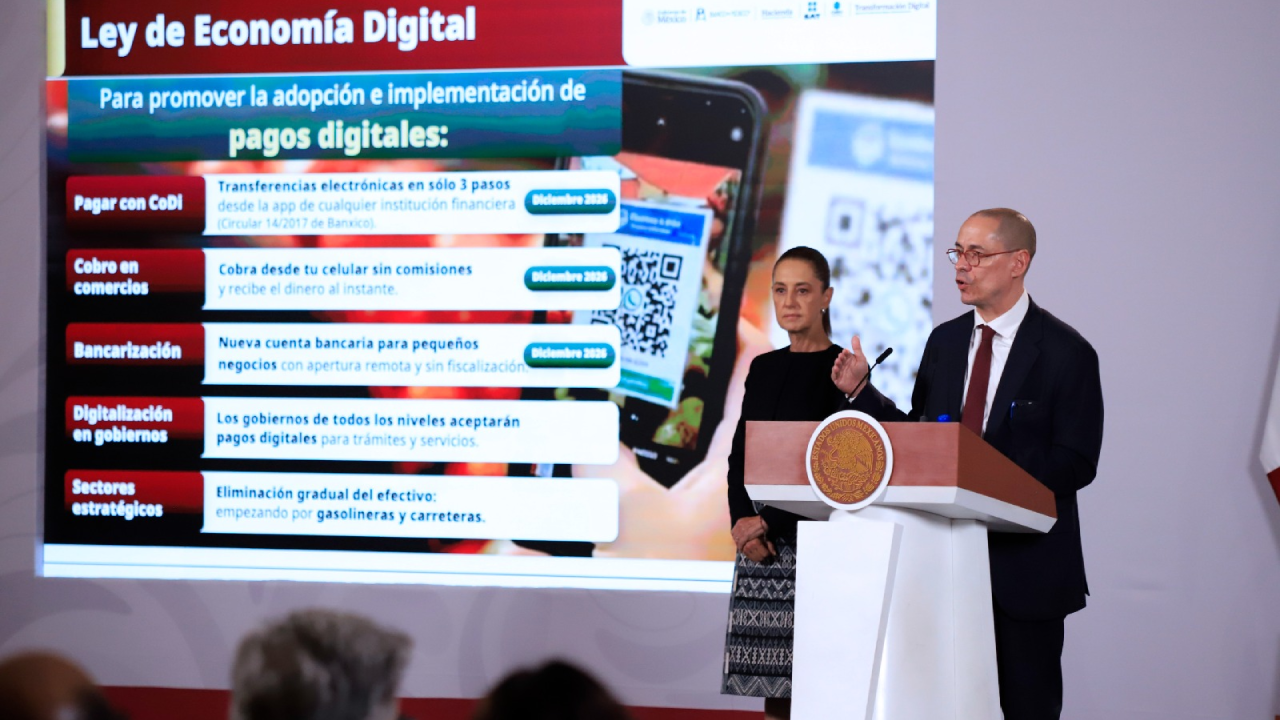
Peña Merino said the proposal would speed up digital payments through financial institutions’ apps and leverage the existing capabilities of the SPEI and CoDi systems to make instant transfers.
It would also ease economic exchanges between individuals and companies, strengthen financial inclusion through bank account ownership, credit history and access to loans, and reduce regulatory and financial-services barriers that hinder formalization, he said.
The official said the new law would promote the adoption of CoDi digital payments for electronic transfers in three steps. Businesses, meanwhile, would be able to receive payments by cellphone with no commissions and instant settlement.
The strategy also calls for extending digital payments across the public sector so they are adopted at different levels of government.
Peña Merino recalled that the gradual phase-out of cash has already begun in strategic sectors such as gas stations and highways.
He added that in the two years since Sheinbaum took office, more than 4,000 government procedures have been simplified, of which 1,947 have been eliminated. Average requirements have dropped from six to two, and processing times have fallen from 44 days to 22.
More Economy
- Playa del Carmen Courts French Tourists With Experiences Beyond All-Inclusive Resorts
- Chetumal Citizens’ Council Calls Cashless Gas Station Plan Unviable in Rural Quintana Roo
- Quintana Roo Aims to Close 2026 Near 20 Million Overnight Tourists With High Hotel Occupancy
- Wind Farm Project in Southern Quintana Roo Moves Forward
- Court Rejects Lili Campos Injunction in Playa del Carmen Funds Case