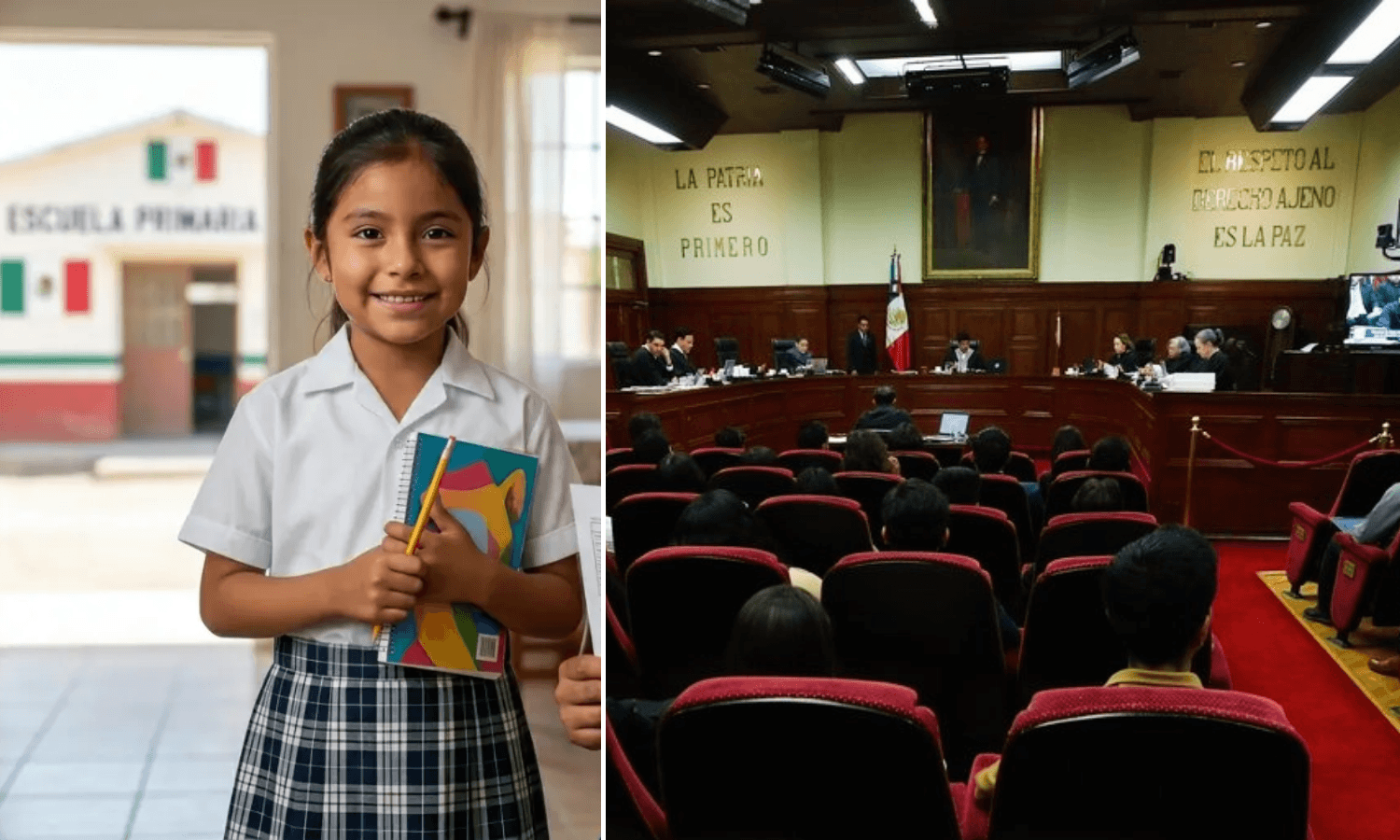
Mexico City — Mexico’s Supreme Court has unanimously upheld a controversial education agreement that prevents students in certain grades from failing and eliminates minimum attendance requirements, ruling the measure constitutional.
The full bench approved a draft ruling by Justice Lenia Batres Guadarrama, denying an injunction sought by Colegio El Roble, a private school, against the Public Education Department (SEP) agreement. The court argued the policy guarantees educational quality and the best interests of children, prevents school exclusion, and aligns with systems in Denmark and Finland where evaluation does not rely on numerical grades.
“Educational excellence is not exhausted by attendance records or passing subjects or grades through quantitative numerical measurements,” Batres wrote in her ruling. “That perspective is reductionist given the complexity and plurality of factors that make up this principle, which affects the education of more than 23 million students in our country.”
What the SEP Agreement Says
The contested agreement, in effect since September 2023, shifts basic education from numerical evaluation to a comprehensive, gradual model. It reorganizes studies into phases and formative fields, allows automatic promotion in preschool and first grade, relaxes failure rules in secondary school with regularization options, eliminates attendance as a decisive requirement, prioritizes qualitative assessments, and sets the minimum passing grade at 6.
School’s Challenge
In its injunction, Colegio El Roble International School — part of the Affinitas Education network — argued the rule violates the constitutional principle of educational excellence. The school opposed the looser evaluation and promotion criteria, saying they undermine academic excellence, the eradication of ignorance, and school discipline by relaxing subject and grade accreditation, reducing the number of subjects required to pass, and increasing opportunities for students to fail courses.
Divided Opinions
Justice Giovanni Figueroa Mejía argued that eliminating attendance as a requirement contradicts the constitution and international norms, and proposed invalidating that article. Justice María Estela Ríos González agreed, stating that the state and families must guarantee school attendance. “If we truly want education to be accessible to all, we must take this into account. Otherwise, we are leaving children’s education adrift,” she said. “Instead of raising the quality of education, we are lowering it.”
However, Chief Justice Hugo Aguilar Ortiz defended the agreement, saying it is not regressive. “Attendance is not the same as excellence,” he said. He warned that punishing a child for not attending ignores that absence may reflect family problems that should be addressed, not penalized.
Justice Irving Espinosa Betanzo noted that the executive branch is responsible for education policy and implemented the agreement with programs to improve access and reduce dropout rates, especially in rural areas. “While the ideal is for all children and adolescents to be in school, we must understand that for various reasons this does not always happen, especially in rural areas,” he said.
The ruling confirms that the SEP agreement is constitutional and compatible with the right to education.
More Lifestyle
- Tulum’s Mureco Museum Adds 53 Mesoamerican Pieces for Second Anniversary
- Chetumal Entrepreneur Develops Automatic Hammock Rocker for Mexico
- Cancún Prepares Janal Pixán 2026 at Puerto Juárez, Aims to Double Attendance
- Mental Health and Addiction Top Concerns Among Playa del Carmen Youth, Survey Finds
- Cancún Opens Registration for Janal Pixan 2026 Catrina and Altar Contests