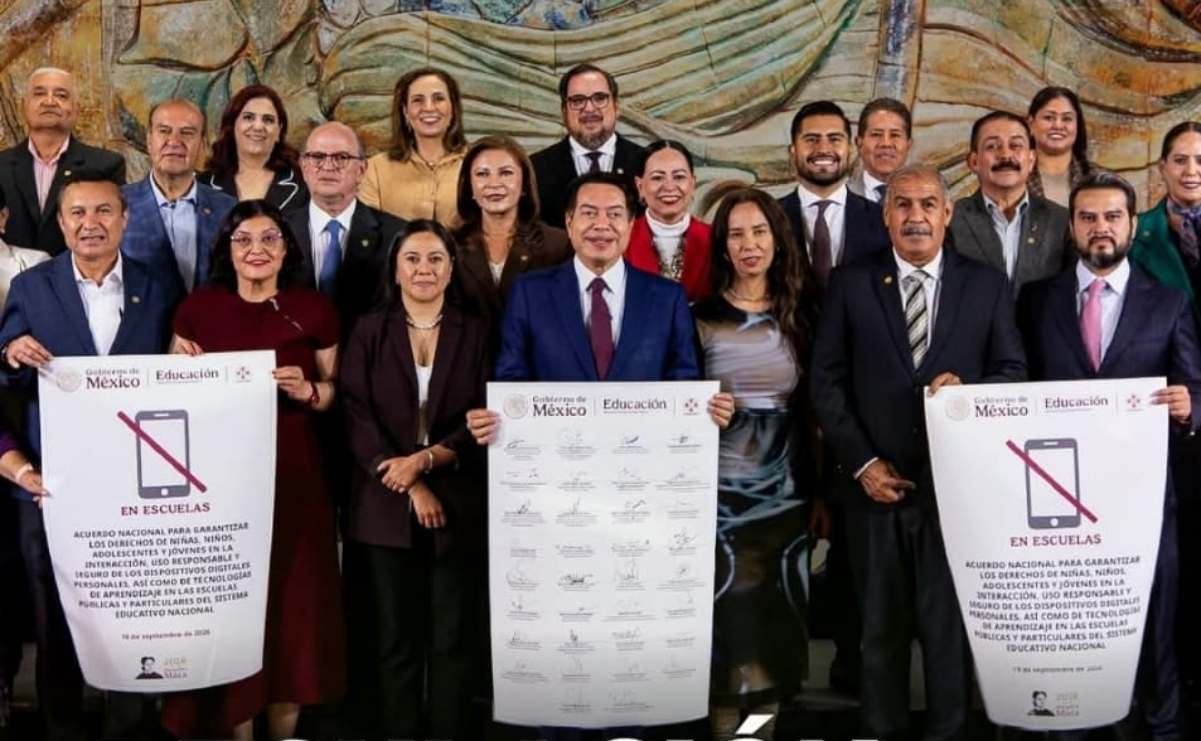
Mexico City — Cellphones will be restricted throughout the school day in Mexico’s primary and secondary schools beginning in October, following a unanimous agreement among federal and state education authorities.
Education Secretary Mario Delgado Carrillo announced the decision after the Third Extraordinary National Plenary Meeting of the National Council of Education Authorities, known as CONAEDU.
The measure goes further than restricting phones during individual lessons. According to information released after the meeting, primary and secondary students will face a “total restriction” during the school day. Rules for upper-secondary schools and universities will be developed by their respective educational communities, reflecting the greater independence expected of older students.
The agreement establishes a national direction, but many of the practical details remain unresolved. The Public Education Department, or SEP, has not yet published the final guidelines explaining whether students may bring phones to school, where devices must be kept or what schools should do when students violate the rules.
What the restriction is expected to cover
Delgado said the regulations would vary according to education level. For younger students, the objective is to keep personal cellphones and similar devices from interfering with classes and school activities throughout the day.
A complete national document setting out exceptions and enforcement procedures had not been published as of Sept. 19. Similar regulations already adopted in several Mexican states allow devices to be used during emergencies, for a teacher-authorized educational activity or when a student requires technology because of a disability or medical need.
Morelos, for example, permits phones for emergencies, approved academic work and accessibility support. Its rules place enforcement in the hands of school directors and teachers and favor progressive disciplinary measures over immediate punishment.
Whether the national rules will follow the same approach remains to be seen. Schools will also need to establish a reliable way for parents to contact children during an emergency. Other unanswered questions include whether devices will remain in backpacks, be collected at the start of the day or be stored in classroom lockers or secure pouches.
Responsibility for lost, damaged or stolen phones will be another issue for schools and families.
Quintana Roo participated in the national discussion
Quintana Roo education officials participated in the national review that preceded the agreement. However, the state Education Department has not yet released its own procedures for applying the restriction in local schools.
Because CONAEDU brings together the federal education secretary and authorities from all 32 states, the unanimous vote indicates that Quintana Roo has agreed to move forward with the policy. Local instructions will still be needed to tell public and private schools exactly how the rules are to be applied.
Families should therefore expect further communication from schools before the October start date. Until those instructions are published, parents should not assume that every campus will immediately use the same collection, storage or disciplinary system.
Most teachers support regulation
The national decision follows a consultation involving 565,396 teachers. SEP reported that 81% supported establishing rules for the safe and educational use of mobile devices in schools.
Four regional forums were also held during August and September to discuss the proposal. Delgado said concern had intensified following findings from the OECD’s PISA assessment about the effect of digital distractions on reading comprehension. Research cited by education authorities indicates that notifications and easy access to social media, games and messaging can make it difficult for students to remain focused, even when the phone is not being actively used.
The measure is not intended to eliminate technology from education. Computers, tablets and mobile devices may still be useful when incorporated into a lesson under a teacher’s supervision. The distinction is between planned educational use and unrestricted access to a student’s personal phone.
Several states had already acted before the national agreement. Querétaro, Guanajuato, Morelos, Aguascalientes, the State of Mexico and Mexico City are among the jurisdictions that have adopted or approved restrictions.
Mexico City’s 2026 reform applies to public and private primary and secondary schools, while allowing devices for expressly authorized educational purposes. The State of Mexico similarly limited their use to academic activities covered by official guidelines.
Regulation is not the same as confiscation
The announcement has frequently been described as a nationwide cellphone ban, but the final effect will depend on the guidelines. A restriction can require students to keep devices turned off and out of reach without prohibiting them from carrying a phone to and from school. It may also provide exceptions for health monitoring, accessibility technology, emergencies and authorized classroom projects.
Specialists have cautioned that removing phones without teaching responsible digital behavior may only relocate the problem. Students still encounter social media, cyberbullying, misinformation and excessive screen time after school.
The success of the policy will therefore depend partly on whether schools combine restrictions with digital education and involve parents in setting consistent expectations.
Mental health strategy expands alongside phone rules
The cellphone agreement is being introduced alongside “El ABC de las Emociones,” a national strategy focused on the emotional well-being and mental health of students between 14 and 18. The program is intended for students in the final year of secondary school and in upper-secondary education. It includes classroom activities, school assemblies, public information campaigns and separate materials for students, families and teachers.
The government says it will distribute approximately 16 million guidance materials and 250,000 posters. Earlier planning documents referred to 18 million guides, but the figure announced at the program’s Aug. 31 launch was 16 million. The federal government outlined the program and its seven areas of action when the strategy began.
Materials are also available through the official ABCs of Emotions website. The program is designed to help students recognize and manage emotions, strengthen relationships, identify warning signs and understand when and where to seek help.
The federal Health Department has said the initiative will be implemented mainly in schools, with mental-health agencies and education authorities working together to reach adolescents. The National Commission on Mental Health and Addictions describes the program as a preventive strategy for young people.
The two policies share a broader objective: reducing digital distractions while paying greater attention to student well-being and in-person interaction.
For families, however, the immediate question is practical. With October approaching, schools will need to explain where phones will be kept, how parents can contact their children and what exceptions will apply. Until those rules are formally published, the national agreement establishes the destination, but not yet every step schools must take to get there.
More Government
- SCJN Orders Quintana Roo to Legislate Disability Representation
- Playa del Carmen to Review Legal Status of Chen Zubul Property
- Cancún’s Huayacán and 135 Avenue Roadworks Reach 65% Completion
- Playa del Carmen Hosts Second National Firefighters Congress With 750-Plus Participants
- Cozumel Freezes New Street Vendor Permits as Review Committee Stalls