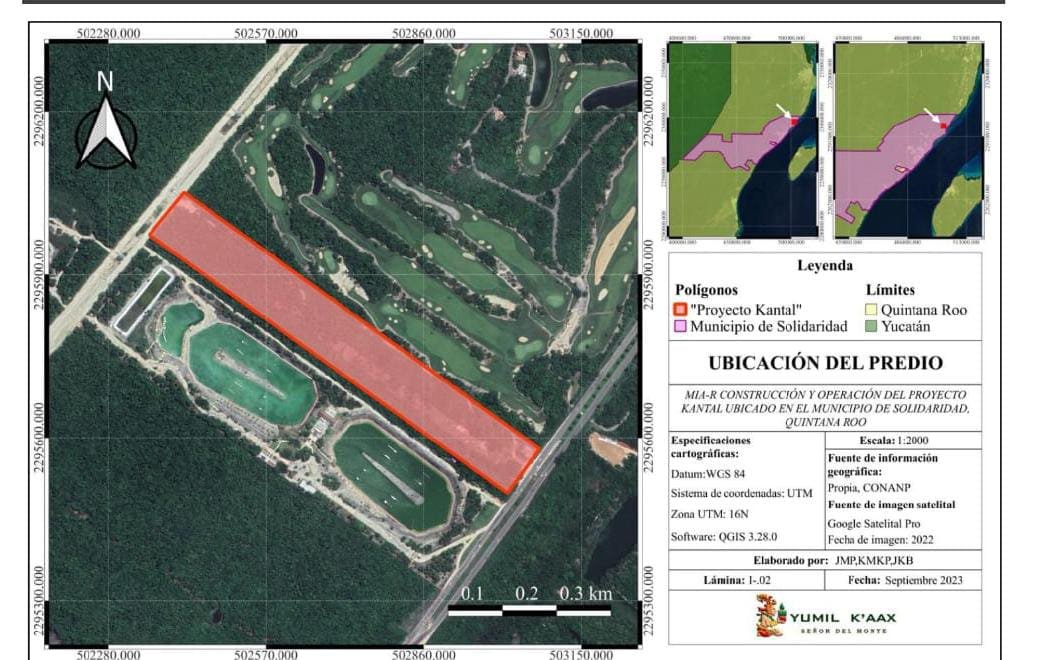
Playa del Carmen, Quintana Roo — Mexico’s Environment Ministry (Semarnat) has denied environmental authorization for Kantal, a tourist and real-estate megaproject that would have covered more than 80 hectares on the northern edge of Playa del Carmen, next to the municipal border with Puerto Morelos.
The ruling by the ministry’s General Directorate for Environmental Impact and Risk (DGIRA) came three years after the developer filed its application. It blocks the company from carrying out the land preparation and urbanization work covered by the request.
The project was promoted by Operadora Beste Boden, S.A.P.I. de C.V., which planned to subdivide and urbanize a large tract known as El Resorte for later residential, tourism and commercial use.
Fifty-five lots for hotels and housing
According to the environmental impact statement filed by the company, the development would have divided the land into 55 lots intended for the eventual construction of hotels, condominiums, residences and commercial buildings.
The plan also included internal roads, a bike lane, sidewalks, green areas, perimeter walls, main and secondary access points, and basic infrastructure such as drinking water lines, sanitary sewer, electricity, public lighting and a wastewater treatment plant.
One key element of the case is that the company did not seek permission to build the hotels, condominiums, homes or shops themselves. In additional information submitted to Semarnat, the developer said those buildings would be put up later by private investors who bought the lots and would have to obtain their own permits separately.
As a result, the environmental review covered only the preparation, subdivision and urbanization of the land, while the buildings that would eventually occupy the 55 lots would be subject to future evaluations. That approach meant the initial transformation of the 80-plus hectares was assessed before the details of the later construction were known.
Officials cite violations of environmental law
After reviewing the company’s documents, the supplementary information and technical opinions from other agencies consulted during the process, the DGIRA decided to refuse the permit.
The federal authority said the decision rested on the technical and documentary record and on the legal and environmental reasoning drawn from the evaluation. It cited Article 35, section III, subsections a) and b), of the General Law on Ecological Balance and Environmental Protection (LGEEPA), along with Article 45, section III, of the law’s regulations on environmental impact assessment.
Those provisions allow officials to deny authorization when a project violates environmental legislation or applicable Mexican official standards, or when the work could push one or more species onto the list of threatened or endangered species, or affect species already under those protections.
In the Kantal case, Semarnat concluded there were sufficient grounds to reject the application because the project conflicted with applicable environmental rules.
Company may submit a new proposal
The refusal is a setback for the developer, but it does not necessarily mean the project is permanently cancelled. Semarnat left open the possibility that Operadora Beste Boden could file a new environmental impact statement, with the changes and technical elements needed to send the proposal through the assessment process again.
If the company takes that route, it would have to address the environmental issues behind the rejection and demonstrate that the work it intends to carry out is viable.
Kantal now joins a list of large-scale real-estate developments whose environmental viability has been questioned along the northern coastal strip of Quintana Roo, a region under pressure from tourism growth, urban expansion and demand for new land for real-estate investment.
More Environment
- Activists File Complaints Over Heavy Machinery on Cancún’s Playa Delfines Dune
- Semarnat Denies Permit for Beach Restoration Project in Puerto Morelos
- Cancún Hoteliers Push to Reactivate Beach Recovery Trust
- Experts Warn of Climate Crisis in Mexican Caribbean, Urge Urgent Action
- Scientists Say Sargassum Must Be Stopped in the Atlantic, Not on Cancún’s Beaches
More Playa del Carmen
- Anti-Corruption Prosecutor’s Office Seizes House in Playa del Carmen
- AMEXME Riviera Maya Holds First General Assembly of Members in Playa del Carmen
- Former Puerto Aventuras Mayor and Two Ex-Officials Ordered to Trial on Extortion Charges
- Playa del Carmen to Prioritize Sargassum Cleanup at Beaches Near Fifth Avenue
- Playa del Carmen Renews 15 Blue Flag Certifications for 2026-2027 Season