
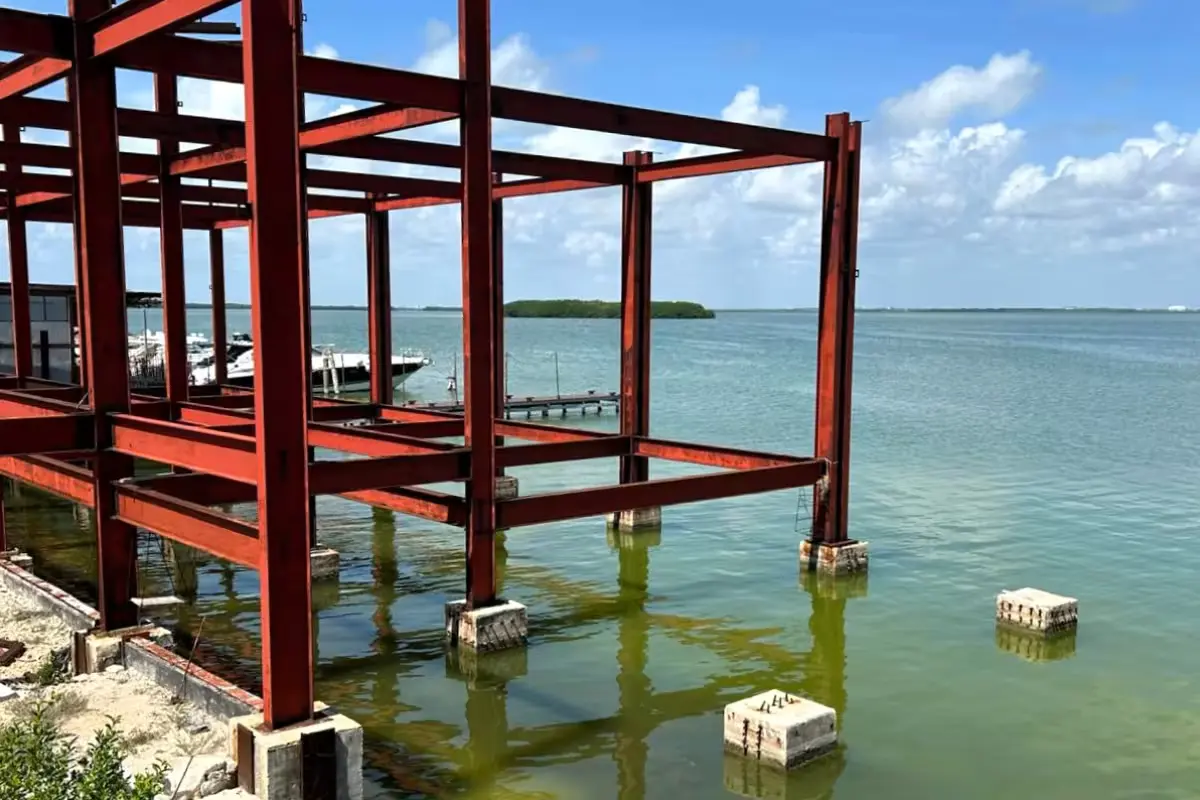
Cancún, Quintana Roo — Mexico’s Secretariat of Environment and Natural Resources (Semarnat) has denied the environmental impact permit for the “Laguna Prime” restaurant project in Cancún’s hotel zone, ruling that the construction would cause serious damage to mangroves and the Nichupté lagoon ecosystem.
The project, promoted by the company Capital de Restaurantes, called for a 12.4-meter-high building with a basement and two levels covering 2,168.34 square meters at kilometer 14+387 of Bulevar Kukulcán, in the municipality of Benito Juárez.
During the environmental review, which began in July 2024 when the company filed its environmental impact statement, authorities found serious inconsistencies in the file. Although the developer said the work would take place on a concession area within the federal coastal zone (Zofemat), cartographic analyses confirmed that a significant part was planned directly over the waters of the Nichupté lagoon, supported by 21 concrete piles.
Metal structures are already in place on the site, having been installed before the ruling. Employees at nearby businesses said the work had been previously shut down and expressed concern that the oxidizing steel columns are attracting crocodiles and disturbing local wildlife.
The environmental group Grupo Ecologista del Mayab (GEMA) has repeatedly warned about the impact of such construction on natural water flow and mangrove preservation.
To reach its negative ruling, Semarnat sought technical opinions from agencies at all three levels of government, including the National Commission for the Knowledge and Use of Biodiversity (Conabio), the federal forestry and coastal zone directorates, Quintana Roo’s Ecology and Environment Secretariat, and the Benito Juárez city council.
The resolution cited confirmed presence of protected vegetation on the property, including red mangrove, button mangrove, chit palm, sea grape, ceiba, chechen and barbasco. Officials concluded that, contrary to the company’s claim that it would preserve garden areas, the construction process would cause the direct and irreversible destruction of mangrove vegetation and the lagoon bed.
More Development
- Sheinbaum Announces More Gas and Power Grid Upgrades for Quintana Roo
- Quintana Roo Plans 4.4 Billion Peso Wind Farm in Othón P. Blanco
- Cozumel Prison Expands Capacity by More Than 50% With 80 New Spaces
- Yucatan Debuts Southeast Mexico’s First Cyclotron for Precision Oncology
- Cancún Shuts Down Two Gated Developments for Selling Lots Without Permits
More Cancun
- Five Men Sentenced To Up To 50 Years For Killings In Cancún And Felipe Carrillo Puerto
- Two Women Rescued From Human Trafficking in Cancún Search Warrants
- Cancún Restaurant Sector Welcomes Extended Hours in Hotel Zone
- Man Who Posed as Inspector to Extort Cancún Merchant Ordered Held Two Years
- 272 OXXO Stores in Cancún Join ‘Purple Points’ Safety Network
