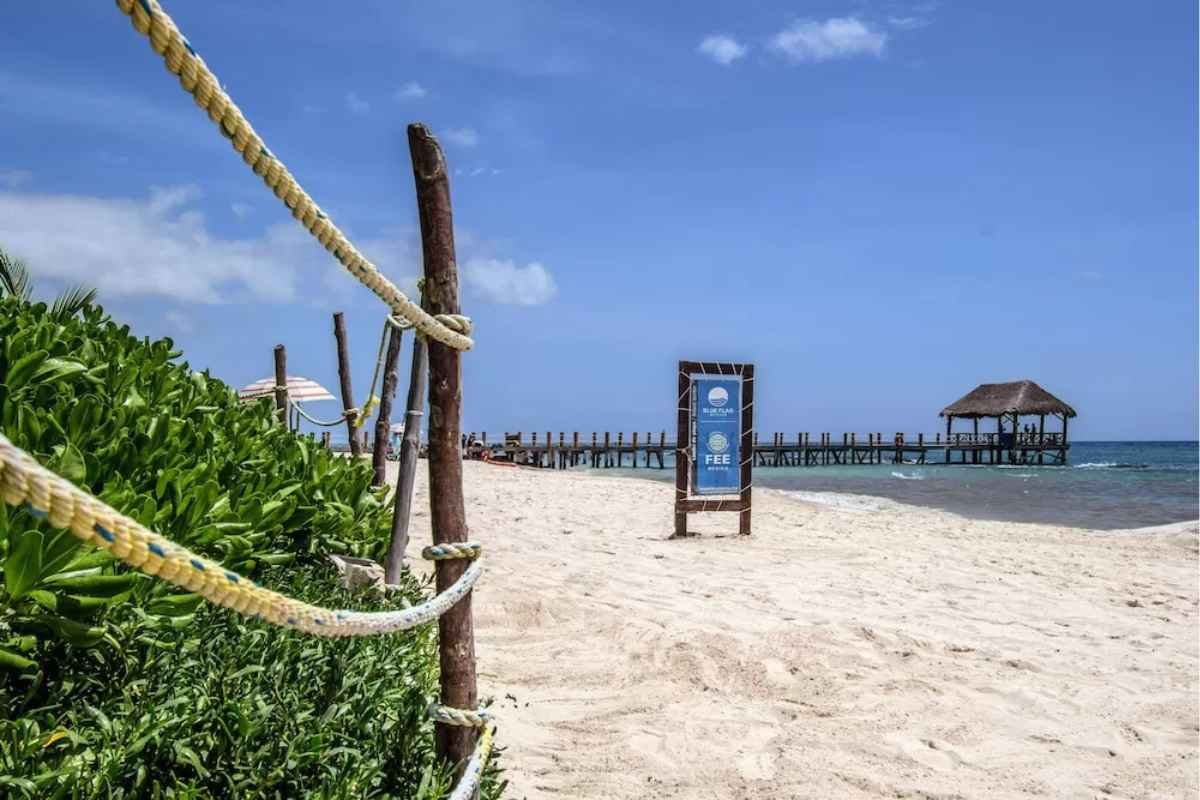
Playa del Carmen, Quintana Roo — The Mexican Environment and Natural Resources Ministry (Semarnat) has reportedly rejected authorization for the Xcalacoco beach club, a 980.43-square-meter tourism project in Playa del Carmen, Quintana Roo, that would have placed facilities on the federal maritime-terrestrial zone and a portion of the sea.
Artemio Roque Álvarez filed the application, which was registered on May 23, 2025, under case number 23QR2025TD027. Although a negative resolution has been reported, the official document confirming the decision and its grounds has yet to be verified.
What Did the Xcalacoco Beach Club Include?
The environmental impact statement (MIA) describes a 381.09-square-meter restaurant, equivalent to 38.87% of the total surface area.
It also projected 338.49 square meters of common areas, 183.18 square meters of walkways and a 42.44-square-meter terrace.
The rest of the site was to be used for solar panels, Balinese beds, lounge chairs, restrooms and a 10,000-liter water cistern.
According to the study, the facilities would mainly use removable materials and movable furniture.
The developer estimated an average of 20 customers per day and four workers.
Xcalacoco Beach Club Included Marine Infrastructure
One of the most notable elements of the proposal was its layout along the coastal strip.
The project plans show a restaurant area next to the beach, connected by a walkway to a shared platform extending into the sea.
The proposal was therefore not limited to placing tables and lounge chairs on the sand.
The environmental study located the facilities between the federal maritime-terrestrial zone and a marine portion of Xcalacoco, north of Playa del Carmen.
Environmental Study Acknowledged Impacts on Wildlife and Soil
The MIA itself identified adverse impacts during the site preparation and construction stages.
These included soil alterations, disturbance of wildlife, noise generation and changes to the landscape.
The document also included protection measures for sea turtles, given the possibility that they might use the area for nesting or movement.
During site preparation, the study identified 21 adverse impacts and 18 beneficial ones.
For construction, it recorded another 28 adverse impacts, although the developer classified none as severe or critical.
These assessments come from the study submitted by the private applicant, not from a conclusion by the environmental authority.
Xcalacoco, an Area of Interest for Tourism Development
The Xcalacoco beach club was planned for a coastal strip where hotels and tourism businesses operate, but which also has public access points used by Playa del Carmen residents.
In June 2025, Novedades Quintana Roo reported on the application submitted to Semarnat.
The outlet documented that the proposal sought to expand recreational and commercial services in the area.
The project also adds to other attempts to develop tourism along the Xcalacoco coast.
In 2020, Semarnat opened a public consultation for a different proposal called Palapa Xcalacoco, which envisioned installing tourism infrastructure in the area.
More Development
- Quintana Roo Hands Over Land for New 90-Bed IMSS Hospital in Cozumel
- CFE to Cut Power in Mahahual, Xcalak and Uvero on November 23 for Maintenance
- UIMQROO to Open Planetarium, Awards Scholarships to 49 Students
- Quintana Roo Reviews More Than 40 Real Estate Developments for Possible Irregularities
- Young Developers Launch Lyra App to Connect Passengers With Mototaxis in José María Morelos
More Playa del Carmen
- Former Solidaridad Mayor Lili Campos Ordered Held for Four Months in $62 Million Graft Case
- Quintana Roo Tourism Ministry Backs Playa del Carmen Tax on Vacation Rentals
- Xcaret Secures Winter Bookings After a Difficult Year for the Riviera Maya
- Federal Agents Raid Home in Playa del Carmen’s Colosio Neighborhood
- Homeless Man Found Dead in Wheelchair on Playa del Carmen’s Fifth Avenue