Chetumal, Quintana Roo — Mexico’s environmental authority has approved a plan to create an underwater cemetery off the coast of Cancún, where cremated human remains will be mixed into concrete structures intended to serve as artificial reefs.
The Ministry of Environment and Natural Resources (Semarnat) authorized the “Mare Santuario del Mar” project in the marine area of Bahía Mujeres and the adjacent Caribbean coastal zone in front of Puerto Cancún.
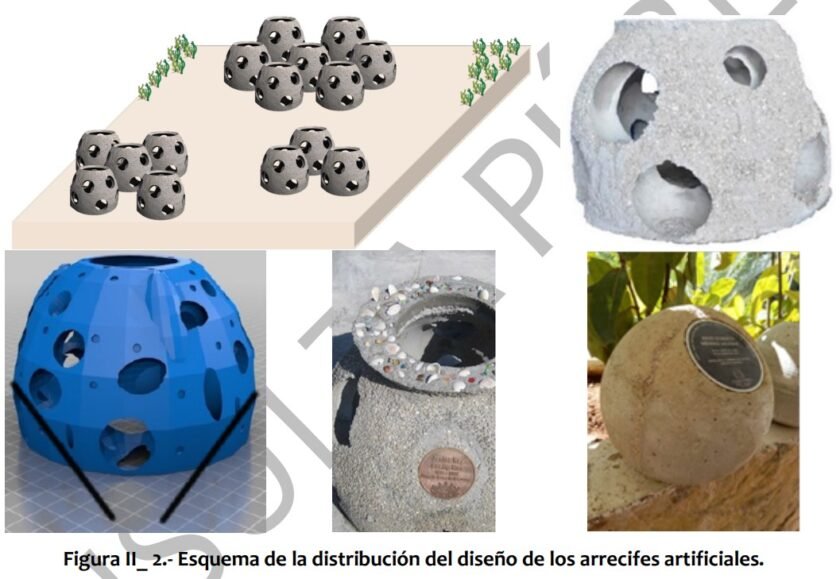
The project involves the placement of 700 prefabricated marine-concrete structures known as Reef Balls on the seabed, following the “Eternal Reef” concept. Each structure will contain a Memorial Pearl made of concrete and ashes of deceased people.
According to the approved environmental impact statement, the Reef Balls will be distributed across three marine zones. Each structure will cover a settlement area of 0.45 square meters, meaning the 700 units will occupy 315 square meters within a total 34-hectare area, or 0.09 percent of the designated zones.
The authorization covers only the placement of the artificial reefs. The manufacturing of the Reef Balls and Memorial Pearls will be carried out by other companies with the necessary permits.
The project is promoted by Capillas y Cementerios del Norte S.A.P.I. de C.V. The permit is valid for six years for site preparation and construction, and 50 years for operation and maintenance.
Each Memorial Pearl will measure 18 centimeters in circumference and will have an exterior stainless steel plate 8 centimeters in diameter with the details of the person being honored, according to the environmental impact statement.
The pearls will be produced by qualified personnel at Corporación Señoriales de Servicio, a subsidiary of Capillas y Cementerios del Norte, using marine cement type II — the same material used for the Reef Balls — and up to two kilograms of ashes. Each pearl will weigh around seven kilograms.
The environmental impact statement says the ashes will remain embedded in the concrete and will not decompose or dissolve in seawater, adding that there is no risk of contamination or environmental damage.
The design includes the creation of reef patches through modules of three to seven Reef Balls, or more, depending on available space and vegetation cover. The structures must be placed on sandy areas free of submerged aquatic vegetation, with particular attention to seagrass, and with no fauna present.
Authorities said the 700 Reef Ball units, model Mini Bay Ball, will contribute to the restoration and conservation of the marine ecosystem and help protect submerged aquatic vegetation, especially seagrasses.
The structures will change the topography of the area and increase the complexity of the marine landscape, which is expected to attract a greater concentration of species, mainly fish. Over time, algae, encrusting sponges, small coral colonies and other marine organisms will colonize the structures, boosting biodiversity and allowing the modules to function as an artificial reef with ecological functions and ecosystem services.
More Development
- Quintana Roo Moves to Power Public Buildings With Clean Energy
- Mayakoba Residents Cite Robberies as Playa del Carmen Announces New Park
- Rain-Filled Trenches Trap Drivers on Cancún’s Avenida Colegios
- Fonatur Weighs Options for Contested Malecón Tajamar Land in Cancún
- Pending Urban Development Plan Stalls Real Estate Growth in Cruz de Servicios, Playa del Carmen
More Cancun
- Cancun’s Tourism Reset: Regenerative Travel Takes Center Stage
- Cinépolis at Plaza Las Américas in Cancún Closes Over Water Leaks
- Cancún Airport Receives First Deported Mexicans From the United States
- Former Tulum Treasurer Sentenced to Nearly 4 Years for Unlicensed Firearms
- Judge Orders Pretrial Detention for Driver in Cancún Crash That Cost Motorcyclist a Leg