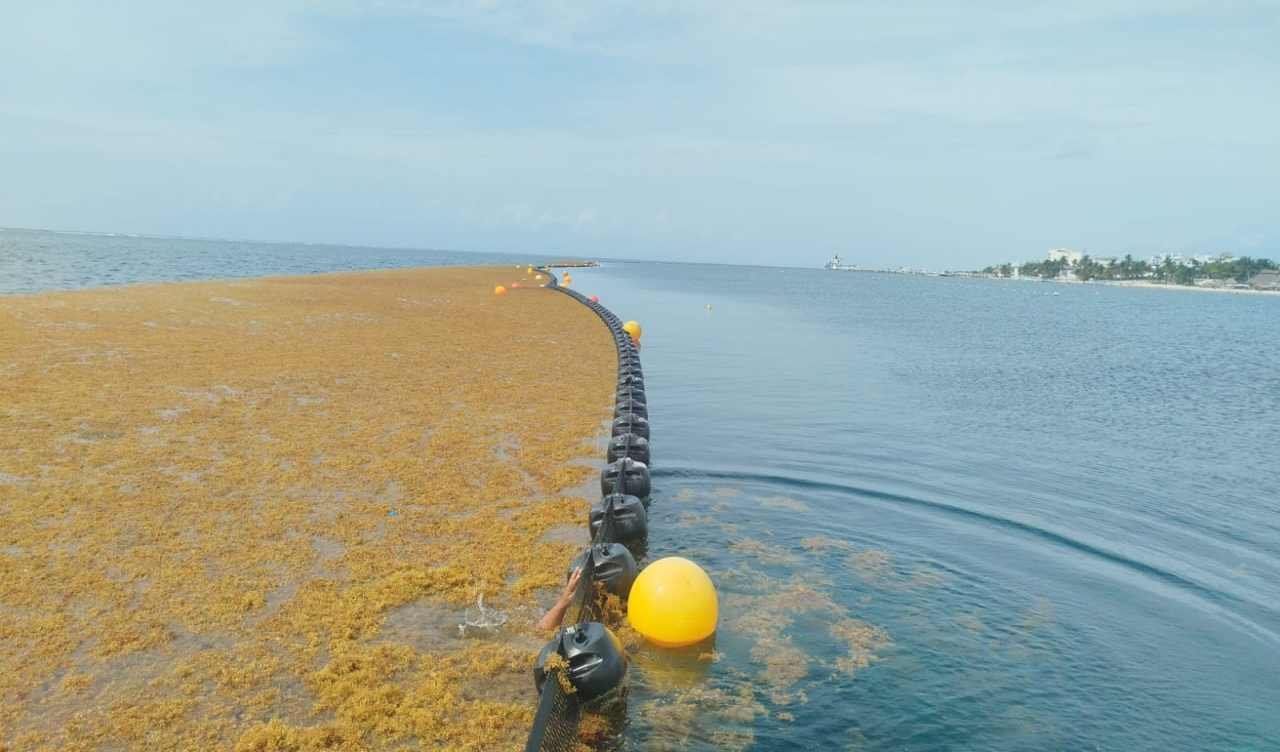
Cancún, Quintana Roo — The Mexican Navy has acknowledged the severity of the sargassum crisis affecting the state’s Caribbean coast and announced a revised strategy centered on stopping the seaweed at sea, before it reaches the region’s beaches.
In a statement, the Navy said the new approach will combine satellite monitoring, containment barriers and at-sea collection. On land, officials plan to establish what they call beach windows — designated stretches of coastline where cleanup crews will concentrate their work.
The announcement comes as Quintana Roo endures one of its most intense sargassum seasons in years, with record volumes washing ashore and mounting pressure on the tourism industry.
Expanding the Fleet
According to the Navy, it currently operates 11 coastal sargassum-collection vessels, each with a capacity of 20 tons, one ocean-going sargassum vessel, two amphibious sargassum vessels, 18 smaller boats and 13,230 meters of containment barriers. The barriers are supervised by specialized naval personnel who inspect their anchors and operating conditions.
The Navy also plans to introduce dynamic barriers designed to redirect and concentrate the seaweed so it can be captured before reaching shore.
As part of a broader federal investment package of 2,635.6 million pesos, the government intends to acquire two ocean-going sargassum vessels, six semi-oceanic vessels, six tugboats, 1,500 meters of dynamic barriers and 35 kilometers of containment and redirection barriers. The plan also includes an early-warning monitoring system and construction of a pier at Puerto Juárez.
A new vessel, the Sargassum, currently being outfitted, will increase daily at-sea collection capacity from 627 to 1,227 tons, according to the Navy. The ship will join the ocean-going sargassum vessel ARM Natans (BSO-01).
A Record Year for Seaweed
The Navy’s own figures underscore the magnitude of the problem. More than 123,400 tons of sargassum have been removed so far in 2026, the highest volume ever recorded in Quintana Roo, compared with 92,782 tons collected during all of 2025.
Cleanup operations are underway in Isla Mujeres, Benito Juárez, Puerto Morelos, Playa del Carmen, Cozumel, Tulum and Othón P. Blanco. The Navy identified Tulum and Othón P. Blanco as the municipalities with the largest arrivals of moderate-intensity sargassum this year.
On land, 191 naval personnel have been deployed in the Emergency Beach Collection Groups (GREP), carrying out manual and mechanical cleanup in coordination with state and municipal authorities.
Beach Windows and the Limits of the Strategy
The beach windows concept is central to the new plan. Navy officials say it will allow priority stretches of shoreline to be recovered more quickly, make beaches more accessible and keep sections open to tourists and residents.
But the approach also acknowledges a difficult reality: with the entire coastline impossible to keep clear, the strategy is to focus on selected segments. That may temporarily reduce visual and economic fallout in specific areas, but it does not address the root cause.
Turning the Seaweed Into a Resource
The federal government is also promoting projects to recycle sargassum and use it as industrial material. The effort involves the Navy, the environment, science and tourism ministries, as well as Fonatur, state and municipal governments, the private sector and the hotel industry.
Still, the record tonnage collected this year says as much about the scale of the influx as it does about operational capacity. While officials point to expanding cleanup power, hoteliers and tourism operators continue to face seaweed-covered beaches, odors, damage to destination image and rising cleanup expenses.
The Navy now hopes to intercept sargassum offshore, before it reaches land. Whether that succeeds will depend less on the tonnage collected and more on whether the seaweed can be stopped from turning every season into a tourism emergency in Quintana Roo.
After seven years of continuous operations, the challenge is no longer proving that sargassum can be collected. The real test is whether public policy can contain its effects before it reaches the state’s beaches.
More Environment
- Activists File Complaints Over Heavy Machinery on Cancún’s Playa Delfines Dune
- Semarnat Denies Permit for Beach Restoration Project in Puerto Morelos
- Cancún Hoteliers Push to Reactivate Beach Recovery Trust
- Experts Warn of Climate Crisis in Mexican Caribbean, Urge Urgent Action
- Scientists Say Sargassum Must Be Stopped in the Atlantic, Not on Cancún’s Beaches
More Cancun
- Same-Sex Couples in Cancún Face Hurdles Certifying Concubinage
- Cancún–Isla Mujeres Boat Cooperatives Sink Under Heavy Losses as Only 20 of 130 Vessels Stay Active
- Vacation Rental Host Confronts Visitax Charge at Cancún Airport
- Graffiti Artists Erase Cancún’s ‘Wall of Corrupt Politicians’ as Activists Prepared to Restore It
- Cancún Named World’s Most Active City in World Wellness Weekend 2026