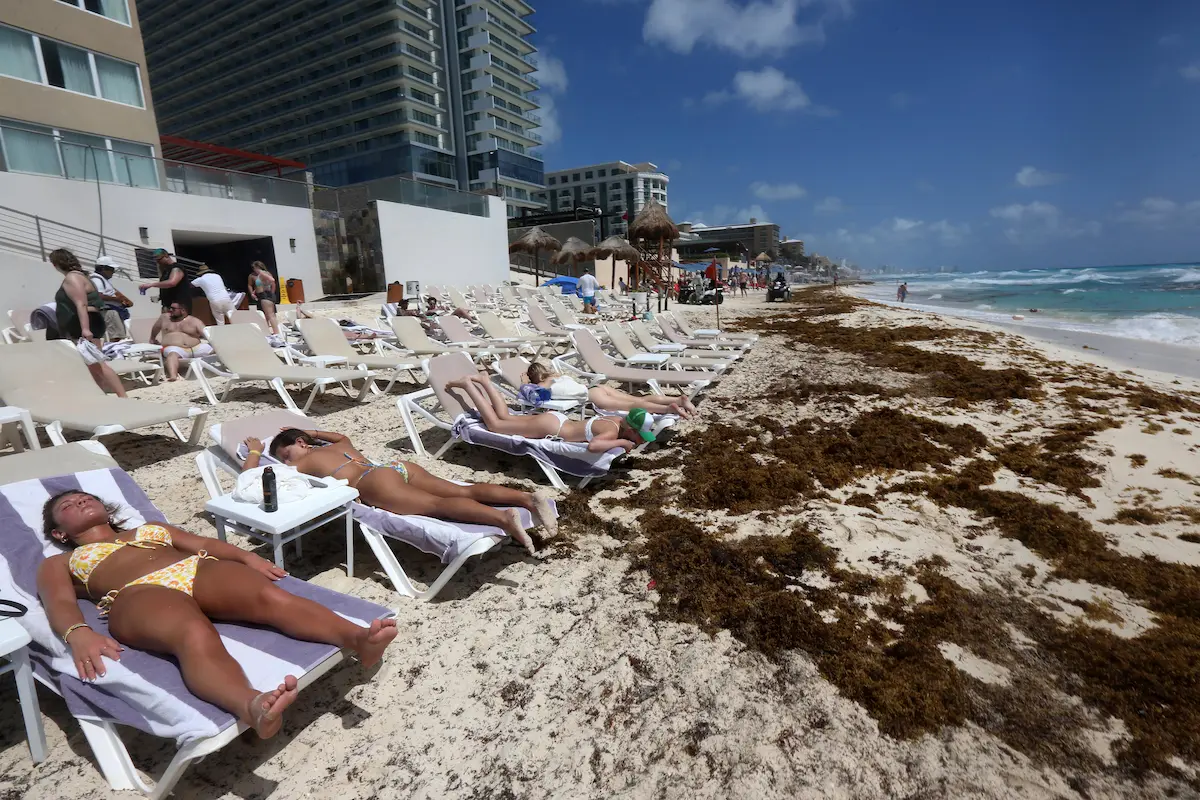
Cancún, Quintana Roo — About 90,538 tons of sargassum are floating off the coast of Quintana Roo, in what officials and scientists describe as the most severe season on record for Mexico’s Caribbean coast.
Environment Secretary Alicia Bárcena said the 2026 volume quadruples last year’s figure and is 27 times above the historical average. She called the year “difficult and atypical.”
A Blow to Tourism
For many marine species, the sprawling brown algae provide food and shelter. But for coastal residents, sargassum has become a problem that damages the environment, fishing, and tourism. In Playa del Carmen, 32-year-old waiter Alan Vázquez watched from an empty restaurant as rotting seaweed stained the turquoise waters brown. “It’s sad that a place this beautiful has ended up like this,” he told The Associated Press.
Vázquez fears he may share the fate of four coworkers who were laid off two months ago, in a state where sales fell 30 percent in the first half of the year, according to local business estimates cited by AP.
By June, about 5 million tons of sargassum had accumulated in the Caribbean, according to the University of Florida’s Optical Oceanography Observatory.
The phenomenon is not limited to Mexico. In Puerto Rico, sargassum has blanketed tourist areas such as La Parguera, and a record 40 million metric tons in 2025 prompted the governor to declare a state of emergency. In the U.S. Virgin Islands, environmental consultant Amy Dempsey said it is possible to walk about seven meters offshore without getting wet.
Why There Is So Much Sargassum This Year
Marine scientist Brian Barnes of the University of South Florida told AP that the record 2025 bloom “never really disappeared” and was enough to spawn a new local bloom. It is the first time scientists have observed large-scale growth in areas such as the Caribbean and the Gulf of Mexico — a phenomenon that usually reproduces asexually as the algae drift from West Africa.
In Tulum, the season, which normally begins in April, started in January, according to The Tulum Times. By mid-July, municipal crews had removed more than 2,800 metric tons from public beaches — nearly double the amount collected in the same period last year. That figure excludes material removed directly by hotels, the outlet reported.
Municipal Efforts and a Disputed Number
The Tulum Times reported that Mayor Diego Castañón Trejo toured Playa del Pueblo on July 15 with David Buchanan, the local director of the Federal Maritime-Terrestrial Zone, to review a cleanup operation that has run year-round. Buchanan’s crews completed more than 1,000 container trips to transfer sites. Data from Simsar, the national sargassum collection monitoring system, places Tulum as the hardest-hit destination in the country between January 2022 and July 2026 — a figure the outlet noted does not fully align with the Navy’s annual totals for Quintana Roo, since the two systems appear to count different things.
Naval Reinforcement and a 2 Billion Peso Investment
President Claudia Sheinbaum on July 30 presented the Sargassum Management and Response Strategy, which concentrates new equipment in five coastal stretches: Cancún, Playa del Carmen, Puerto Morelos, Tulum, and Mahahual.
The first phase, budgeted at 768.7 million pesos (about $115 million), includes two tugboats, six coastal sargassum collection vessels, 1.5 kilometers of dynamic barriers, and 50 kilometers of coastal containment barriers, according to a breakdown presented by Navy Secretary Admiral Raymundo Pedro Morales and reproduced by The Tulum Times.
Rear Admiral Topiltzin Flores Jaramillo, who coordinates the strategy, said the goal is to increase collection at sea, rather than relying mainly on beach cleanup, where most of the work currently focuses.
The Navy, which has led the operation for seven years with about 500 sailors, reported collecting 92,782 tons in 2025 and 96,151 tons so far in 2026 — the two highest annual totals on record.
Current collection capacity is about 1,200 tons per day, just 30 percent of what reaches the Mexican Caribbean. The new vessels are expected to raise that to 1,870 tons per day this year and 4,000 tons next year, according to figures cited by Semarnat and Governor Mara Lezama, who has allocated more than 770 million pesos in state funds to the problem.
Environmental Risks and a Second Life for the Algae
Buchanan warned, according to The Tulum Times, that removing sargassum from the sand only makes sense if the final disposal site does not create a second problem: leachate from decomposition can reach the aquifer, vegetation, and coastal wildlife.
The macroalgae also contains arsenic and other heavy metals. When it decomposes, it releases hydrogen sulfide, the rotten-egg-smelling gas that irritates the respiratory tract and can cause dermatitis on direct contact.
The federal plan will send collected material to four facilities where it will be dried and pretreated to produce biofertilizer, biochar, and biogas. In parallel, private and academic initiatives — including one by UNAM in Cozumel, Akumal, and Puerto Morelos, and a company called Carbonwave that exports agricultural biostimulants to the United States, Ecuador, and Brazil — are seeking to turn the algae into an income source for coastal communities.
Sheinbaum said about 150 scientists are working with Semarnat and the Science Secretariat to determine why this year produced so much sargassum and what profitable uses the harvested biomass might have. On October 1–2, Mexico will host a Global Gateway European Union-Caribbean conference on the issue, with participation from Caribbean countries, Brazil, and Japan — the latter offering decommissioned whaling ships adapted for sargassum collection.
More Economy
- Trump to Fed: Cut Rates or I’ll Halt Trade With Deficit Nations
- Sheinbaum, Trump Near USMCA Deal but New Demands Emerge
- Playa del Carmen Opens One-Stop Shop to Streamline Business Permits
- Cancun Hotels Look to 2027 for Rate and Occupancy Rebound
- Cancún Airport Logs Just 286 Flights in a Day, Its Lowest Level in Two Decades