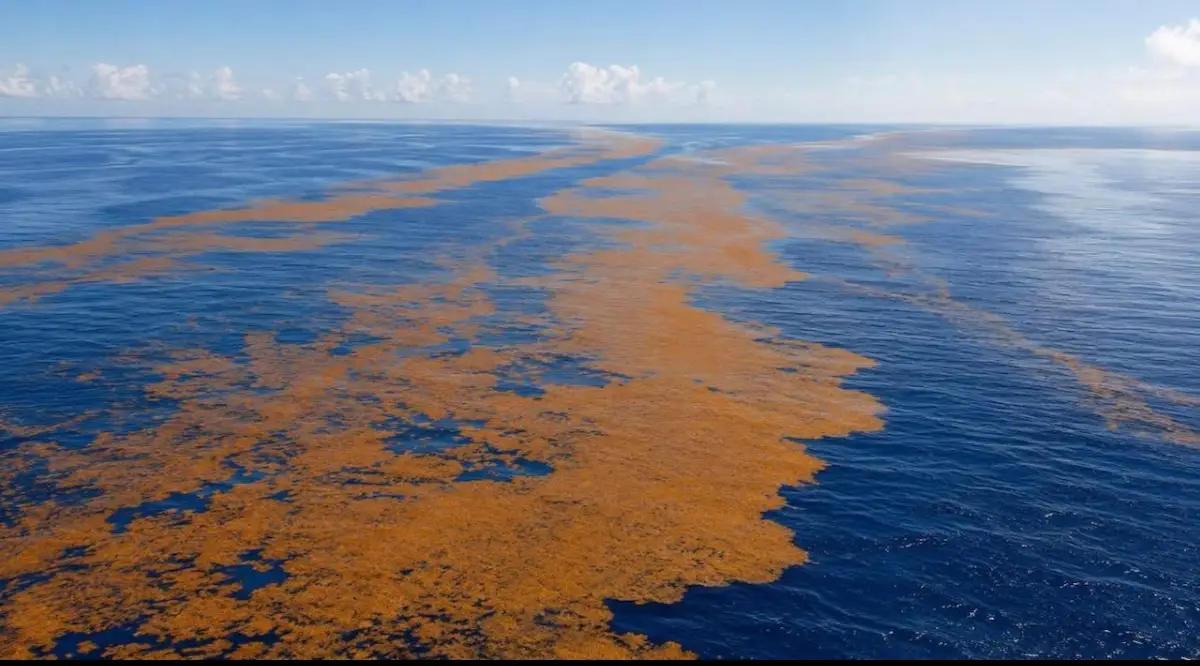
Cancún, Quintana Roo — A massive new sargassum bloom is forming in the Gulf of Mexico off the coasts of Texas and Louisiana, and researchers warn it could bring heavy seaweed landings to Mexico’s Gulf coast states within the next one to two years.
The bloom, described as a “mega-nursery” covering an area of about 500,000 square kilometers — roughly a quarter of Mexico’s national territory — had accumulated an estimated 4.2 million metric tons of the brown macroalgae by June 2026, a 400% increase in just one year, according to hydrobiologist Esteban Amaro Mauricio.
“Because this is a new population that is still growing, it will take a while to consolidate, so we could be seeing these major sargassum landings in another year or two,” said Amaro, founder of the Caribbean Sea Environmental Monitoring and Climate Change Network and coordinator of Quintana Roo’s Environmental and Sargassum Monitoring Center (CEMAS).
Amaro said the algae, of the genus Sargassum, began accumulating in the northern and northwestern Gulf of Mexico about three years ago. Once it drifted beyond the influence of prevailing winds and currents, it began reproducing rapidly, he explained.
The new Gulf of Mexico “Sargasso Sea” is independent from the original Sargasso Sea in the North Atlantic, discovered by Christopher Columbus in 1492. Amaro said it is being fueled by climate change, warming waters linked to El Niño, Sahara dust, and nutrient runoff from the Mississippi River and several Mexican rivers, including the Rio Grande, Pánuco, Coatzacoalcos, Grijalva, and Usumacinta.
The researcher drew parallels with the Great Atlantic Sargassum Belt, which formed between the coasts of Brazil and West Africa in the winter of 2009–2010 and became a self-sustaining population. Today, 90% of the sargassum that reaches Quintana Roo’s coasts comes from that belt, with only 10% from the original Sargasso Sea, he said.
In the Gulf of Mexico, the algae is already arriving in small amounts in Tamaulipas, Veracruz, Tabasco, and Campeche. In Yucatán, however, an “explosion” of sargassum has been observed along more than 120 kilometers of beaches, from Sisal to Telchac Puerto.
“My hypothesis is that the conditions are in place, and it appears this is what will happen, that soon we could begin to see significant arrivals in all the coastal states of the Gulf of Mexico,” Amaro said.
The latest records show the Great Atlantic Sargassum Belt contains 34.7 million metric tons of macroalgae, while the original Sargasso Sea holds about 4 million metric tons — a volume similar to that already contained in the new Gulf of Mexico Sargasso Sea, according to Amaro, who is preparing a scientific paper on the discovery.
More Environment
- Sargassum Barrier Reaches Puerto Aventuras as Navy Support Takes Shape
- Why Quintana Roo’s Sewer Gap Is Polluting Cenotes and Coasts
- Hotels in Cancún and Puerto Morelos Restore Coastal Dunes With Native Plants
- Dolphin Swims Continue in Puerto Aventuras as Cancún Dolphin Debate Simmers
- Punta Allen Lobster Fishermen Report 40 Tons Three Months Into Season