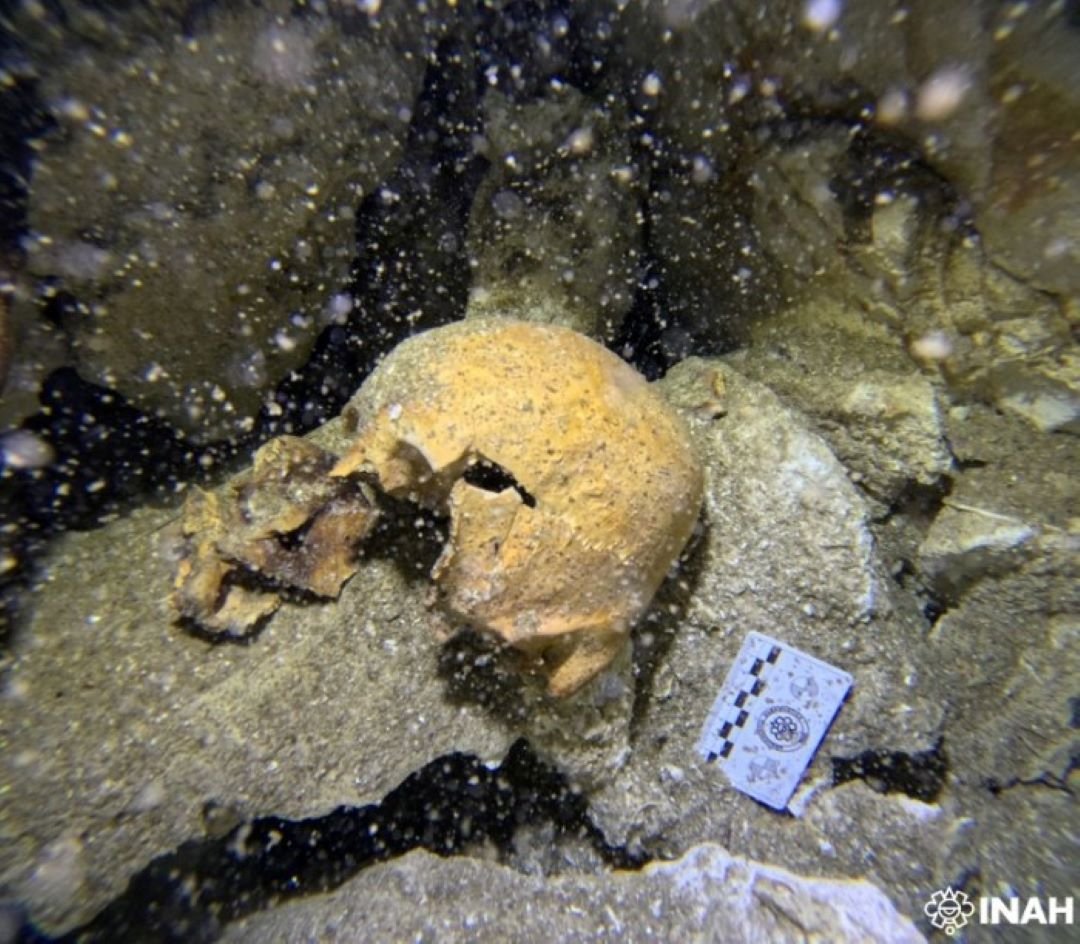
Playa del Carmen, Quintana Roo — Mexico’s National Institute of Anthropology and History (INAH) has launched a research project to conserve the skeletal remains of an ancient woman found in the Yaakun cenote, officials announced.
Culture Secretary Claudia Curiel de Icaza said the remains, believed to belong to a young woman, have been named Yatzil, a Mayan word meaning “beloved person,” in keeping with the cenote’s name, which translates to “love.”
“Every archaeological discovery we manage to protect thanks to community collaboration strengthens our knowledge of the cultures that inhabited this territory and reaffirms that heritage is a shared responsibility,” Curiel de Icaza said in a statement. “Scientific research and social participation are essential to preserve these intact contexts and pass them on to future generations.”
After reviewing reports and georeferencing maps, field work began. Over five days, underwater archaeologist Gustavo García García conducted dives between 42 and 53 meters (138-174 feet) deep, identifying two archaeological concentrations: an area with ceramic vessels and another with human bone remains, separated by about 30 meters (98 feet).
Using photogrammetric surveys of both contexts, the team formalized the Cenote Yaakun Research Project, authorized by INAH’s Archaeology Council. The initiative aims to prevent looting, alteration, and removal of artifacts. A fence has been placed to mark the two zones, and with support from the landowners, diving groups are instructed not to touch, extract, or vandalize any elements.
According to García García, the site’s custodians are the main advocates for preserving the cultural heritage, especially the bones. Preliminary analysis by physical anthropologist Salvador Isab Estrada indicates the remains belong to a female individual. The guardians suggested naming her Yatzil.
Beyond a cloud of hydrogen sulfide, the Yaakun cenote opens to a depth of more than 80 meters (262 feet), with a diagonal slope where the materials lie. On the north side, between 42 and 46 meters (138-151 feet), a pile of Yatzil’s bones and animal remains were found. On the south side, at 46, 48, and 53 meters (151, 157, and 174 feet), three globular pots — one intact and two fragmented — likely used for domestic purposes were discovered.
Osteobiological analysis identified humeri, radii, femurs, tibias, and the pelvis, as well as the left portion of the mandible with three molars. The absence of pronounced dental wear and premolar loss suggests the individual was between 18 and 25 years old.
Researchers are cautious about assigning a cultural affiliation or date to Yatzil’s remains. They will wait for a dental sample extraction — the best skeletal source for well-preserved DNA — which may be a goal for the second field season in 2027.
Despite optimal preservation due to stable water conditions, both specialists emphasized the need to protect the site, which will be registered in the Archaeological Atlas of Caves and Cenotes of the Yucatan Peninsula.
More Culture
- Free Theater Production ‘Catsup’ Brings Pandemic Childhood Story to Cancún
- Documentary on Puebla River Defenders Screens Free in Cancún
- Cancún Looks to Promote Its Cultural Heritage to Tourists
- Playa del Carmen Opens Nominations for Elvia Carrillo Puerto Award Honoring Outstanding Women
- Quintana Roo Names Winners of 2026 State Craft and Embroidery Prizes
More Playa del Carmen
- Car With Two Children Overturns at Paamul Curve on Highway 307
- CFE and Playa del Carmen to Review Plan for Submarine Power Line to Cozumel
- American Says Stolen Truck Was Resold in Playa del Carmen With Forged Paperwork
- State Adult Education Institute to Open Branch in Villas del Sol
- Playa del Carmen Council Adds 66.5 Million Pesos to 2026 Public Works Budget