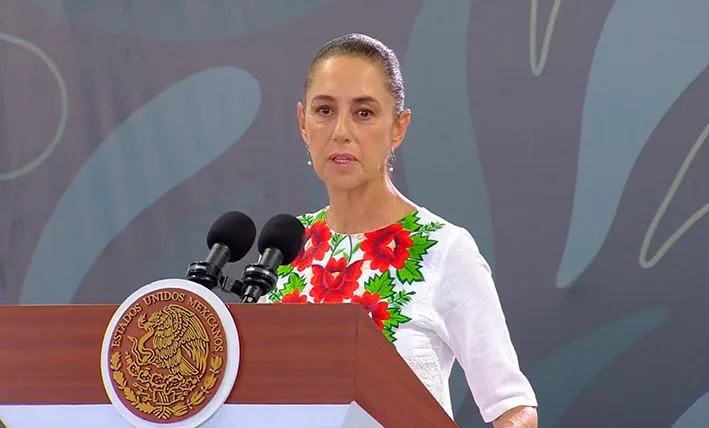
TULUM, Quintana Roo — President Claudia Sheinbaum announced a new package of changes for Tulum’s Parque del Jaguar, including lower entry fees, free access to the public beaches inside the park and infrastructure improvements intended to make the site easier and less expensive to visit.
The measures are part of the federal government’s Tulum Renace strategy, a broader plan aimed at reviving tourism in a destination that has faced months of criticism over high prices, restricted beach access and a decline in visitors. The federal government said the new fee structure and access changes are designed to make the park and archaeological zone more accessible while supporting tourism recovery in Tulum.
Under the new plan, visitors who want the full tour of the Tulum archaeological zone, the protected natural area and Parque del Jaguar will pay 80 pesos for Mexican nationals and 265 pesos for foreign visitors. The presidency described the change as a significant reduction from the previous combined cost of visiting the area.
Visitors who only want to go to the beaches will be able to enter free of charge. The only optional cost will be internal transportation for those who choose to use it. During her July 17 press conference, Sheinbaum said visitors heading only to the beach would not be charged admission to the park itself.
A Response to Months of Complaints
The announcement directly addresses one of Tulum’s most visible public frustrations.
Although beaches in Mexico are public by law, access to Tulum’s coastline became increasingly difficult after the opening and management changes around Parque del Jaguar. Residents, tourists and business owners complained that people were being forced to pay additional fees or pass through controlled access points in order to reach beaches that, in principle, should be open to the public.
The issue escalated in 2025 when Tulum Mayor Diego Castañón accused Grupo Mundo Maya, the state-owned company that manages the park, of failing to honor agreements allowing residents and tourists free access to the beaches. Grupo Mundo Maya responded at the time that it was respecting free access for properly accredited residents.
That dispute unfolded amid a broader downturn in Tulum’s tourism activity. In late 2025, business owners and tourism operators reported lower occupancy, fewer visitors and growing complaints about high prices, transportation costs, sargassum and the complexity of accessing the archaeological zone and beaches.
What Will Change at the Park
Sheinbaum said the government will remove the wall at the park’s main entrance and replace it with a more open access point, improving the first impression for visitors entering the site. The plan also includes an eco-friendly parking area at the southern entrance, which would allow people arriving by private vehicle to enter more easily.
The federal government also plans to expand the Visitor Center and other facilities inside Parque del Jaguar to broaden the tourism offering and improve the visitor experience.
The new rates are expected to be published in the Diario Oficial de la Federación, Mexico’s official federal gazette, making the changes formal.
Why Parque del Jaguar Matters
Parque del Jaguar is not simply a recreational park. It sits around one of Mexico’s most visited archaeological sites and forms part of a larger protected landscape in Tulum.
The federal government declared the Jaguar Flora and Fauna Protection Area in 2022, covering approximately 2,249 hectares in the municipality of Tulum. The decree placed the area under federal environmental protection because of its coastal ecosystems, wildlife habitat and proximity to the Tulum archaeological zone.
That combination makes the park politically and economically sensitive. It is meant to protect natural areas and improve the visitor experience around the ruins, but it also controls access to some of Tulum’s most valuable tourism assets: the archaeological zone and the beaches.
For residents and tourism businesses, the problem has been less the existence of the park than the way access and pricing were handled. Visitors who once expected a relatively simple trip to the ruins or beach were instead encountering multiple fees, new logistics and uncertainty about where they could enter.
Part of the “Tulum Renace” Strategy
The new park measures form part of Tulum Renace, the federal recovery strategy announced in 2025 after concerns grew over Tulum’s tourism slowdown. The strategy includes actions related to beach access, public infrastructure, tourism promotion, environmental management and regulation of attractions.
Sheinbaum also announced that the federal government will launch a promotional campaign to encourage tourism to both Parque del Jaguar and Tulum more broadly.
The pricing changes may be especially important for domestic visitors. Tulum has long depended heavily on international tourism, but complaints about cost have made it less competitive for Mexican travelers and regional visitors. Reducing the basic cost of entry to the park and archaeological circuit could help reposition the destination as more accessible.
The Real Test Will Be Access in Practice
The announcement is likely to be welcomed by residents and visitors who have argued that Tulum’s beaches should not be treated as paid attractions.
But the practical test will come after the new rules are implemented. Visitors will need clear signage, simple entry points, reasonable transportation options and consistent enforcement so that free beach access works in practice, not only on paper.
For Tulum, the change is an attempt to correct one of the most damaging perceptions to emerge over the past year: that the destination had become too expensive, too complicated and too closed off from the public.
The new message from the federal government is the opposite: the beaches are free, the park will be easier to enter and Tulum is being pushed to become more accessible again.
More Politics
- Mexico Expects US Tariff Relief Despite Delayed USMCA Talks
- Poverty Fell 38% in Quintana Roo, Governor Mara Lezama Says
- HR Ratings Cuts Mexico and Pemex Ratings on Fiscal Deterioration and Debt Pressure
- Juan Arena Sworn In as Puerto Aventuras Mayor After Predecessor’s Extortion Arrest
- SCJN Orders Quintana Roo to Legislate Disability Representation
More Tulum
- Quintana Roo Tourism Falls 7% as Cancún and Tulum Airports Lose 800,000 Visitors
- Mexican Caribbean Destinations and Resorts Win Across 2026 World Travel Awards
- Why a Councilman Wants Tulum Out of the Airport’s Name
- Zamna Tulum 2027: Dates, Lineup and Ticket Details
- Cancun Tourism Slumps 7% as Industry Leaders Urge Marketing Overhaul