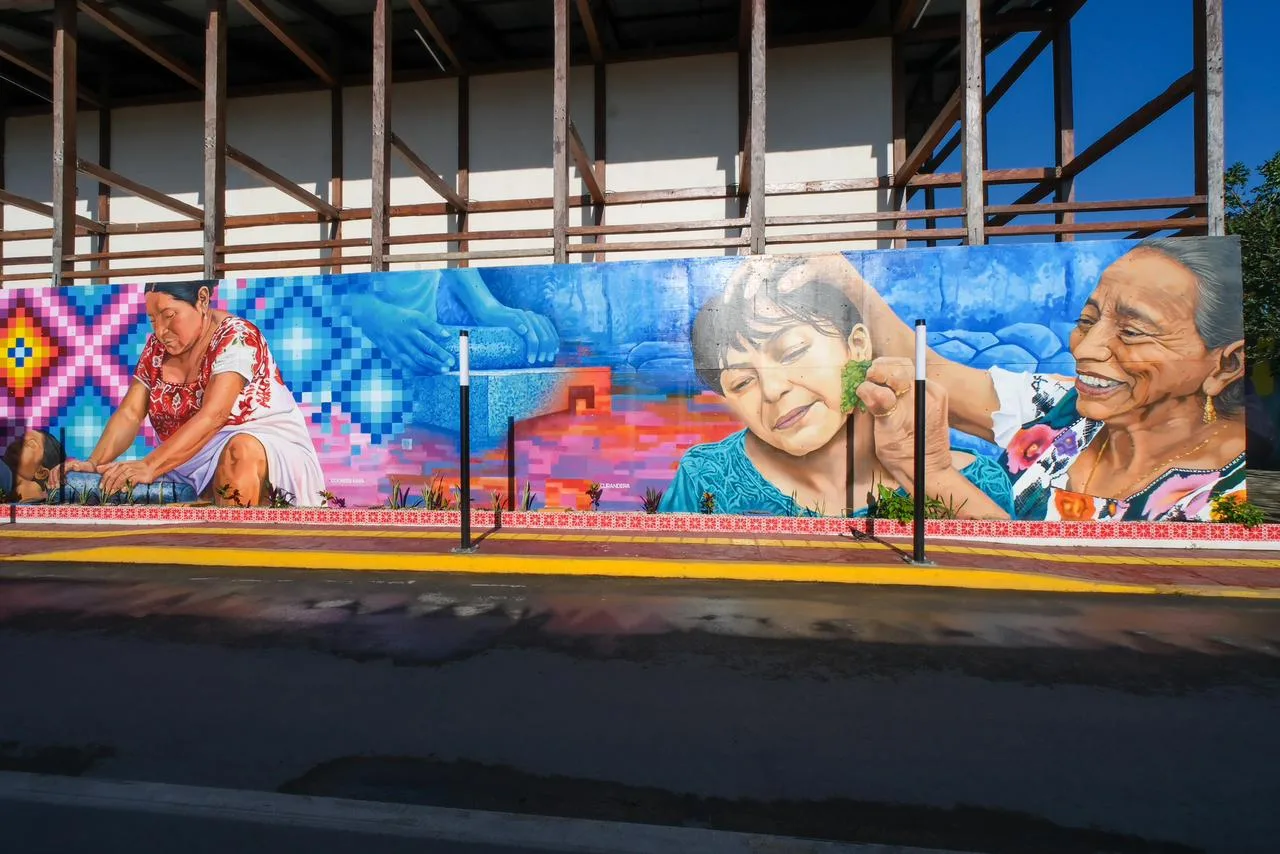
Felipe Carrillo Puerto, Quintana Roo — State and municipal officials have inaugurated “Caminos Ancestrales,” a new cultural corridor featuring a kilometer of murals that celebrate Maya heritage and transform the urban landscape of this city in southeastern Mexico.
Governor Mara Lezama Espinosa and Mayor Mary Hernández led the opening ceremony at the intersection of Juárez Avenue and 63rd Street, near Mothers’ Park, unveiling the first phase of the “Safe Paths” project. The initiative aims to enhance the city’s image and strengthen community identity through public art.
The corridor showcases the work of local artists who have transformed seven streets into a vibrant canvas depicting Maya traditions, history, and daily life. The murals visually narrate stories that define the region’s cultural richness.
During the event, Governor Lezama emphasized Felipe Carrillo Puerto’s significance within the national “Fourth Transformation” agenda and highlighted support from federal and state governments, including that of President Claudia Sheinbaum. She noted the project positions the region as a leader in community tourism.
“Today we speak of a Carrillo Puerto that is present at international fairs, with more educational and cultural infrastructure, renovated parks, a theater, a museum, a strengthened university, and the long-awaited ‘Gateway to the Sea’ that will soon open,” Lezama said.
Mayor Hernández stated that “Caminos Ancestrales” reflects colors and themes that tell regional stories through the vision of local artists. The participating artists include:
- Julio César Yam Nah, who brings ancestral traditions and the natural environment to life
- Omar Alejandro Palomo Sulub, who highlights local flora, fauna, and identity
- Rubén Alberto Morales Xool, who honors customs and daily scenes
- José Armando Jiménez Santos, who preserves the historical memory of indigenous peoples
- Juan Jesús Andrade López, who promotes art as an engine of cultural identity
- Imer Omar Uh Castillo, who offers a critical and contemporary interpretation of Maya culture
The murals employ a symbolic color language: green represents the Sian Ka’an ecosystem, water, reefs, and sustainable tourism, while red evokes culture, history, struggles, and community resistance. The artworks feature historical figures linked to the Cruzob movement, characters from Tihosuco, social leaders, and emblematic women such as Rita Cetina, Elvia Carrillo Puerto, Rosa Torres, Felipa, and María Uicab.
The collection also includes collective representations of midwives, healers, priestesses, warriors, embroiderers, and artisans, along with legends like the Xtabay. One mural pays tribute to singer Pedro Infante alongside his close friend Ruperto Prado.
Plans call for a second phase with broader community and artist participation. Contributors already include translators who will provide signage in Maya, Spanish, and English, plus the architectural team that designed the cultural corridor.
The inauguration concluded with a ribbon-cutting by officials and artists, accompanied by Maya children, in front of a mural dedicated to master muralists painted by Imer Uh and Rusel Castillo. This collective work features the faces of artists José Antonio Corona, Marcelo Jiménez, Jorge Enrique Palomo, Juan Cimá Barzón, Néstor Balam Coh, Mario Chan Collí, and Manuel Novelo.
Discover more from Riviera Maya News & Events
Subscribe to get the latest posts sent to your email.