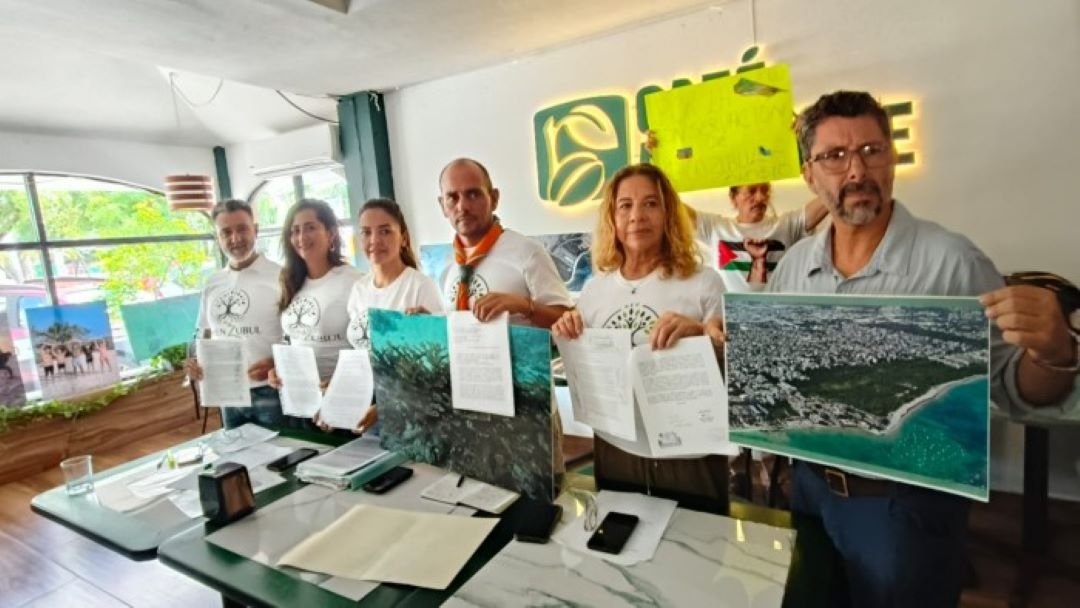
Playa del Carmen, Quintana Roo — Environmental groups and residents have filed a citizen initiative to protect the Chen Zubul property, a tract of more than 40 hectares that they describe as Playa del Carmen’s last natural remnant, as the Federal Electricity Commission (CFE) moves ahead with a submarine transmission line linking the resort town to Cozumel.
The push came after Governor Mara Lezama announced the start of work on the project, which the CFE plans to run between Playa del Carmen and the island of Cozumel at Chankanaab. The CFE official in charge of the project has maintained that the Chen Zubul property holds no biological value, according to the group.
At a press conference, members of the Red por Chen Zubul (Chen Zubul Network) laid out 10 requests forming a citizen initiative to protect and preserve the site, which sits in the heart of the Luis Donaldo Colosio neighborhood.
Jeansi Ramírez said CFE personnel visited the property in January and February of this year as part of the planned project. Residents gathered signatures and delivered them to the project offices in Mérida, Yucatán, she said, and when they asked to see environmental impact studies, they were told the land harbored no life. The response halted the work at the time, she added, but residents now worry because the technology slated for the property and the seabed is obsolete.
Mónica Chavarría, of the civil association Dejando Huella and a representative of the Oasis Maya initiative, presented the legal and environmental framework behind the proposal, which is also known as the last “green lung” of Playa del Carmen. She said it rests on the constitutional recognition of the human right to a healthy environment and draws on the Escazú Agreement, federal and state environmental law, the General Wildlife Law, Semarnat’s NOM 059 standard, international biodiversity and wetlands instruments, international climate commitments and the state strategy for the sustainable use of biodiversity.
Chavarría said the initiative does not seek to impose a specific legal designation, but rather asks authorities to carry out the technical and legal studies needed to determine which one is appropriate.
The 10 requests include:
- Formal recognition of the environmental, social and historical importance of the Chen Zubul property.
- Delimiting and shielding the area from interventions, development or land sales that could compromise its integrity while its legal status is decided.
- Compliance with a request for interagency coordination through working groups involving all three levels of government.
- Asking Semarnat and the National Commission of Protected Natural Areas (Conanp) to carry out and oversee comprehensive, independent technical studies of the area’s ecosystems and biodiversity.
- Establishing a legal protection figure based on those studies.
- Designating an office or official responsible for institutional follow-up and formally reporting on the actions and decisions taken.
Sonia López, a representative of the Association of Founding Residents of Colosio, described the history of the neighborhood and its close ties to Chen Zubul. She stressed the importance of distinguishing legally between private property, national assets and the public right of access to beaches, and of recognizing the memory and participation of a community that has defended its territory for decades.
Rodrigo Garcídueñas, of the group Pulmón Verde, pointed to more than 10 years of citizen work to safeguard, protect and document the site, including surveillance, cleanup, reforestation, vandalism prevention and community organizing.
José Urbina, of Selvame del Tren, said citizens were complicit in allowing major projects to be built along Playa del Carmen’s coastline, including the pier on Constituyentes Avenue owned by the company Ultramar. In his view, that cost the town the Playa del Carmen that was known for its biological wealth and wide white-sand beaches.
Participants stressed that the initiative is not meant to confront any company, government or individual, but responds to a demand from organized civil society: that Chen Zubul be studied, recognized and protected on the basis of evidence, science, law and citizen participation.
The proposal aims to open a space for institutional dialogue that can produce a long-term solution before any environmental damage becomes irreversible.
More Environment
- Screwworm Cases Detected in Two Dogs and a Horse in Tulum
- Playa del Carmen Recognized as International Bull Shark Zone
- Five Zones in Playa del Carmen Lose Urban Jungle to Construction Boom
- Hurricane Isaias Strengthens to Category 3 as Heavy Rain Hits Quintana Roo
- Hurricane Isaías to Bring Rain and Heat to Cancún and Playa del Carmen This Weekend
More Cozumel
- Quintana Roo Pursues Direct Europe-Cozumel Flight, Boosts Tulum Air Connectivity
- Cozumel to Host 18th Island Bird Festival Oct. 7-11
- Cozumel’s Day of the Dead Festival Returns With Michoacán as Guest of Honor
- Cozumel Prison Expands Capacity by More Than 50% With 80 New Spaces
- Cozumel Tightens Crocodile Response Protocols After Sightings