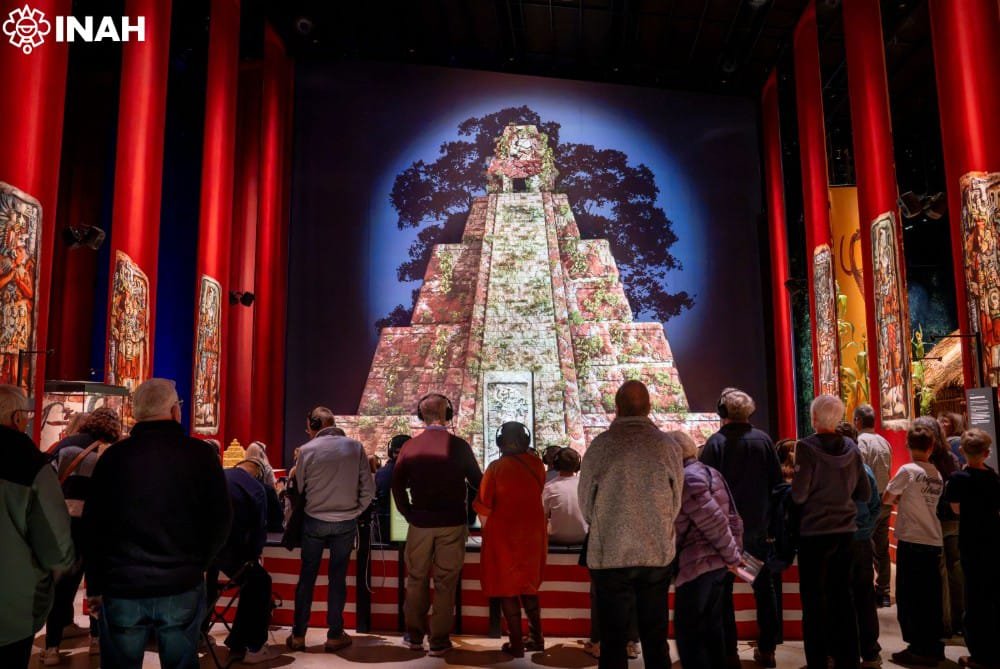
Cancún, Mexico — A new exhibition in Aarhus, Denmark, is bringing the story of one of the most influential dynasties of the Maya world to European audiences, thousands of kilometers from the jungle where it once held power.
The show, titled El señorío bajo la selva: Dzibanché y Calakmul (The Lordship Beneath the Jungle: Dzibanché and Calakmul), opened in early October at the Moesgaard Museum and had received 47,335 visitors as of November 17, according to a statement from Mexico’s National Institute of Anthropology and History (INAH).
It features 167 archaeological and artistic pieces that explore various aspects of Maya civilization during the Classic period, from 200 to 900 AD.
The exhibition is organized around the Kaanu’l dynasty, whose name means “snake” in the Maya language and whose political influence extended from the southern jungles to parts of the eastern Gulf of Mexico and northern Central America. Its history is closely tied to Dzibanché and Calakmul, two ancient centers of power that took part in a complex network of alliances, disputes and exchanges that shaped the development of Mesoamerican cities.
The show is divided into three thematic sections. The first, The Maya World, introduces visitors to the territory and timeline of the civilization. The second, The City and Time, explores the mathematical knowledge, calendars and hieroglyphic writing that helped consolidate political and religious institutions. The third, The Ruler, explains the expansion of ideas and the influence of the Kaanu’l house into territories in Belize and the central Petén region.
Among the highlights are funerary masks made of jade and shell that are leaving Mexico for the first time to be displayed abroad. The collection also includes anthropomorphic clay figurines, polychrome tripod plates, ceremonial urns and limestone reliefs recovered during archaeological research carried out since the 1990s at sites in Campeche, Chiapas and Quintana Roo.
Beyond the objects, the exhibition incorporates digital resources, sound, images, set designs, videos and games that allow visitors to explore the rituals, beliefs, monuments and myths of the culture. Danish scholar Jesper Nielsen also participates, guiding visitors through interactive screens and sharing knowledge developed with Mexican specialists.
Curatorial research was led by Daniel Juárez Cossío, Sandra Balanzario Granados and Erik Velásquez García, with the collaboration of Alexandre Tokovinine and Jesper Nielsen.
The pieces come from various INAH collections, including those of the National Museum of Anthropology and the National Museum of History, as well as state collections.
The exhibition will remain open until August 9, 2027. In the halls of the Moesgaard Museum, accustomed to showing remains of Nordic Bronze Age and Viking cultures, the Maya world now establishes a dialogue between two territories separated by the ocean: the Jutland peninsula and the Yucatan Peninsula.
More Culture
- UIMQROO to Open Planetarium, Awards Scholarships to 49 Students
- Quintana Roo Gastronomy Expands to More Municipalities
- Cozumel Art Exhibition ‘Desafiar al Polvo’ Showcases Local Craftsmanship
- Cozumel Museum Opens ‘Instantes Divinos,’ Michelle González Ávila’s Third Solo Show
- Cozumel Marks 177 Years Since Decree Recognizing It as a Town
More Zona Maya
- Young Developers Launch Lyra App to Connect Passengers With Mototaxis in José María Morelos
- Maya Traditional Cooks Showcase Flavors and Knowledge at First Quintana Roo Gathering
- Maya Ka’an Communities Strengthen Monitoring and Governance of Their Aquifers
- Playa del Carmen to Promote Community Tourism at Travel Fairs
- Beekeepers in Mexico’s Maya Zone Report Damage From Badgers, Beetles and Ants