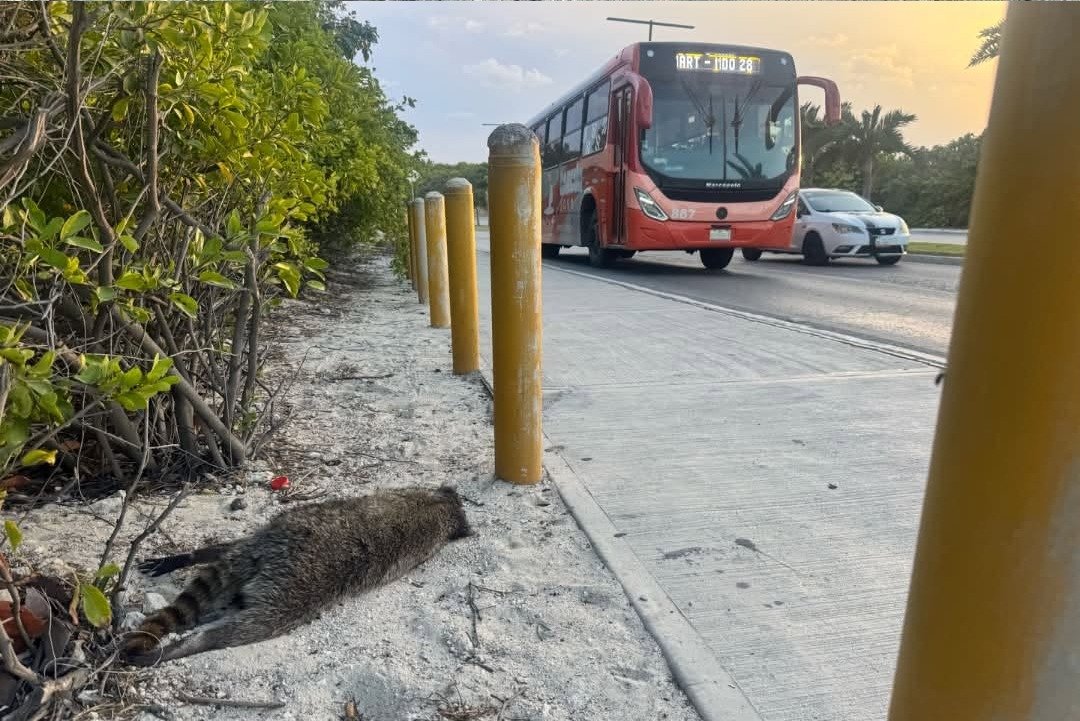
Cancún, Quintana Roo — A raccoon was found dead on the shoulder of Boulevard Kukulcán, one of the busiest roads in Cancún’s hotel zone, after attempting to cross the thoroughfare. Mangrove vegetation still stands just a few feet away, but between the two lie lanes of traffic and concrete that now cut through what was once the animal’s natural habitat.
The discovery highlights a recurring problem on roads bordering jungle and mangrove areas across the region: drivers traveling at high speed and failing to account for the wild animals that share the territory. At times, motorists seem to forget that they are not only sharing the road with other vehicles but also with local wildlife species.
For an animal like the raccoon, crossing the avenue is not simply a matter of walking from one side to the other. It means moving through land that for generations was covered by jungle and mangrove, providing food and shelter. Urban expansion has reduced and divided those areas, forcing wildlife to venture ever closer to traffic corridors.
The problem becomes more acute when drivers do not slow down or stay alert in areas known to have animal activity. A vehicle moving too fast can become a death sentence in seconds for an animal trying to cross its own habitat — including protected or at-risk species.
The sight of the raccoon lying along the boulevard should serve as a wake-up call. The growth of Cancún cannot mean that wildlife is condemned to die under vehicle tires. As long as ecosystems remain fragmented, drivers’ responsibility will be crucial in preventing roads from becoming deadly traps for the animals still struggling to survive in what remains of their home.
More Environment
- Yucatán Suspends Classes in 27 Municipalities as Tropical Storm Isaías Nears
- Sheinbaum Acknowledges Little Progress in Talks With Vulcan Over Calica
- Quintana Roo Plans 4.4 Billion Peso Wind Farm in Othón P. Blanco
- Tulum Ranks Second as Mexico Claims Six Spots on Best Beaches List
- University of the Caribbean Unveils Crocodile Coexistence Manual in Cancún
More Cancun
- Five Men Sentenced To Up To 50 Years For Killings In Cancún And Felipe Carrillo Puerto
- Two Women Rescued From Human Trafficking in Cancún Search Warrants
- Cancún Restaurant Sector Welcomes Extended Hours in Hotel Zone
- Man Who Posed as Inspector to Extort Cancún Merchant Ordered Held Two Years
- Cancún Shuts Down Two Gated Developments for Selling Lots Without Permits