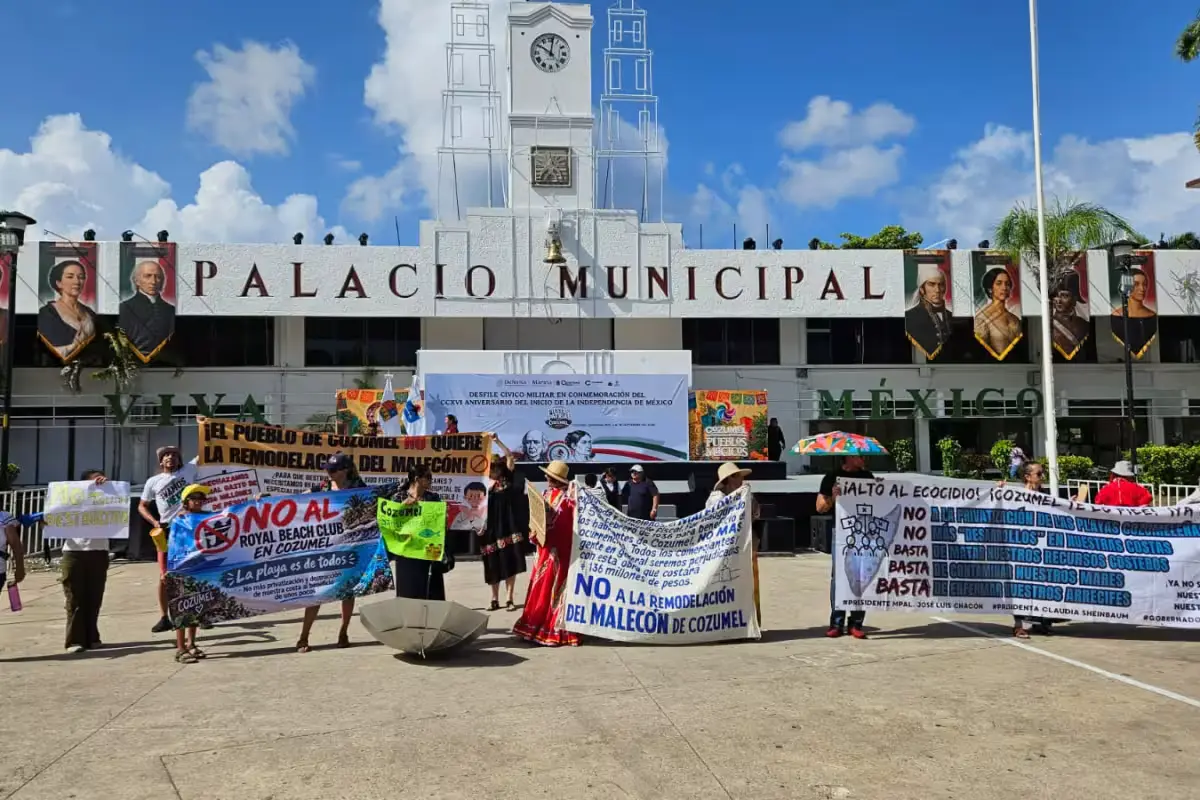
Cozumel, Quintana Roo — Residents and representatives of civic organizations marched through Cozumel to protest the planned rehabilitation of the island’s malecón and to demand that the 136 million pesos budgeted for the work be redirected to basic services and urban infrastructure instead.
The marchers want the money channeled into drinking water supply, street maintenance, garbage collection and efforts to address environmental problems affecting the island’s reefs, said Guadalupe Cab, the representative of CIMAC in Cozumel.
The demonstration drew residents who question the administration of Mayor José Luis Chacón for prioritizing the project, arguing that pressing needs remain unmet in several neighborhoods. Their central demand was a review of how the investment will be spent and consideration of alternatives that address basic services before the project moves forward.
Basic services cited as the priority
Cab said the issues raised during the march included deficiencies in the drinking water supply, the condition of local roads and the collection of solid waste. Participants also cited pollution and the conservation of the reefs, which they said are vital to the island’s environment.
“For many families, the priority is having basic services in adequate condition. The proposal is that before making an investment of this size, the needs that exist in the neighborhoods be reviewed,” she said.
According to the marchers, an incident occurred during the march when security personnel prevented some participants from joining the route because their names did not appear on a list of participants, forcing them to walk alongside the main group. Demonstrators questioned the move but continued with the mobilization. The account comes from participants, and the security agency has not issued a position on the incident.
Protesters also raised the issue of the island’s irregular settlements, where they say families have gone years without basic services.
Víctor Cárdenas, who runs a small business downtown, said the malecón is part of Cozumel’s economic life. “Any rehabilitation project must also consider how it will affect businesses during the works and what concrete benefits it will bring to the population,” he said.
Calls for a say in spending decisions
Participants said the debate is not limited to the malecón itself but extends to how public money is prioritized. In their view, upgrading existing infrastructure should be weighed alongside the needs of residential areas.
“There are areas where families have been waiting years for services. The request is that those needs also be part of the decisions about the budget earmarked for infrastructure,” said Bertha Tamaño, a resident of the Las Fincas neighborhood.
The mobilization also sought a greater role for residents in decisions about urban infrastructure projects. Marchers have previously called for the project to be discussed publicly and for its scope to be made known before work begins.
Rather than demanding that the project be canceled outright, residents asked that officials study the possibility of directing the funds to services, infrastructure and environmental needs they consider more urgent. The protest leaves open the debate over how the public investment will be used and what Cozumel’s infrastructure priorities should be, with participants insisting that the project’s decisions reflect the needs voiced by residents across the island.
More Community
- Isla Mujeres Residents Demand Land for Cemetery, Market and Slaughterhouse
- Cancún’s Teatro de la Ciudad Nears 75% Capacity Ahead of Second Anniversary
- Brain-Eating Amoeba Confirmed in Mérida Lake: What to Know in Quintana Roo
- Dead Sea Turtle Hatchlings Found With Dog Bites at Playa del Carmen Beach
- Explorers Document New Underwater Cave System South of Cozumel
More Cozumel
- Ángeles Viajeros to Take 16 Children With Cancer to Cozumel for a Week by the Sea
- Leonardo Aguilar to Headline Free Cozumel Concert for Grito de Independencia 2026
- Cueva Popotitos: New Underwater Cave System Found South of Cozumel
- Armed Men Try to Abduct Woman on Cozumel; She Escapes on Her Motorcycle
- Cozumel Opens New Sustainable Tourism Trail in Island’s South