
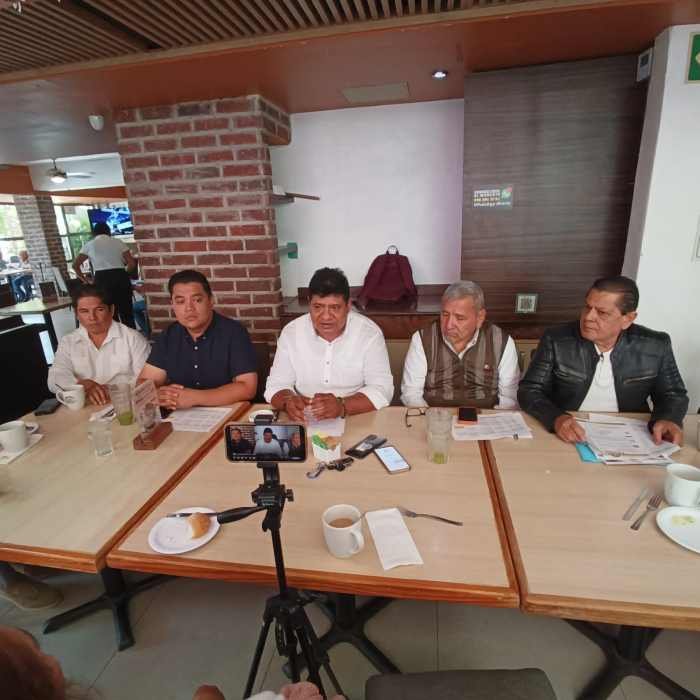
Cancún, Quintana Roo — A coalition of civil society and union organizations has launched a new push against high electricity costs in Quintana Roo, demanding the Energy Ministry eliminate shared consumption meters in informal settlements and standardize rates with cheaper states like Tabasco and Yucatán.
At a press conference on Wednesday, Alfredo Gutiérrez, a representative of the Unidad y Fuerza Ciudadana Siglo XXI collective, said rising temperatures in the state are forcing families and workers to use air conditioning and refrigeration more intensively, leading to increasingly unaffordable bills.
“Current rates do not reflect the climatic reality of Quintana Roo, where heat is constant and energy is no longer a luxury but a basic necessity,” Gutiérrez said.
José Salvador Arauz Arredondo, general secretary of the Frente Sindical de Obreros y Vecinos del Estado de Quintana Roo (FESOC), said workers feel they are “working just to pay the electricity bill,” receiving no significant subsidies or relief despite previous appeals to officials, including the Energy Ministry and the Federal Electricity Commission (CFE).
Beyond the rate complaints, he warned that the region’s lack of energy capacity causes supply fluctuations and failures, a problem seen in recurring outages across the Yucatán Peninsula and major urban centers like Cancún and Chetumal.
The groups presented two main demands to federal authorities: first, to remove the shared meters that complicate transparent billing in irregular zones and are seen as a source of potential malpractice and inequity; and second, to standardize or reduce electricity rates to levels similar to states like Tabasco or Yucatán, where the cost per kWh is lower than current rates in Quintana Roo.
According to recent reports, residents of Quintana Roo pay between 1.07 and 1.30 pesos per kWh, a figure activists and citizens consider unsustainable for a region dependent on continuous cooling due to high temperatures.
The meeting announced plans for a working session in March with agencies including Infonavit, Conavi, FIDE, and the Energy Ministry to explore potential credits for installing solar panels in homes, aiming to reduce reliance on the traditional grid and mitigate costs.
“Promoting clean energy, like solar panels, is part of the strategy so families are not continually hit by high rates and we can move toward energy self-sufficiency,” Arauz Arredondo explained.
The social leaders announced a public conference on Friday at 12:00 p.m. in Cancún to provide further details on these efforts and call for more citizens to join the demand for more equitable and transparent rates.
More Lifestyle
- Deer Trapped in Playacar Fence Rescued After Social Media Reports
- Playa del Carmen Adds Lifeguard Stations and Patrol Vehicles as Swimmers Ignore Red Flags
- Playa del Carmen Offers 21,000 Flu Vaccine Doses to Older Adults and Young Children
- First Monarch Butterfly of the Season Sighted at Cozumel’s Kuzá Park
- Mara Lezama Brings ‘La Voz del Pueblo’ Hearing to Cancún’s Villas Otoch Paraíso, Serving 1,200 Residents
More Cancun
- Cancún Restaurant Owners Press for Tax Incentives to Revive Avenida Yaxchilán
- Hotel Occupancy in Quintana Roo Drops Below 60 Percent
- Crews Remove More Than 1.6 Tons of Trash From Cancún’s Nichupté Mangroves
- Visitax Collection Will Continue at Cancún Airport, Governor Mara Lezama Says
- Quintana Roo Truckers Threaten to Block All Four Lanes of Cancún’s Boulevard Colosio
