
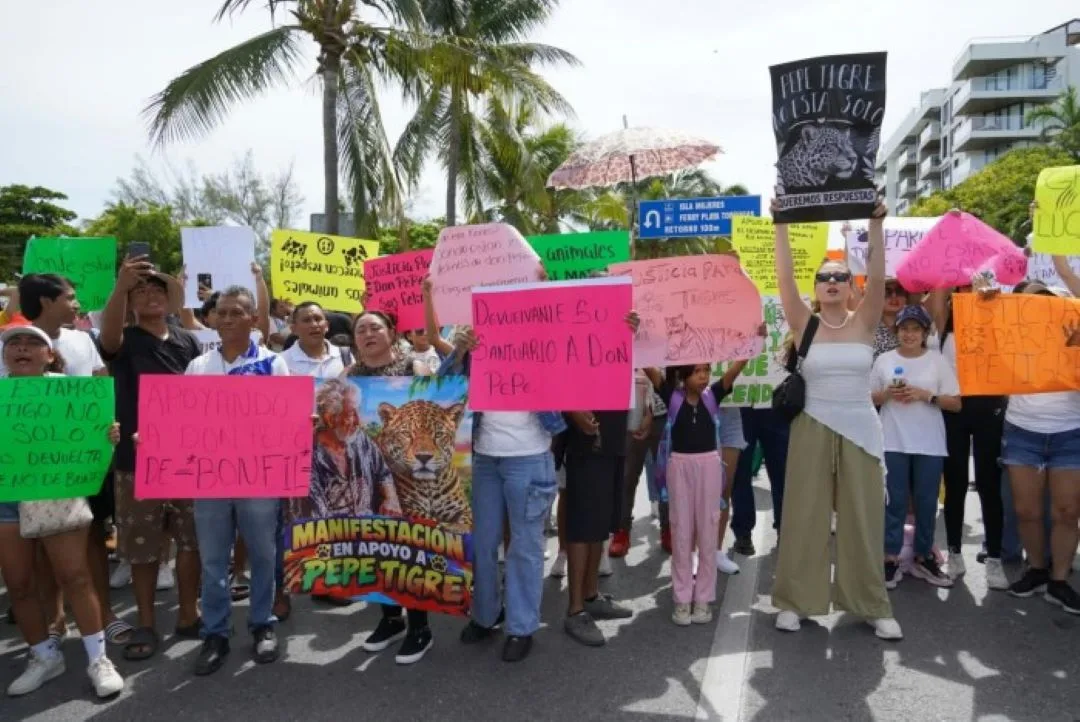
Cancún, Quintana Roo — Dozens of residents gathered at several points across Cancún on Sunday to voice support for José Juárez Gil, the animal handler known as “Pepe Tigre,” and to press authorities for information about the big cats that spent years in his care at a property in the Hotel Zone and on Luis Donaldo Colosio avenue.
Organizers called the demonstration through social media. Participants first assembled at a building tied to Juárez Gil at kilometer 6.5 of Kukulcán boulevard, where they raised banners and chanted slogans defending the animals and the site the handler describes as his own sanctuary.
A group then moved to Luis Donaldo Colosio boulevard, where around 1 p.m. demonstrators closed one direction of traffic, disrupting vehicle flow. They carried signs reading “Animals are not killed” and “Justice for Pepe Tigre,” and demanded to know what has happened to the animals.
A Case Rooted in Cancún’s Growth
The dispute reaches back decades, to the years when Cancún was expanding as a tourism destination and environmental and wildlife rules differed sharply from today’s standards. At the time, keeping and handling large felines on private property was part of a reality that gradually fell under increasingly strict environmental regulation.
The controversy took on a new dimension after the death of a tiger publicly identified as “Pepe,” which raised questions about the conditions the animals were kept in and about who was responsible for their care.
Juárez Gil has said that for roughly three months he has been unable to enter the site widely known as a sanctuary, and that he does not know what became of the felines he says were kept there. Influencers and residents began circulating the case online, and a petition posted September 19 on Change.org has now passed 17,000 verified signatures, according to material shared by the campaign’s organizers.
The petition asks authorities to publicly disclose the location, health and current status of the jaguars that were under Juárez Gil’s care. It also calls for a review of the legal status of the property he claims as his own and for his access to be permitted in line with applicable law.
Concern for the Surviving Animals
Protesters focused much of their attention on the animals still at the site. They urged that any transfer or seizure be preceded by veterinary assessments and that the age and specific condition of each animal be taken into account.
Demonstrators also called for clarity on the circumstances surrounding “Pepe’s” death and warned against assigning blame prematurely while the investigations continue.
In recent days, personnel from the Federal Attorney’s Office for Environmental Protection (Profepa) carried out inspections at two properties linked to Juárez Gil. One is the building where he lives, at kilometer 8.6 of the Hotel Zone.
The environmental agency’s actions come as the keeping, handling and protection of wildlife fall under federal rules, meaning the legal status of both the animals and the properties involved will be settled through the corresponding proceedings.
Among the main demands raised during the march were a full account of the tiger’s death, transparency in the investigations, veterinary evaluations for the remaining animals, and proper legal justification for any seizure or relocation.
As of Sunday, no definitive resolution on the animals’ future had been announced publicly. The case remains in the hands of the competent authorities, who must decide on the appropriate measures based on the applicable legislation and the outcome of the investigations. (InZoomMX)
More Environment
- Cancún Hotel Zone Projects Must Include Wastewater Pre-Treatment Plants
- Microplastics, Sunscreen Chemicals and Repellents Under Study in Quintana Roo Waters
- Cancún Launches Operation to Protect Blue Land Crabs During Migration to the Sea
- Quintana Roo to Present Mexican Caribbean Cenote Guide at DEMA Show 2026
- Sargassum Threatens to Spread Into Chetumal Bay, Experts Warn
More Cancun
- Cancún Street Markets See Customers Return in Sign of Economic Recovery
- MOBI Route 27 in Cancún Ends Free Service Monday as Paid Fares Begin Tuesday
- Kukulcán Interchange Hits 70% as Cancún Delivery Slips to December
- Cancún’s Nichupté Bridge Draws 3,500 for Third Puenteando Nichupté Edition
- Cancún Beaches Keep Red and Yellow Flags as Swell Conditions Shift