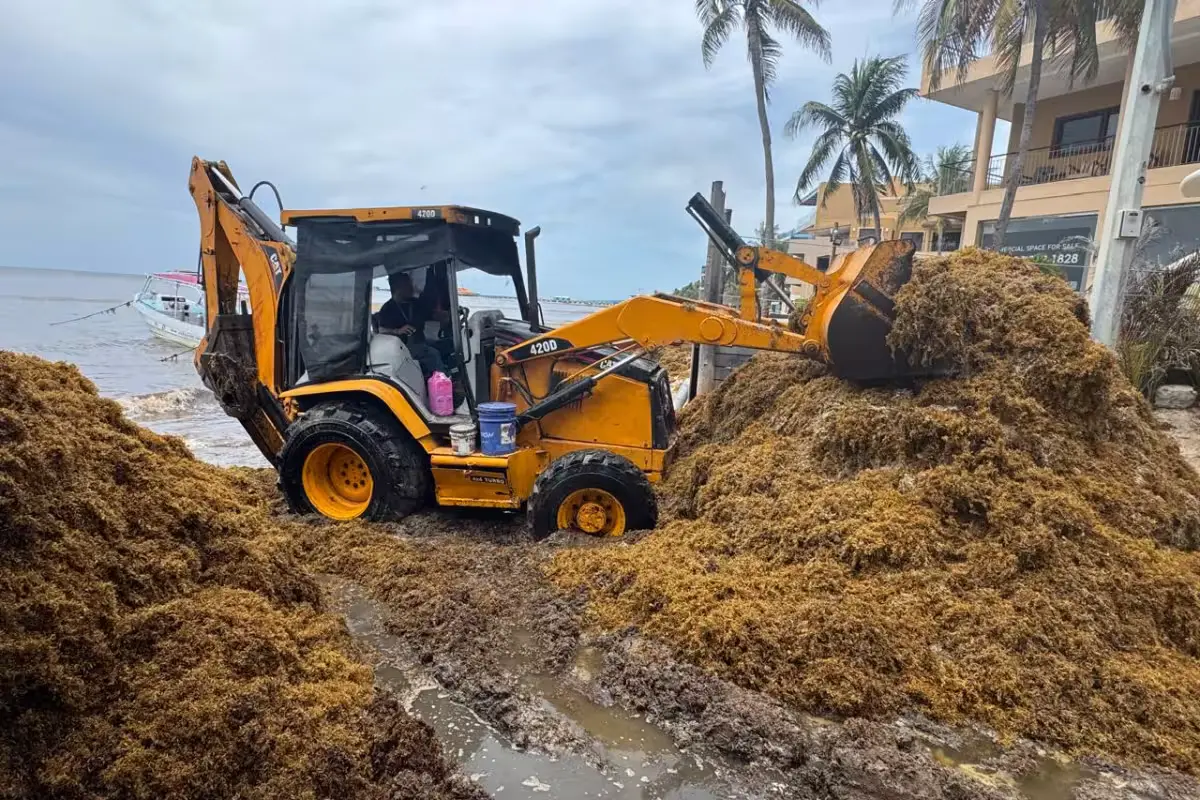
Playa del Carmen, Quintana Roo — Environmental activists are warning that the use of heavy machinery to remove sargasso from coastal areas is disrupting the ecological balance, increasing coastal erosion, and destroying marine fauna, according to local advocacy groups.
Guadalupe de la Rosa, president of the civil association MOCE – YAS-CUXTAL, said the real challenge is not removing sargasso at any cost, but doing so without destroying marine life.
Activist Carlos Jiménez noted that heavy machinery used to compact sand parallel to the shore damages marine species living beneath the sand. Equipment that collects sargasso at sea also harms various marine species, he added.
Marine species that depend on sand include sea turtles such as hawksbill and loggerhead turtles, which bury their eggs in it. Benthic animals like rays and flatfish camouflage themselves in the substrate to avoid predators. Ghost crabs and bivalves that filter nutrients also inhabit the sand.
De la Rosa said the situation is worrying, noting that a severe sargasso influx was forecast by specialists last year. She called for integrated strategies that listen to experts and science.
“The problem of coastal erosion is getting worse, and there are no studies or integrated beach management. They are working improvisationally, and we will hardly recover our beaches as they were before,” she said.
Jiménez added that the risk is imminent, especially because sand compaction affects areas where turtles bury their young, as well as endemic species such as migratory birds.
The use of heavy machinery on beaches causes serious environmental imbalances, including coastal erosion from removing large amounts of sand along with sargasso, soil compaction that destroys sea turtle nests, and biodiversity loss from removing essential organic matter from the ecosystem.
More Environment
- Quintana Roo’s Beaches Are Disappearing Up to 14 Meters a Year
- Rabies Found in Fox That Scratched Baby in Cancún
- Cozumel’s Reefs Get a 3D Map Divers Can Explore Before Entering the Water
- Documentary Exposes 30 Years of Pollution in Cancún’s Chacmuchuch Lagoon
- Crocodile Surprises Tourists Swimming at Cozumel’s El Cielo Sandbar
More Playa del Carmen
- LIPU Bus Rear-Ends Van, Flipping It Off Highway 307 Near Playa del Carmen
- Woman Shot Dead on Motorcycle With Her Daughters in Playa del Carmen
- At Least Four Women Shot Dead Across Quintana Roo Over the Weekend
- Xcaret Says It Will Abide by Any Supreme Court Ruling on Use of Maya Culture
- Playa del Carmen Calls Volunteers to Clean More Than 7 Kilometers of Beach