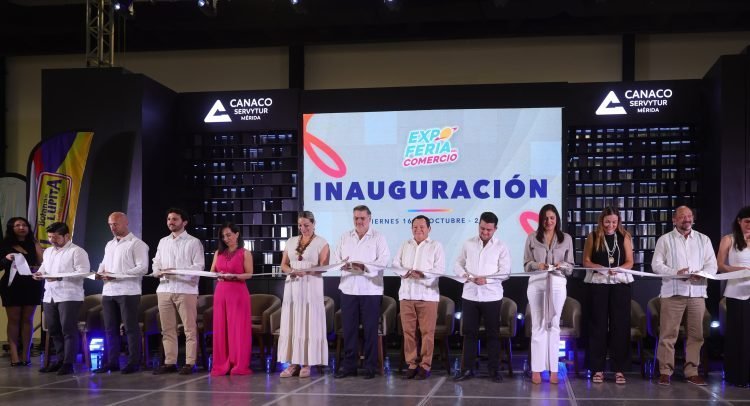
Mérida, Yucatán — Governor Joaquín Díaz Mena inaugurated the 26th Expo Feria del Comercio 2026 at the Centro de Convenciones Yucatán Siglo XXI, an event organizers expect to draw 200,000 visitors over four days and that brings together 400 exhibitors from across the state and the wider southeast.
The fair aims to open new sales channels and strengthen commercial activity in Yucatán, offering products, brands and proposals across a wide range of budgets. The lineup includes automobiles, clothing, trousers, hats, books, notebooks, eyeglasses, furniture, household goods, architectural consulting, souvenirs and a broad selection of food.
New features for 2026
This year’s edition adds digital kiosks that help visitors locate stands and check real-time promotions, along with spaces for university projects and incubated companies. Organizers also scheduled responsible pet adoption activities and programming tied to a culture of prevention.
Díaz Mena praised the expo’s 26-year record as a showcase for businesses in Yucatán and the southeast, and credited the Mérida National Chamber of Commerce, Services and Tourism (Canaco Servytur) for sustaining it.
“Friends, the Expo Feria del Comercio has been running for 26 years as the great showcase for businesses in Yucatán and the southeast,” he said. “Here you find distributors, small and medium-sized companies, small shops and brands that are already traditions, but above all you find Yucatecan families.”
The governor said the event has become part of the city’s life and renews itself year after year, calling its timing favorable for local commerce.
Trade figures
Díaz Mena paired his remarks with data on the state’s commercial performance. In July, wholesale trade revenue in Yucatán grew 6.8 percent year on year, the third-largest increase in the country, while retail trade rose 2.4 percent, placing the state second nationally.
He said more than 1,280 new commercial businesses opened over the past year, bringing the state’s total to more than 51,000 establishments. In September, the sector reported more than 95,000 formal jobs, nearly 3,500 more than two years ago.
The governor also cited an 8.7 percent annual increase in the average trade salary, which rose from 467 to 508 pesos per day.
“Growing with better wages is growing with justice,” he said.
He announced that he has instructed Economy and Labor Secretary Ermilo Barrera Novelo to prepare a campaign promoting products made in Yucatán.
“We want more Yucatecans to know, choose and consume what we produce here,” he said. “When we buy local, the money stays at home, our companies grow and families do better.”
Infrastructure and education
Díaz Mena linked commercial development to infrastructure and education projects underway in the state, including the modernization of the Puerto de Altura in Progreso, the Tren Maya de Carga freight line, natural gas supply, the industrial poles for well-being and the opening of new universities.
He said the port’s third stage involves more than 5 billion pesos in federal investment, with an expanded platform and new terminals. Under his projections, Yucatán could go from receiving roughly 400,000 cruise passengers to nearly 1 million between this year and next, an opportunity for tourism destinations and local businesses.
More than 88 companies have signed letters of intent to set up operations in the state, drawn in part by the planned port infrastructure, he said.
On rail, he reported that the Tren Maya de Carga is 70 percent complete, with planned investment of 25 billion pesos. On energy, he cited the third stage of the Mayakan pipeline, referred to in the transcript as Cuxtal 2, aimed at expanding natural gas supply for power generation and businesses on the peninsula.
For higher education, he reiterated a commitment to open five universities, naming the Universidad Rosario Castellanos in Kanasín and the Universidad del Mar in Progreso, along with three Benito Juárez campuses in the state’s interior.
“This way, friends, we fulfill these five ingredients needed for Yucatán’s future development: port, train, energy, industrial poles and better higher education,” he said.
Business leaders weigh in
José Enrique Molina Casares, president of Canaco Servytur Mérida, noted that trade has been part of the region’s history since Mayan times and that while the way business is done has changed, the essence of building relationships remains.
“Our challenge today is no small one; our challenge today is not only to sell more, but to innovate, adapt to new technological changes and join the technology wave. In fact, we have to be more competitive every day,” he said.
Molina Casares stressed that trust between buyers and sellers is essential and noted that the chamber is marking its 120th anniversary. He said the expo generates partnerships and opens markets through collaboration among business owners, organized society and authorities.
“We can definitely make Yucatán grow through commerce, because commerce is what truly generates well-being and quality of life,” he said.
Mérida Mayor Cecilia Patrón Laviada described the fair as a tradition that showcases the talent of merchants and entrepreneurs, letting families discover brands and products while supporting local businesses.
She said Mérida has 38 investment projects worth more than 16 billion pesos and argued that growth should also be measured in jobs, opportunities and businesses that manage to stay open.
The mayor added that the city government is digitizing procedures to make it easier to open companies, with 78 processes now available end to end on a digital platform and a goal of adding all 365 municipal services.
More Business
- Maya Women in Mérida’s Outlying Communities Launch Stingless Beekeeping Projects
- Yucatán Truckers Warn of Fake Kidnapping Extortion Calls Demanding 200,000 Pesos
- Clínica de Mérida to Open PET-CT Diagnostic Center in Yucatán
- Puerto Morelos Looks to Boost Culinary Scene With New Tourism Projects
- Mexican Researcher Builds Machine to Process 40 Tons of Sargassum per Hour, Aims to Bring It to Quintana Roo