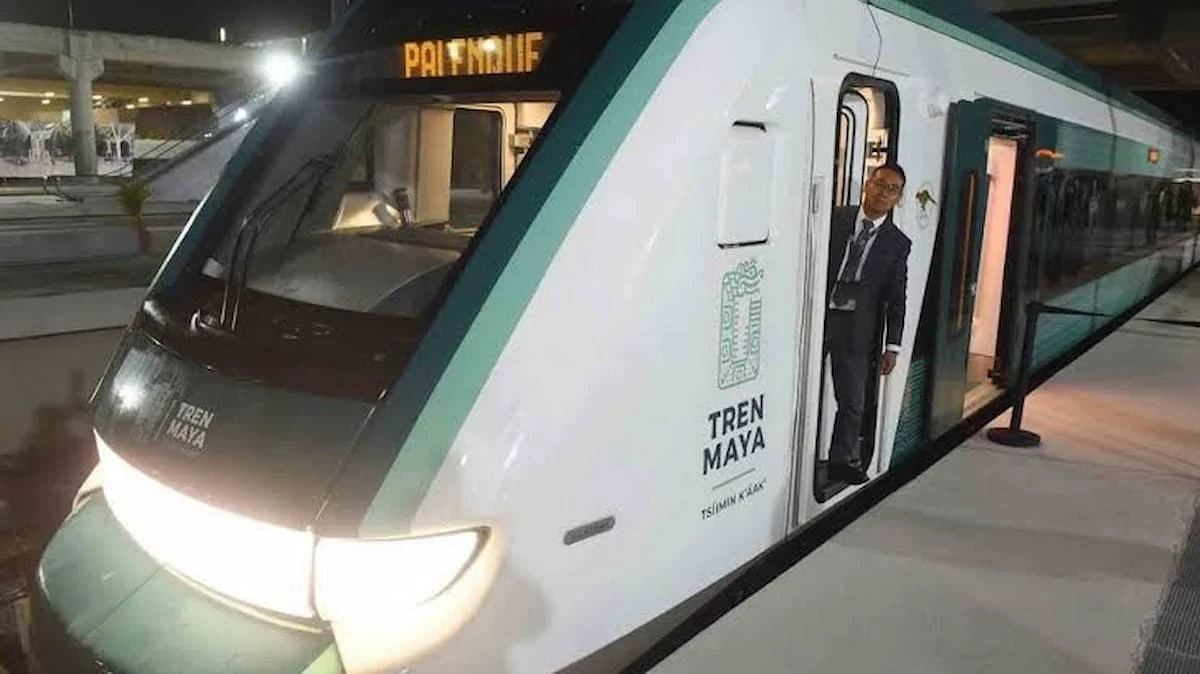
Cancún, Quintana Roo — The Tren Maya will keep requiring heavy injections of public money, according to figures in the 2027 Federal Expenditure Budget Proposal presented by Mexico’s Finance Ministry.
The proposal allocates about 18.18 billion pesos to the project for the coming fiscal year. Roughly 17.19 billion of that would go toward completing the freight branch, with the rest covering the overall operation of the rail system.
Federal Deputy Ernesto Sánchez Rodríguez of the opposition PAN party used the figure to question the project’s finances and to warn that the Tren Maya still depends on the federal budget even though it already carries passengers.
Revenue vs. Operating Costs
One of the central questions concerns the gap between what the railway earns and what it costs to keep running.
During the second quarter of 2026, the Tren Maya took in 117 million pesos from services while its operating costs reached 985 million pesos, according to the figures cited by the lawmaker. The gap between the two came to about 868 million pesos over three months.
In simpler terms, for every peso the system earned from its services during that period, it needed about 8.42 pesos to cover operating costs.
Losses in 2025 and 2026
The criticism is not limited to a single quarter. Sánchez Rodríguez said the financial statements for 2025 also showed losses for the company running the project, equivalent to roughly 9.9 million pesos a day.
The situation appears to have worsened during the first six months of 2026, when losses reached about 5.013 billion pesos, compared with 4.810 billion pesos for all of 2025.
If that trend holds through the end of the year, the six-month loss would exceed the accumulated loss for the previous twelve months.
The 2026 World Cup Factor
The second quarter of 2026 overlapped with the World Cup hosted by Mexico, the United States and Canada. The lawmaker argued the tournament represented an opportunity to boost tourism demand and, with it, revenue tied to the rail service.
Yet the figures he cited show service revenue during that quarter remained far below operating costs, renewing the debate over whether the project can generate enough income to cover what it costs to run.
Calls to Review Financial Viability
Sánchez Rodríguez argues the problem is not only about finishing outstanding construction, but about the need to keep a significant flow of public money going so the system can operate.
He points to the gap between the Tren Maya’s own revenue, its operating expenses and the new budget allocations for infrastructure, and says the federal government should review the project’s financial viability before directing more public resources toward its expansion.
The wider debate is how much public money the Tren Maya will need and for how long. On one side, work remains unfinished, including the freight branch funded in the 2027 budget. On the other, the figures cited show a considerable shortfall between service revenue and operating costs.
The challenge for the federal government will be to show whether further investment can change that picture and move the system toward greater financial self-sufficiency, or whether it will keep relying on budget allocations to sustain operations.
More Economy
- Mexico Assigns $110 Million Navy Budget to Fight Sargassum in Quintana Roo
- Mexico’s Treasury Seeks Power to Ban Cash Payments Sector by Sector
- Business Leaders Urge Playa del Carmen to Diversify Economy as Tourism Slumps
- Playa del Carmen Inaugurates Plaza Punto Sur Under Public-Private Alliance
- Hotel and Business Groups Warn 35.8% Non-Resident Fee Hike Threatens Quintana Roo Tourism