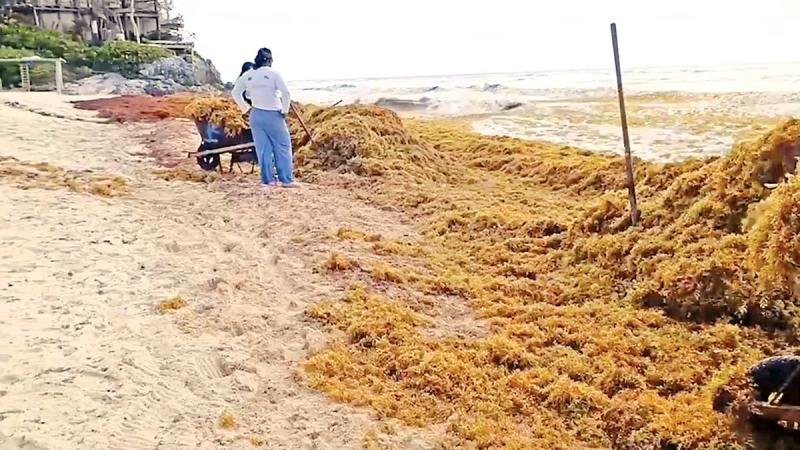
Quintana Roo, Mexico — A massive influx of sargassum has reignited alarms along the Mexican Caribbean, with rotting seaweed releasing toxic gases that pose serious health risks to residents, workers, and tourists. Recent monitoring shows that of 140 beaches under surveillance in Quintana Roo, 66 have “excessive” accumulation and 30 have “abundant” levels, while only five remain free of the algae.
Beyond the economic damage and loss of turquoise waters, the decomposition of sargassum on shorelines has triggered a public health crisis. Research confirms that rotting sargassum emits high concentrations of hydrogen sulfide and methane, causing severe health effects among cleanup workers, locals, and visitors.
“Some say their toenails fall off, they have no leg hair, some have burns… nearly half had dermatitis, headaches, and irritations,” warned Rosa Elisa Rodríguez, a researcher at UNAM’s Institute of Marine Sciences. “Some people we wanted to interview said they were resting because they felt ill,” she added.
A joint study by the University of São Paulo, the Canadian Fund, and UNAM in Puerto Morelos used specialized sensors on about 30 workers in Mahahual, Puerto Morelos, and Playa del Carmen. Results from manual collection shifts confirmed that airborne toxicity levels far exceed safe limits for human health.
“We found very high hydrogen sulfide values… the peak was 50 parts per million,” Rodríguez said, contrasting this with Mexican official standards that allow no more than one part per million over an eight-hour work shift.
The health impact on frontline workers has led to a labor exodus, as employees fear chronic and irreversible damage. “They gave me medicine to strengthen my lungs because they’re a bit weak, I think from the toxic gas this releases, but I’ll only work for a while and then retire to avoid risking my health further,” said María, a sargassum collector, reflecting the environmental catastrophe.
The crisis has deepened social and economic inequality across the state’s tourist destinations. While large hotel chains in Cancún’s hotel zone and the Riviera Maya keep beaches clean with costly barrier systems and private staff, small business owners in vulnerable communities face the disaster with little support.
“Very bad, quite bad, we lack hands, we lack tools, we are practically forgotten, and we do what we can but we need more support from the authorities,” said Jesús Hernández, manager of a restaurant in Mahahual, urging for machinery, personnel, and funds to contain the sargassum that “keeps slipping through and there’s no way to stop it.”
More Environment
- Mexican Navy Opens Youth Photography Contest on Ocean Conservation
- WHO Warns El Niño Poses Major Global Health Threat
- Hurricane Polo Hits Category 5; Five Mexican States Brace for Heavy Rain
- Isla Mujeres Fishermen Face Grouper Shortage as Catch Barely Covers Local Demand
- Cancún Officials Urge Residents to Protect Pets After Reported Puma Sighting in Cuna Maya
More Quintana Roo
- Quintana Roo Congress Ranks Among Mexico’s Least Transparent
- Riviera Maya Business Groups Push to Block 35.8% Hike in Mexico’s Tourist Entry Fee
- Quintana Roo Climbs 12 Spots to 9th in Competitiveness Index
- Sargassum Collection in Quintana Roo Tops 133,000 Tons, Setting New Record
- Quintana Roo Courts European Airlines to Boost Winter Flights to Cancún