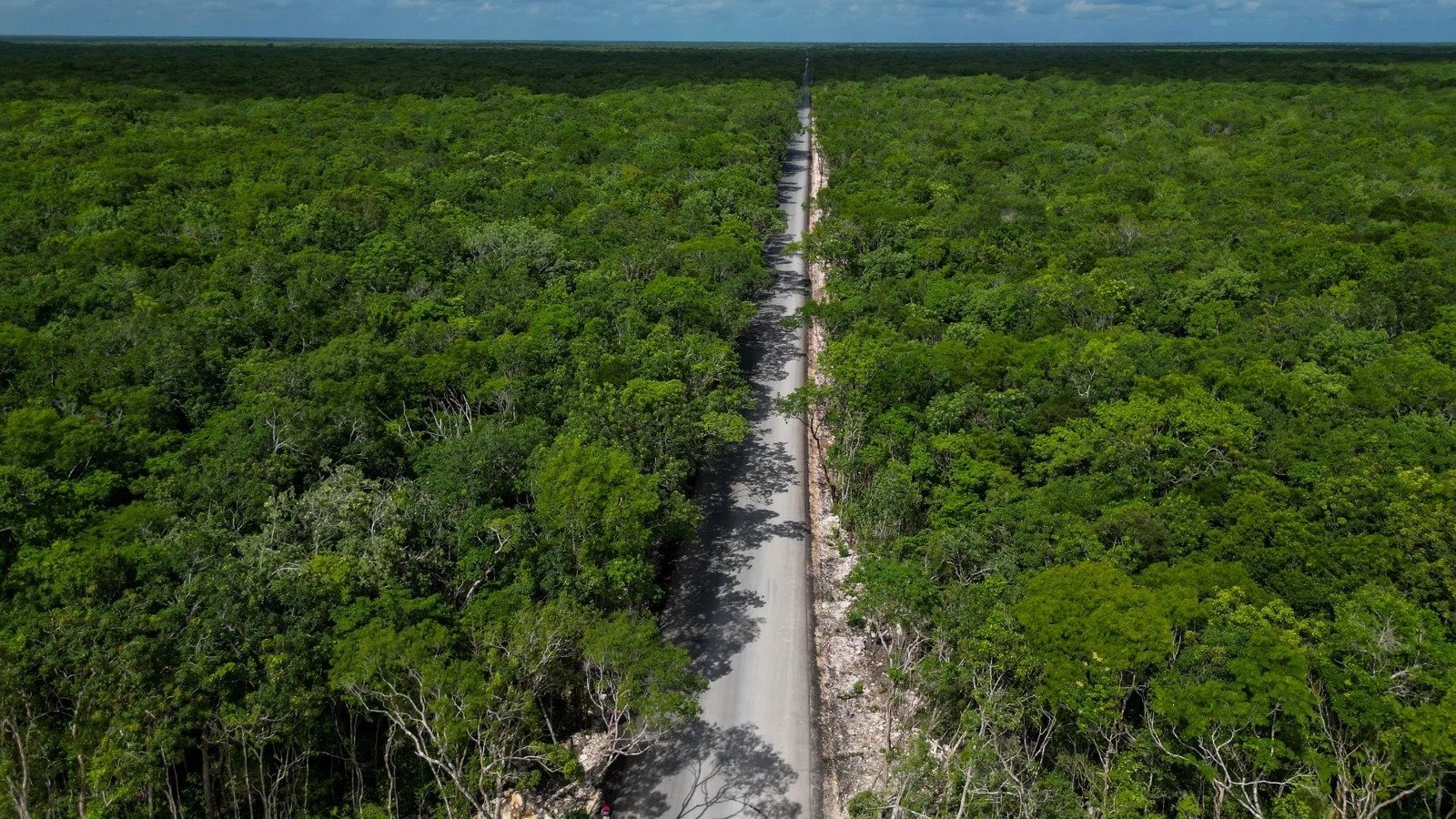
Felipe Carrillo Puerto — The "Puerta al Mar" tourist-road project, promoted by the Secretary of National Defense (Sedena) and backed by the Government of Quintana Roo, continues to advance within the Sian Ka'an Natural Protected Area, even as access to Vigía Chico remains closed by elements of the National Guard. The restriction, argued as a security measure, has been interpreted by organizations and communities as an attempt to hide the environmental impacts of a project that began without environmental authorization and that has accumulated complaints of damage to protected ecosystems.
Governor Mara Lezama Espinoza previously presented the work as a response to a "historical debt" with Felipe Carrillo Puerto. During her visit on October 18, accompanied by Sedena commanders, she assured that access to the sea "is social justice." However, behind the official discourse, contradictions accumulate: the project began in 2023 without having the environmental impact authorization from Semarnat, despite being located in one of the most sensitive biological reserves in the country.
At the Public Information Meeting convened by Semarnat on October 15, Mayan communities, fishing communities, and urban communities expressed a resounding rejection. The interventions documented the clearing of mangroves, removal of coastal vegetation, damage to habitats of protected species—such as jaguar, tapir, manatee, and sea turtles—and the total absence of prior consultation with the communities. Furthermore, it was denounced that the project violates the Reserve's Management Plan by contemplating tourist infrastructure prohibited in the core zone, including parking lots, commercial premises, a pier, and an artificial beach.
The official argument that the work will generate development and "shared prosperity" contrasts with the allegations of illegality. The technical file reveals that Sedena submitted the Environmental Impact Statement until December 2024, one year and four months after the official inauguration. By then, roads had already been opened, vegetation cleared, and basic infrastructure placed, actions that, according to specialists, constitute direct violations of Mexican environmental legislation.
The project spans more than 54 kilometers of road between Felipe Carrillo Puerto and the coast of Vigía Chico, divided into a 22-kilometer paved section and a more than 32-kilometer artisan road of hydraulic concrete. The route crosses medium jungle, an ecosystem with high biodiversity and ecological sensitivity. Although the authorities assure that there will be no damage within Sian Ka'an, the testimonies of inhabitants and organizations contradict that version. In fact, the official documents themselves recognize the change of land use in more than 1,500 hectares.
UNESCO has also expressed concern. In May 2024, it warned that any tourist or infrastructure work in a World Heritage site must guarantee the protection of its Outstanding Universal Value. The organization lamented not having received complete information on the Environmental Impact Assessments of projects associated with the Tren Maya nor of "Puerta al Mar" itself. In its 2025 report, it reiterated that Mexico has failed to deliver strategic environmental studies to evaluate the cumulative impacts in the region.
Despite these questions, the state government insists that the work will not stop. Official promises include a service zone, treatment plant, natural water passages, and alleged environmental restoration work. On a recent tour, signage and reforestation work were observed, but also an accumulation of trash, alcohol consumption on the side of the road, and an absence of preventive surveillance, elements that contradict the sustainability narrative promoted by the state administration.
Organizations and communities have formally requested that Semarnat deny the environmental authorization, arguing that the agency has a legal obligation to protect a natural protected area of international relevance. Furthermore, they recalled that Semarnat itself has already denied other Sedena projects in Quintana Roo for failing to comply with legislation.
While the work continues at an accelerated pace, access to the sea remains closed "until further notice." The National Guard maintains the blocked passage to the lighthouse area and the coast, a restriction that affects fishermen, visitors, and residents. For opponents, this measure is an unequivocal symptom that the military intervention—more than guaranteeing security—seeks to prevent the documentation of the environmental impacts that are already being generated.
The future of "Puerta al Mar" will depend on Semarnat's resolution, but the work has not stopped for a single day. Between the urgency of physical progress and the demands of an incomplete legal process, a growing tension is maintained: on one hand, a project presented as a symbol of social justice; on the other, a natural reserve facing unprecedented pressures in the name of development. The discussion is not minor: in Sian Ka'an, every opened section and every removed tree tests the integrity of one of the most valuable ecosystems in the country.
Discover more from Riviera Maya News & Events
Subscribe to get the latest posts sent to your email.