
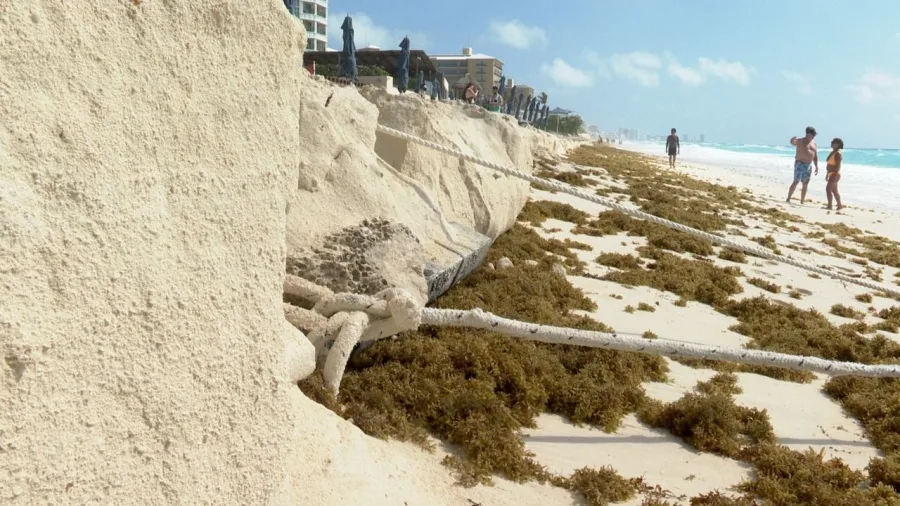
Cancún, Quintana Roo — The 2026 sargassum season has exposed a problem that extends far beyond the massive arrival of seaweed on Quintana Roo’s coasts. While authorities at all levels of government maintain continuous cleanup operations, experts and local residents say the strategy is causing accelerated beach erosion, significant sand loss, irregular disposal of the algae, and growing damage to tourism.
Esteban Amaro Mauricio, a hydrobiologist and coordinator of the Center for Environmental Monitoring and Sargassum in Quintana Roo, said the significant loss of sandy coastline is not limited to the state. It is occurring throughout the Yucatan Peninsula. “The arrival of sargassum is one of the great climate challenges facing Mexico right now,” he said.
In recent weeks, a considerable reduction in sand volume has been reported along parts of Cancún’s coastline and elsewhere in the state. Residents and tourism service providers say some areas have lost nearly half a meter of depth compared with previous seasons.
Amaro noted that the coast typically loses an average of 1.5 meters of beach per year. But with machinery now being used to remove seaweed from the beach, erosion has intensified, and in some areas the loss could reach three meters.
Guillermo Garduño Cruz, a topographer with the Federal Maritime-Terrestrial Zone and Coastal Environments Directorate of the Ministry of Environment and Natural Resources (Semarnat), said keeping an updated record of coastal land use is essential to prevent urban development from causing further damage and to verify that projects hold environmental impact authorizations.
An international study titled “Sand Loss Associated with the Removal of Sargassum Deposits on Caribbean Beaches” — carried out by academics from the Dominican Republic, Palma de Mallorca, the University of the Balearic Islands, and the University of Girona — warned that sargassum cleanup is accelerating erosion at an alarming rate on Mexican Caribbean beaches.
The study analyzed sargassum removed from 12 beaches in Mexico and the Dominican Republic, including stretches in Tulum and Cancún. It measured a total volume of 18,987.3 cubic meters of collected material, of which 61.23 percent was sand adhered to the sargassum.
That amounts to approximately 9,872 tons of sand extracted from the sea that did not make its way back to the coastal dunes, but instead was hauled away with the sargassum to final disposal sites — or in the worst cases, to landfills.
More Environment
- Sargassum Barrier Reaches Puerto Aventuras as Navy Support Takes Shape
- Why Quintana Roo’s Sewer Gap Is Polluting Cenotes and Coasts
- Hotels in Cancún and Puerto Morelos Restore Coastal Dunes With Native Plants
- Dolphin Swims Continue in Puerto Aventuras as Cancún Dolphin Debate Simmers
- Punta Allen Lobster Fishermen Report 40 Tons Three Months Into Season
More Quintana Roo
- Former Quintana Roo Tourist Police Chief Bound Over for Trial in Human Trafficking Case
- Quintana Roo Gains Power to Inspect Tourism Service Providers
- Quintana Roo Hoteliers Urge Action to Protect Mexican Caribbean Tourism Competitiveness
- Scientists Warn Sargassum and Pollution Threaten Quintana Roo’s Coral Reefs
- Cancún Loses 20 Restaurants So Far This Year, Industry Group Says