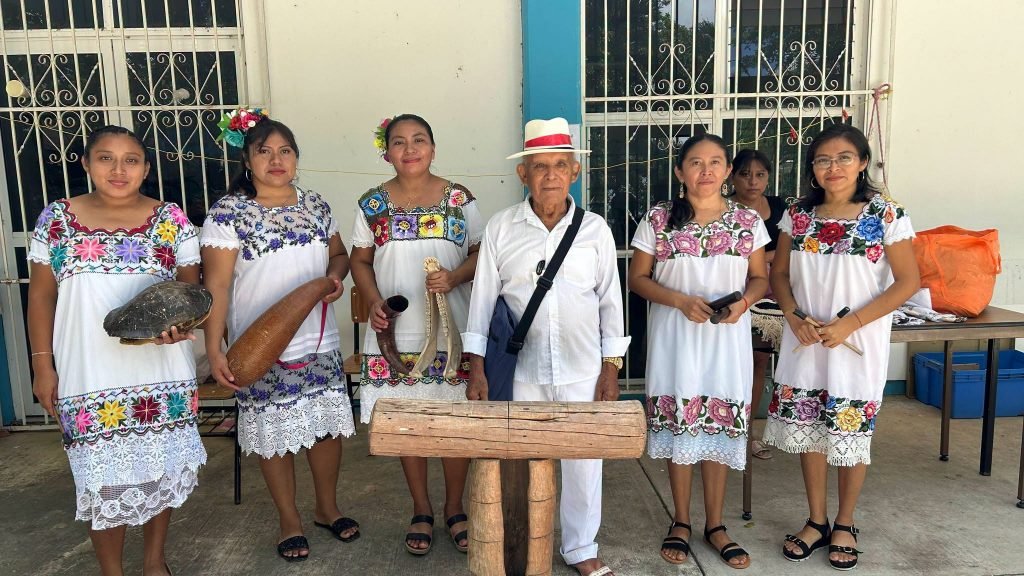
Felipe Carrillo Puerto, Quintana Roo — Isis Yareni Albornoz Chan is leading an effort from the community of Saban to preserve Maya knowledge and traditions through a tourism model in which local residents, not outside investors, decide what to share and how to share it.
Through the organization Múuch’ Talil and the Ik Lu’um network, Albornoz Chan promotes community-based tourism, a model rooted in the organization, planning and leadership of the people who live in the territory. She draws a contrast with schemes in which an investor arrives, hires a few families and presents that participation as a benefit for the entire population.
“Today there are young people who are finishing their degrees, who are becoming professionals and who come back to generate income, to show their faces and to represent their culture, even when they are told they are folklorizing it,” Albornoz Chan said in an interview.
Women and youth strengthen Maya culture
The activist, a native of Saban, said this participation offers a chance to recover knowledge that has been lost and to reinforce traditions that survive, among them Maaya Paax music, played on ancestral instruments.
She said the work builds on earlier efforts that stalled for lack of information, commitment or organization. Members now also spend their own money to take part in different forums and raise the visibility of their work.
About 60 people from Saban are involved. Between 40 and 50 of them are women, with men making up the rest. The group also includes 15 to 20 young people between the ages of 15 and 35, accompanied by adults who serve as mentors and share their knowledge and experience.
A tourism model that respects community decisions
Albornoz Chan said the group is not seeking mass tourism or buses loaded with large groups of visitors. Its proposal targets a smaller market — few people, limited impact — made up of travelers who understand the value of the culture and respect the communities.
From Saban, the youth network is pursuing agreements designed to protect local knowledge and set clear conditions for anyone who wants to work in the territory. Albornoz Chan recalled that researchers used to arrive in communities, collect information and leave without acknowledging residents’ participation.
Now, she said, the group wants dialogue first. Researchers must ask what the communities want and sign agreements setting out commitments, including handing over photographs, data and the results of their studies, and giving proper credit for work done in the territory.
The same approach applies to the promotion of the traditional Maya milpa, or farm plot. Rather than turning it into a tourism product with set prices or conventional advertising, the group shares it through experiences of shared work and learning.
“They also work the Maya milpa, they research it and at the same time they promote it, but they don’t sell it with an estimated price or tourist flyers — they share it as a communal experience,” Albornoz Chan said.
The goal is for visitors to grasp the value of the culture and of caring for the environment, so that a visit is not limited to arriving, eating and leaving, but instead builds awareness of practices that can harm what the communities protect.
The Ik Lu’um network strengthens collective work
The Saban organization is also part of the Ik Lu’um network, created by remote communities to meet, exchange knowledge and build their capacities. Each member contributes skills drawn from its own experience, and by working together the communities identify problems and design proposals to address them.
They also take part in the Maya Ka’an destination, a tourism project whose model is meant to give communities a central role in its administration and development.
For Albornoz Chan, belonging to these spaces lets communities weigh in on decisions that affect their territory. If authorities do not know their needs, she argued, they will struggle to address them.
“It is not easy to walk alone. If the government doesn’t know you, how is it going to see your needs? That’s why they bring us a pile of things that have nothing to do with us. That’s why it is important to be in these decision-making spaces, to say what it is we actually want,” she said.
More Tourism
- Los Rápidos Is Closed, but Its Operators Say Visitors Are Still Entering the Bacalar Channel
- Chetumal Hosts Free Caribbean Culture Festival With Bacilos, Los Pericos and Astrid Hadad
- Cozumel Welcomes 41.5% of Mexico’s Cruise Passengers as Industry Grows 15%
- Playa del Carmen to Host Quintana Roo International Film and Series Festival 2026
- Edith Encalada Releases ‘Contigo Aprendí’ Video, a Tribute to Armando Manzanero
More Zona Maya
- UADY Presents ‘Wáay Chivo,’ a Wordless Graphic Novel Reinterpreting a Yucatecan Legend
- Religious Divides Thwart Maya Traditions at Quintana Roo Intercultural University
- Maya Women Bring Solar Power to 29 Communities in Quintana Roo
- Solar Project Near La Presumida Raises Deforestation Fears in José María Morelos
- Puerto Morelos to Host 10th Mesoamerican Ballgame Championship