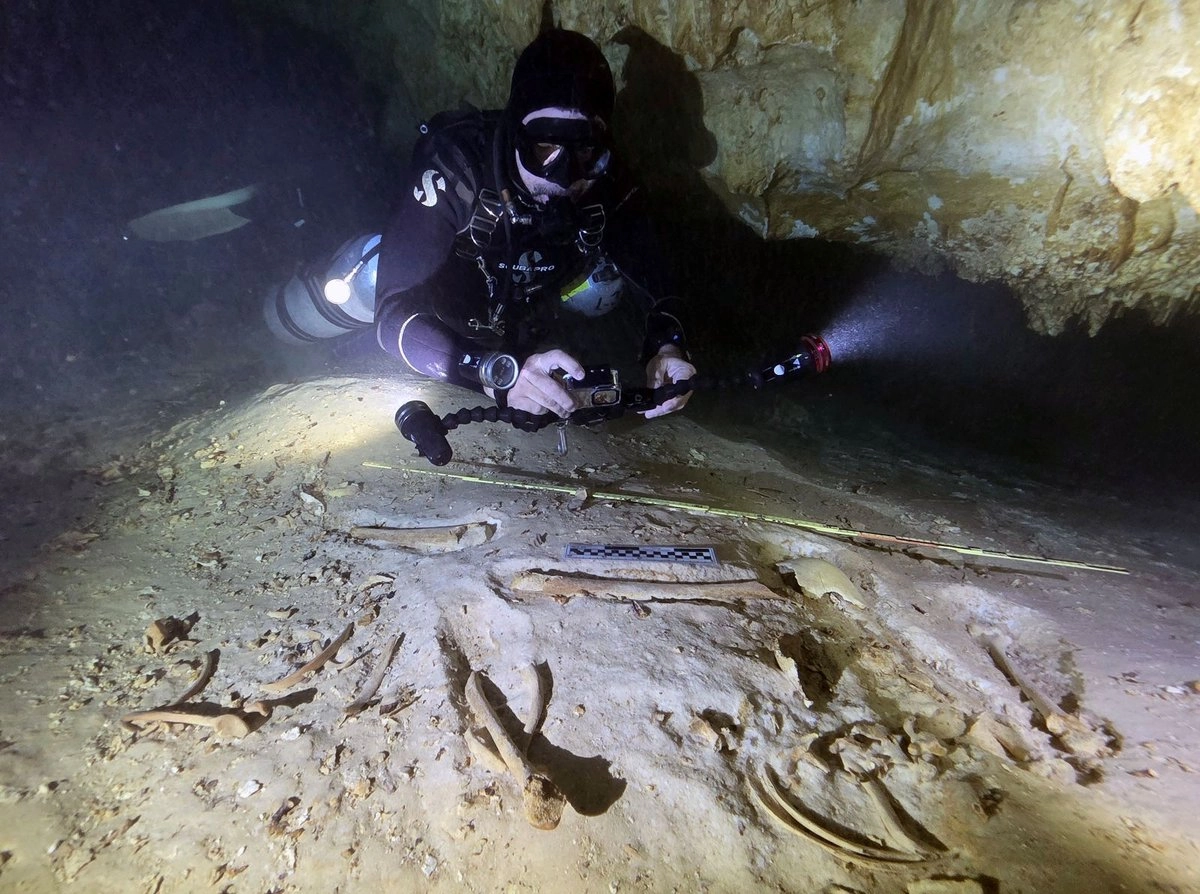
Mexico City — A human fossil reported in 2022 and recovered at the end of 2025 from the Sac Actun underground river system in Quintana Roo has been transferred to the Bioarchaeology Section of the Directorate of Archaeological Salvage in Mexico City for study. The transfer was conducted by members of the Directorate of Archaeological Studies of the National Institute of Anthropology and History.
The remains, packed in airtight boxes, were delivered to physical anthropologist Arturo Talavera González, head of the area. After preliminary observations, Talavera González determined the skeleton belonged to a male individual between 20 and 25 years old. Based on the bones, he estimated the individual's height was approximately 1.45 to 1.50 meters.
The specialist indicated that approximately 40 percent of the skeleton was recovered. This includes parts of the skull, some ribs and vertebrae, the clavicles, the right scapula, fragments of the hip bone, and long bones from the upper and lower limbs. Due to the state of preservation of the remains, a consolidation process has begun before they can be handled for detailed study.
During the same exploration, a female skull was also recovered. It will undergo osteometric studies to determine its physical characteristics and define a possible ethnic affiliation. Talavera González confirmed the skull belongs to a woman between 35 and 45 years old, who suffered from malnutrition.
Context of the Discovery
Archaeologist Luis Alberto Martos López, who serves as advisor and academic guarantor for the project, explained the context of the finds. He stated the male skeleton was located at the bottom of a cenote, 200 meters from an entrance and at a depth of eight meters underwater.
Martos López also explained that a significant amount of charcoal was found at the site, indicating it was a cavern 8,000 to 10,000 years ago. During that period, the sea level was between 20 and 30 meters below its current level. The female skull was found near another entrance to the area, at a shallow depth.
He recalled that, during that era, the Yucatán Peninsula was a vast grassland with shrubs, grasses, few trees, and megafauna. Caves therefore served as shelters for the first inhabitants. "There were hearths, which indicates that the cave was active and that, probably, when this person died, they used the chamber as a natural burial crypt, which speaks to certain beliefs and funerary rites," Martos López said.
Significance of the Research
Regarding the discovery, the federal Secretary of Culture, Claudia Curiel de Icaza, pointed out that the transfer and study of the remains represents an important advance for the investigation into the first inhabitants of what is now Mexico.
Discover more from Riviera Maya News & Events
Subscribe to get the latest posts sent to your email.