Chetumal, Quintana Roo — Quintana Roo plans to build two new wastewater treatment plants and two aqueducts to serve Cancún, Playa del Carmen and Isla Mujeres Continental, part of an effort to keep basic services in step with a wave of new residential and commercial development.
José Alberto Alonso Ovando, head of the state Secretariat of Urban Territorial and Sustainable Development (Sedetus), detailed the sanitation and drinking water projects during an appearance before the Sustainable Urban Development and Metropolitan Affairs Commission of the XVIII Legislature of the Quintana Roo Congress. He outlined the technical specifications of each project and the populations they are intended to serve.
Two Treatment Plants, 330 Million Pesos Each
In Cancún, the Mayab Wastewater Treatment Plant would be built in the northern part of the city at a cost of 330 million pesos and would benefit an estimated 1.3 million residents. The facility is designed to handle population growth in the area by expanding the coverage, conveyance and treatment of collected wastewater, while strengthening the system’s operating capacity and bringing discharges into compliance with Mexican standard NOM-001-SEMARNAT-2021, which sets limits on pollutants in wastewater releases.
In Playa del Carmen, the Playa Norte Wastewater Treatment Plant carries the same 330 million peso price tag and would serve 394,326 residents. It is projected to handle up to 600 liters per second, rolled out in four stages of 150 liters per second each.
“In the case of Cancún, the land is already secured in the Polígono Paraíso area, and in Playa del Carmen we are working with developers to locate a site in the Esmirna area so that it can go ahead. There is one at Cristo Rey, but it is very small and cannot handle the development that is coming,” the secretary said.
Both plants are classified as high priority in the department’s technical files. Officials say building them will allow wastewater treatment to expand progressively as the city’s demand grows.
Two Aqueducts for New Housing Developments
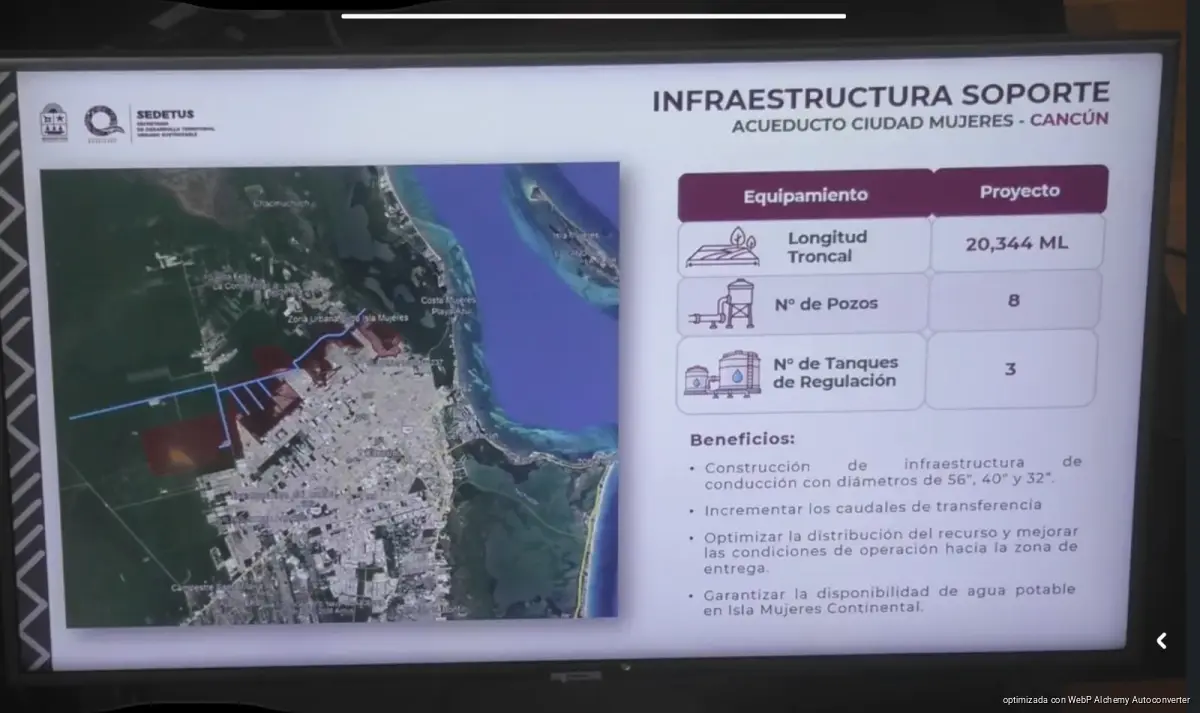
On the drinking water side, Alonso Ovando described the Ciudad Mujeres–Cancún aqueduct, which includes a 20,344-meter trunk line, eight wells and three regulation tanks. The conveyance infrastructure calls for pipes measuring 56, 40 and 32 inches in diameter, intended to increase transfer flows and improve water distribution to Isla Mujeres Continental.
In Playa del Carmen, the planned Palmanova aqueduct would have a 16,800-meter trunk line, 14 wells and one regulation tank.
“The aqueduct is meant to double the amount of water Playa del Carmen receives. Developers are paying through a trust fund set up specifically for the purpose, so it can be built under a project prepared by CAPA and Aguakán,” the secretary said, referring to the state potable water and sewerage commission and the private water concessionaire.
According to the technical file, the project would increase the system’s transport capacity to feed a key distribution node and cover drinking water demand first from new residential and commercial developments in Playa del Carmen. The regulation tank would optimize hydraulic load and maintain a steady supply at the pressure needed to serve the city’s growth.
Together, the Ciudad Mujeres–Cancún and Palmanova aqueducts involve 37,144 meters of trunk lines, 22 wells and four regulation tanks. The Mayab and Playa Norte plants are separate sanitation projects, each backed by 330 million pesos.
Alonso Ovando did not say when construction would begin.
More Development
- Tren Maya Freight Project Targets 4.7 Million Tons by 2030
- Cancún Advances Yaxchilán Revitalization With Pedestrian Corridor to Avenida Nader
- Mexico’s 911 Centers Explore AI to Speed Up Emergency Response
- Punta Allen Road Rehabilitation Reaches 80 Percent Completion
- Tulum Warns Residents of Housing Scams Along Punta Allen Road
More Playa del Carmen
- Quintana Roo Riders Resume ‘Vest Law’ Talks, No Protests
- Playa del Carmen Ranks Second in HIV Cases in Quintana Roo, Official Says
- Playa del Carmen Recognized as International Bull Shark Zone
- Five Zones in Playa del Carmen Lose Urban Jungle to Construction Boom
- Playa del Carmen to Build Tactical Operations Center to Boost Fifth Avenue Security