
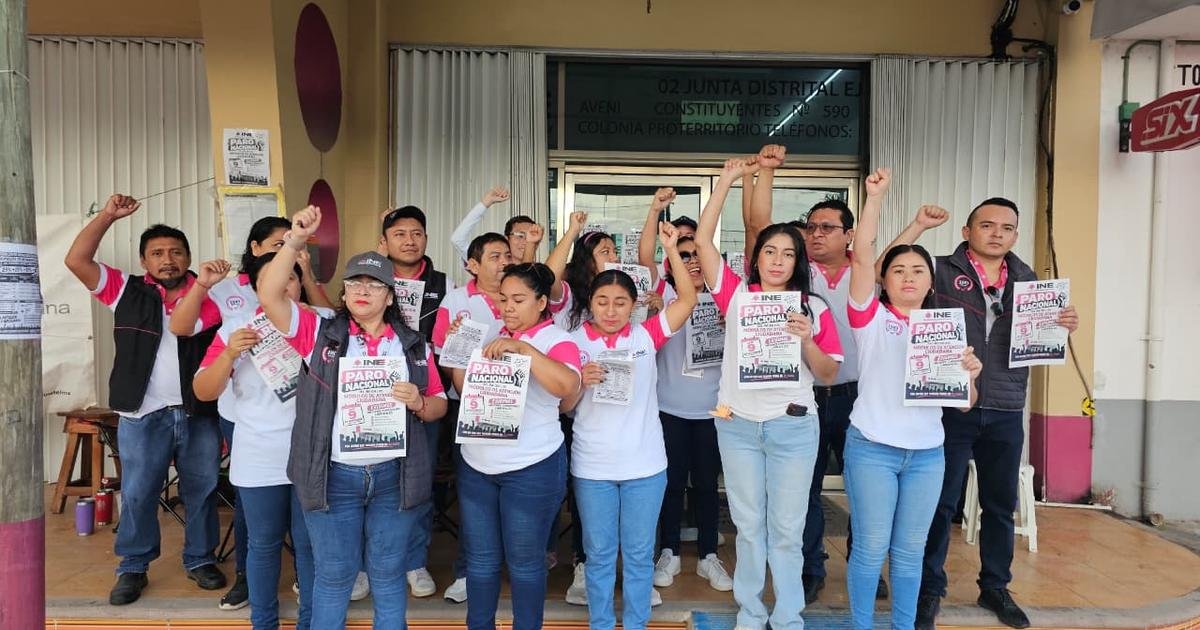
Chetumal, Quintana Roo — Citizen service modules run by the National Electoral Institute (INE) closed across Quintana Roo’s four electoral districts on Monday as about 100 workers joined a national strike to demand higher pay, recognition of their accumulated seniority and better working conditions.
The walkout came after workers were told this year’s salary increase would be just 6 percent. Module managers, assistants and technology equipment operators all took part, arguing their pay does not match the duties they perform — from reviewing official documents and protecting personal data to confirming the identity of citizens applying for a voter ID card.
Specialized work, basic shortfalls
Fernando Rafael Cortés Zúñiga, who heads the District 02 module, said the job requires specialized knowledge and carries heavy responsibility, since operators must check birth certificates and other records to rule out possible forgeries and follow protocols to guarantee the accuracy of information entered into the voter registry.
“We carry a lot of responsibility and we feel the pay we get isn’t enough for the responsibility we bear, with everything it means to handle citizens’ personal data,” he said.
Cortés Zúñiga said the wage does not match the demands of the work and that staff also lack supplies and tools. He cited the absence of basic materials, including the banners that identify each module — some of which are already torn — and said employees have only about 12 minutes to eat.
Barred from organizing
Pedro González, a technology equipment operator, said workers struggle to organize and defend their rights because they are classified as “trusted personnel,” a category that prevents them from forming a union that would formally represent their demands.
He pointed to case law holding that a worker’s classification should not depend solely on the appointment they receive but also on the functions they actually perform. On that basis, he argued, the work done by module managers and operators should be reviewed to determine whether the trusted-personnel label still applies.
“Because we work for the institute we’re classified as trusted personnel, and under that classification we can’t have a union or a permanent post, even though many of the functions we perform don’t necessarily fit that category,” González said.
He said that for years staff were hired under temporary arrangements, starting with three-month contracts that made it impossible to accumulate the time needed to qualify for certain social security benefits. They later moved to a permanent fee-based scheme, and it was not until 2024 that they were folded into the institute’s administrative branch with some labor rights recognized. That change, he said, did not resolve all their grievances, particularly the recognition of seniority accrued since they joined the agency.
Promises from 2024 still unmet
Milton Gómez, who runs a mobile module in District 02, said workers were promised in 2024 that their earlier service with the INE would be recognized, a commitment that has not been honored. He said staff began pressing for a salary increase in 2025.
As an example of the disparity, he said janitorial staff in other areas can earn 3,000 to 4,000 pesos more than module staff, even though module workers take training outside their regular hours, work weekends and travel to meet their obligations. Gómez, who said he has worked at the institute since 2011 with stretches of temporary contracts, said raises have amounted to roughly 100 pesos a year.
“It’s gone up 100 pesos a year; it doesn’t even keep up with inflation,” he said.
By contrast, he said, the INE hires temporary staff during election cycles at considerably higher rates — electoral trainers can earn around 18,000 pesos — and the institute has secured budget increases to fund those contracts. He argued that shows resources can be found when deemed necessary, and questioned why more is not allocated to improving conditions for permanent module staff. He also criticized the institute for citing budget constraints while maintaining major medical expense insurance for senior officials, whose benefits extend to their families.
Gómez said the shortages go beyond pay and affect daily operations, with modules struggling even to obtain basic materials and cleaning supplies. He called it contradictory that the INE’s General Council describes the modules as the backbone of the institution while their staff are not treated accordingly.
Wider duties during elections
Beyond processing voter IDs, Gómez said, module staff deliver notifications during election cycles, visit citizens who could serve on polling station boards, assist at electoral warehouses, help with voter education and — when other areas are short-staffed — cover those duties. In peak periods, he said, they work until the final minute of voter registration deadlines and help receive and unload electoral materials.
“The modules don’t just process voter IDs; we have different functions. When other areas are short-staffed, we’re the ones who go out and help. We’re trained, and we hope the public understands our demand: we’re not against the INE, we are part of the INE, but we want our grievances taken into account,” he said.
The workers asked the public for patience over the suspended service and urged INE’s national leadership to respond. They insisted they are not seeking privileges, but salaries in line with their responsibilities, recognition of their seniority and adequate conditions to do their jobs.
More Government
More Quintana Roo
- Quintana Roo Tourism Master Plan Shifts From Sustainability to Regeneration at 18% Completion
- Kantunilkín Opens Fair Season With Century-Old Maya ‘Primicia’ Ritual
- Quintana Roo Lobster and Mayan Octopus Reach Miami and Spain via Hotel Suppliers
- 28 Children in Quintana Roo Shelters Are Eligible for Adoption
- Cancún, Playa del Carmen and Chetumal Account for 81% of Quintana Roo’s Disappearances