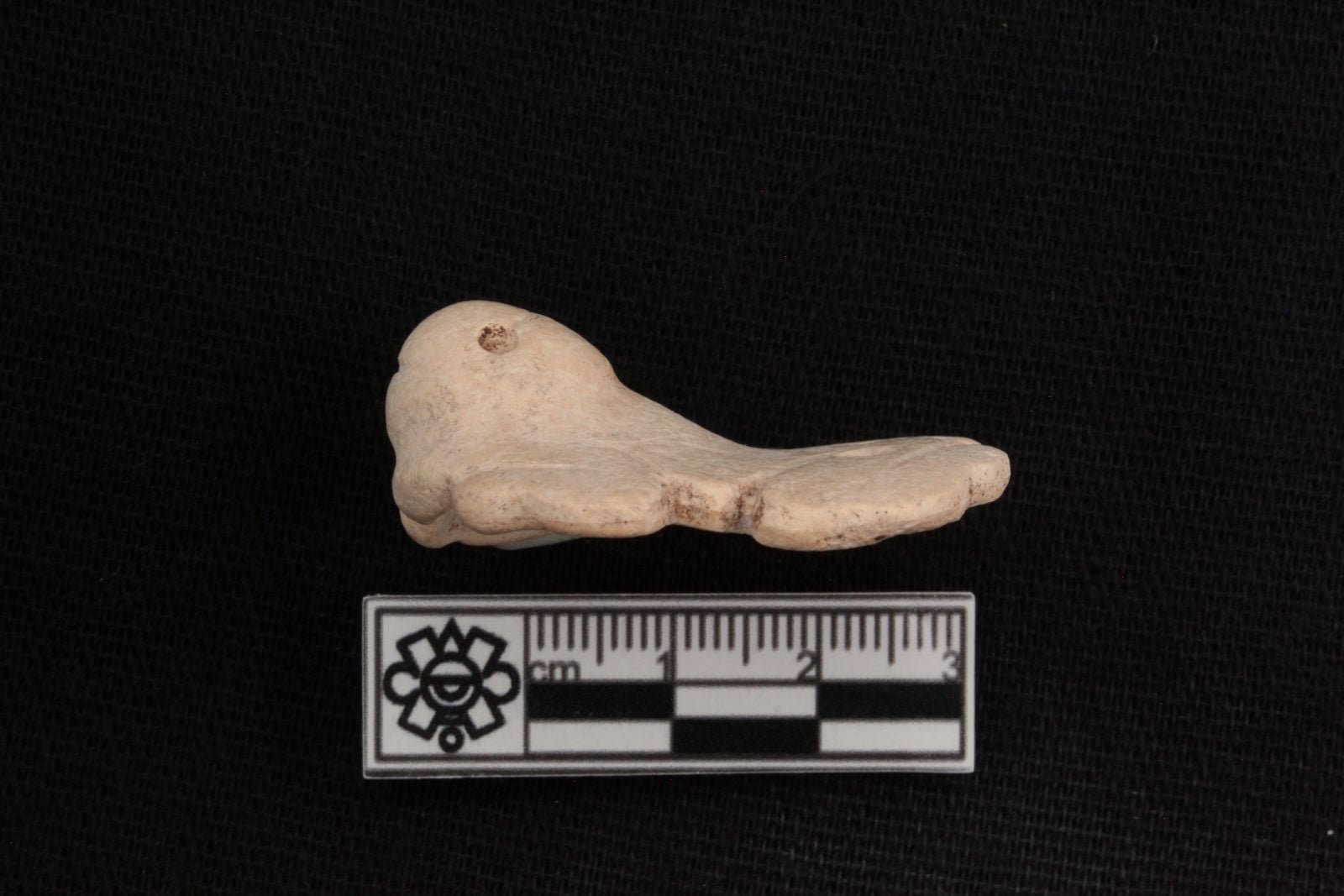
Chetumal, Quintana Roo — The analysis of 14 zoomorphic pendants recovered from funerary contexts along sections 2, 3 and 4 of the Tren Maya project in Campeche and Yucatán will deepen understanding of ancient trade networks and technological knowledge in what is now southeastern Mexico, the National Institute of Anthropology and History (INAH) announced.
The study is also expected to yield information on the distribution of raw materials, the habitats of the species depicted and the symbolism attached to the objects, which date to the Late Classic period (650–900 A.D.).
The pendants are tiny carvings of anurans — frogs and toads — cut from shell and measuring between 2 and 4 centimeters. They come from the archaeological sites of Sacamuy, Dzitbalché, Xiol, Kimbilá and Kanab.
Mexico’s Secretary of Culture, Claudia Curiel de Icaza, said the finds show how much information even the smallest artifacts can hold.
“Pieces just a few centimeters long can provide information about exchange routes, technical knowledge and the way ancient Maya communities understood their relationship with nature,” she said. “That is the value of archaeological research: the heritage we preserve is also a source of knowledge that expands what we know about our history.”
Symbols of Water and Rebirth
María Elodia Acevedo Chin, an archaeologist with the Tren Maya project’s Zooarchaeology Laboratory, said the shell material was recovered in July 2024 during archaeological salvage work carried out by INAH.
In Maya cosmology, she said, anurans were regarded as deities of water and messengers of rain, as well as beings linked to the underworld and rebirth.
“In keeping with their biological characteristics, they were venerated and depicted in fertility rites and ceremonies, sacrifices and agriculture. These objects therefore did not have only aesthetic value; they embodied the sacred bond between human beings, nature and the spiritual world,” Acevedo Chin said.
She added that shells, because of their association with water as a vital element for survival, were important in the ideology of ancient peoples and served as a marker of social status, in addition to their ritual use.
Craftsmanship and Open Questions
Because the research is ongoing, it is not yet known whether the anurans were placed in the burials of infants or adults. Researchers theorize that they may have been deposited as offerings in infant graves, since similar objects have been found in such burials in the region.
According to the specialist, published research shows that in Mesoamerica shells and snails were used to make bracelets, pectorals, armbands, ear ornaments, rings, pendants and other personal adornments, as well as musical instruments.
The pendants analyzed are made of shell with a polished finish and a channeled-incised decorative technique. All lack details on the limbs and have two conical perforations near the cloaca.
Two variants appear in the depiction of the head: one features circular rotary wear for the eyes and an incised line for the mouth, while the other uses circular wear only to indicate the eyes.
Researchers hypothesize that the face-down position of the figures refers to an image on folio 17 of the Madrid Codex, where anurans are associated with falling rain.
The sample forms part of the most diverse malacological material proposed for study, since it comes from different archaeological contexts across the Maya area. It is currently held at the Zooarchaeology Laboratory in Chetumal, Quintana Roo.
“This discovery invites us to reevaluate the exchange networks and the worldview of the communities that inhabited the region, leaving the door open for new analyses that add to what is known about the presence of zoomorphic pendants, particularly of anurans, in this area,” Acevedo Chin said.
She added that ethnographic studies could help show how the symbolism persisted over time and how it connects to the beliefs and traditions of ethnic groups in the region today.
More Culture
- Mayatek Brings Technology and AI Talks to Mérida, Entirely in Maya
- Five Finalists Chosen for Xmatkuil Fair Ambassador Contest
- Yucatecan Filmmaker Wins Ariel Award for Cliff Divers Film
- Same-Sex Marriages Nearly Triple in Yucatán as 2025 Sets an Eight-Year Record
- Tanit de María Valerio Wins Isla Mujeres Singing Contest ‘Cántale a México con el Corazón’
More Chetumal
- Chetumal Airport Customs Nears Full Operation Next Year
- Former Quintana Roo Tourist Police Chief Bound Over for Trial in Human Trafficking Case
- Quintana Roo Crews Clear 70,000 Liters of Water in Bacalar and Chetumal After Heavy Rains
- Nacional Monte de Piedad to Reopen Chetumal Branches on October 7
- Bacalar Hoteliers Push for More Flights at Chetumal Airport as Tulum Routes Shrink