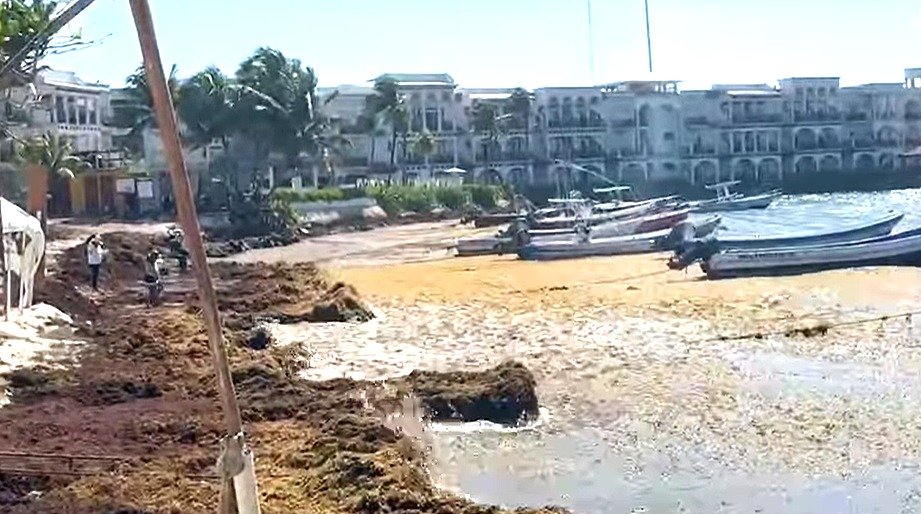
Playa del Carmen, Quintana Roo — The municipal government of Playa del Carmen plans to begin work in November to restore roughly 750 linear meters of beach between the El Recodo area and the vicinity of Calle 8, using about 5,000 cubic meters of sand recovered during sargassum cleanup.
The start of the project still depends on authorization from Semarnat, Mexico’s Environment and Natural Resources Department, which is reviewing the plan and studies on the quality of the stored material, said Irving Lili Madrigal, director of the Federal Maritime-Terrestrial Zone (Zofemat).
Madrigal said the proposal calls for recovering about 20 meters of beach width along that stretch of coastline, though the surface area and technical details of the work could change based on observations from federal environmental officials.
The sand comes from beach-cleaning operations, in which removing sargassum sometimes also pulls out sandy material. The municipality wants to return that sand to stretches where the beach has eroded, as long as it meets the required environmental conditions.
Madrigal said Semarnat personnel have already taken samples and carried out studies to determine the quality of the sand, and those results form part of the agency’s evaluation before it issues a permit.
If the project wins approval, the municipal government plans to carry out the work itself, and no outside company is currently slated to handle the restoration.
The plan goes beyond simply dumping sand back onto eroded areas, the official said. Crews would first need to study coastal dynamics, currents and shoreline conditions to determine how the material should be distributed to reduce the risk of waves washing it away again.
The goal is a longer-lasting recovery rather than a temporary replenishment, so the project includes maintenance and monitoring measures over the next four to five years.
The work remains subject to Semarnat’s review and to any technical changes the federal authority may require before granting authorization.
More Environment
- Bull Shark Diving Hits Carrying Capacity in Playa del Carmen
- Federal Court Halts Macondo Playacar Construction, Voids Building Permit
- Yucatán Peninsula Lost 285,580 Hectares of Jungle in 4 Years
- Quintana Roo Crews Clear 70,000 Liters of Water in Bacalar and Chetumal After Heavy Rains
- Yucatan Drafts Rules for Artificial Lakes After Worker Dies of Amoeba Infection
More Playa del Carmen
- Tropical Wave 36 Floods Northern Quintana Roo, Hits Tourism
- Police Rescue Mother and Son From Playa del Carmen House Fire
- Technical Study Advances for Quintana Roo’s Grand Subterranean Rivers Reserve
- Playa del Carmen to Spend 66 Million Pesos on Fifth Avenue and Road Repaving
- Business Leaders Propose Autonomous Committee to Run Quinta Avenida Trust