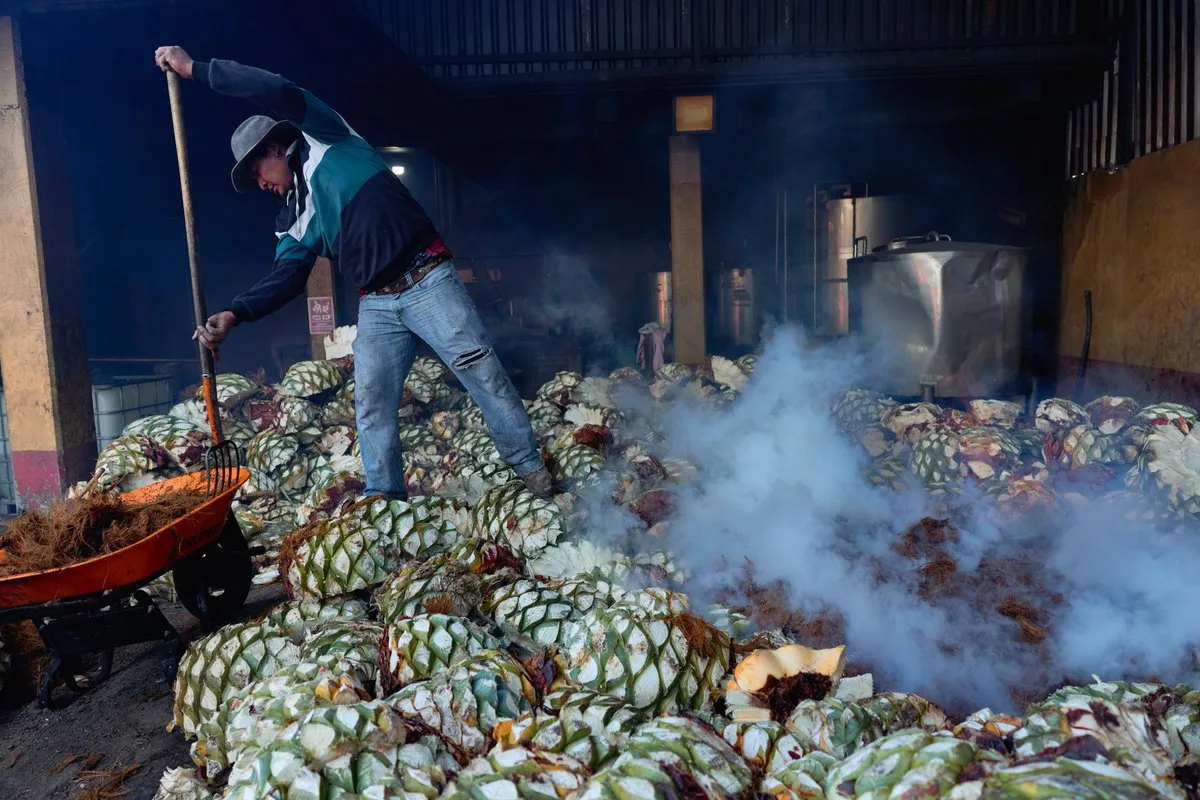
San Pedro Totolápam, Oaxaca — Thirty years ago, a single light bulb illuminated the family mezcal distillery of Gladys Sánchez Garnica in rural Oaxaca, where the agave spirit was distilled through the night. As drops slowly fell from a clay oven, Garnica and her siblings listened to their parents tell stories while neighbors arrived on horseback to sample the smoky-flavored drink.
“They taught us when to harvest agave, how to care for the land, and how much we could ask of the mountain,” said Garnica, 33, from a women-run distillery in San Pedro Totolápam, a town of just over 3,000 people in Oaxaca’s Central Valleys, where much of the economy depends on mezcal.
Today, that small tradition coexists with a global boom that has transformed mezcal into a multibillion-dollar industry dominated by international brands. As mezcal has spread to bars worldwide, so has its environmental footprint across the landscape.
Along the highway leading to communities like San Luis del Río, where celebrity-backed brands such as Dos Hombres—created by actors Bryan Cranston and Aaron Paul of Breaking Bad—are produced, vast agave plantations now cover hillsides that were once forest. While the boom has brought economic benefits for many local producers, it has also had increasingly visible environmental consequences.
More Popularity Means More Production
Production in Mexico has risen from 1 million liters in 2010 to over 11 million in 2024, according to the Mexican Council for Mezcal Quality Regulation (Comercam). Nearly all is produced in Oaxaca, but less than 30% stays in the country. About 75% of exports go to the United States.
More than 34,953 hectares of tropical dry forests and pine-oak forests have disappeared over the past 27 years to make way for agave cultivation—an area roughly equivalent to the size of the Mexican city of Querétaro, according to a study led by Rufino Sandoval-García, a forestry engineer and professor at the Technological University of the Central Valleys of Oaxaca.
The study also found that agave plantations have expanded over 400% in the last three decades, increasingly replacing forests and agricultural land with a variety of agave known as espadín, used in most commercial mezcal.
The loss of native forests is accelerating soil erosion and reducing carbon capture by more than 4 million tons per year in the studied area. It is also limiting the soil’s ability to retain water and creating heat islands in areas with high concentrations of crops.
“It will take a long time for the ecosystem to recover the resilience it had,” Sandoval-García said.
Mezcal Production Has Always Been Intensive
One liter of mezcal can require at least 10 liters of water for fermentation and distillation processes, in addition to generating waste such as bagasse and vinasse—acidic residues often dumped untreated into rivers. A large amount of firewood is also burned to roast agave pineapples and fuel distillation, much of which comes from illegal logging, according to Sandoval-García.
As industrial production increases, so does the extraction of wild agave species without proper management, raising alarms among researchers about the risk of biodiversity loss.
For generations, the environmental impact of this drink remained limited thanks to the small scale of production and the ability of forests and soils to recover. That balance, however, is now fragile.
Félix Monterrosa, a third-generation producer from Santiago Matatlán and owner of the Oaxacan brand CUISH, explained that the industrial mezcal boom displaced the milpa system he learned from his ancestors, in which corn, beans, and squash were cultivated alongside agave.
“Now everything is monoculture, and that’s the real problem,” Monterrosa said. In his town, decades of dumping mezcal waste into the river have left it so polluted that residents nicknamed it the “Nilo,” short for “ni lo huelas” (don’t even smell it).
Monterrosa now plants wild agaves alongside corn and trees to restore biodiversity, though he acknowledges that maintaining this system on a large scale remains a challenge.
Water is also a growing concern in Oaxaca, which in 2024 suffered its worst drought in over a decade, according to Mexico’s National Water Commission.
Armando Martínez Ruiz, a producer in Soledad Salinas who sells his mezcal to the Mexican brand Amarás, installed a system to cool and reuse water during distillation.
“We’ve never had enough water here, so I try not to waste it,” he explained.
Tension Between Sustainability and Profitability
While major beverage companies highlight their sustainability commitments, their contracts with distilleries—often through third parties—typically involve bulk mezcal purchases. Producers say these agreements rarely cover the costs of raw materials, worker wages, or distillery maintenance.
Del Maguey, one of the world’s top-selling mezcal brands, says it is working to reduce its environmental footprint by planting trees. Over the past five years, the company reused over 5,000 tons of bagasse and 2 million liters of vinasse to build an elevated platform at a distillery in San Luis del Río to prevent flooding and pollution, according to its Sustainability Manager, Gabriel Bonfanti.
For many, the prosperity brought by the mezcal boom is a lifeline in a region where poverty levels remain among Mexico’s highest.
Luis Cruz Velasco, a producer from San Luis del Río who works with Mexican brands like Bruxo, says the industry’s growth has created jobs for nearly every family in his town of about 300 people. Where previous generations lived in palm-roofed houses, mezcal income has allowed his siblings to attend university.
“Many people criticize us and ask what we’re doing to reforest the forest, and yes, we know it affects it,” Velasco said. “But we have to seek sustenance and food,” he added.
For Velasco, the problem is not the arrival of big brands, which he says have done more than the government to support marginalized areas like his, but the lack of public incentives for farmers to protect the environment—whether by planting native trees or maintaining traditional milpa systems.
In Oaxaca, much of the land is communally owned and managed through local self-governance systems. Converting forests into agave plantations requires federal approval from Mexico’s Secretariat of Environment and Natural Resources (Semarnat).
The process for obtaining permits is so slow and bureaucratic that some communities choose to bypass it, explained Helena Iturribarría of Tierra de Agaves, a group working on reforestation in Oaxaca’s valleys and promoting more sustainable agave production.
Semarnat, responsible for issuing permits, said it has not received any applications to clear forests for agave cultivation in Oaxaca over the past three years. The agency also noted it is investigating nine public complaints filed since 2021 regarding illegal deforestation linked to mezcal production.
Seeking Ways to Protect the Land
In 2018, Garnica founded a women’s collective called Guardianas del Mezcal. The group promotes mezcal production by women using sustainable practices, such as using only fallen tree wood for firewood and planting agave in designated areas.
With help from Tierra de Agaves, Guardianas del Mezcal and local communities in Santa María Zoquitlán secured protected status for 26,000 hectares of forest around the municipality.
“It’s sad how the geography and nature of the region change in exchange for the wealth of people who aren’t even from here,” Garnica said. “Mezcal is a way of life, a way of work that our parents taught us, so it means a great deal.”
Discover more from Riviera Maya News & Events
Subscribe to get the latest posts sent to your email.