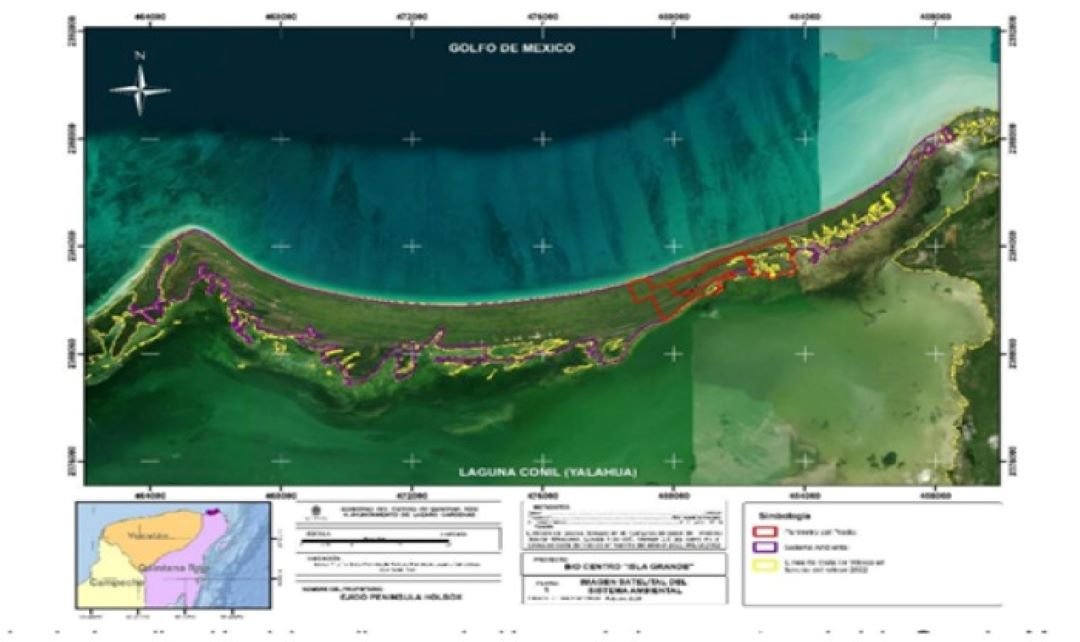
Holbox, Quintana Roo — Mexico’s Secretariat of Environment and Natural Resources (Semarnat) has denied an environmental impact permit for a proposed eco-hotel on Isla Grande, the larger portion of Holbox Island, citing violations of protected area regulations and a 2025 wildfire that legally restricts land-use changes for 20 years.
The project, named “Biocentro Isla Grande,” was submitted by Pradesa, S.A. de C.V., a steel trading company, and promoted by Iván Mendoza Téllez. It sought to build 49 stilted palafito cabins, along with pools, restaurants, bars, and utility infrastructure, on a 331-hectare (818-acre) site within the Yum Balam Flora and Fauna Protection Area. The total investment was estimated at $4 million (about 72 million Mexican pesos).
Semarnat’s Directorate of Environmental Impact and Risk (Dgira) issued the denial after determining the project violated density and intensity limits established for the protected area. The resolution also noted that the property suffered a wildfire in September 2025. Under Article 97 of the General Law of Sustainable Forest Development (LGDFS), no land-use change may be authorized on forest land where tree cover was lost due to fire, logging, or clearing for at least 20 years.
“Once the MIA-R was evaluated, this Dgira confirmed that there are legal and technical grounds to deny authorization for the project, since it contravenes legal provisions regarding densities, intensities, conditions, and modalities to which works and activities within the Yum Balam ANP must adhere,” the resolution states.
Holbox Island is divided into two sections — Isla Chica and Isla Grande — separated by the Kuka and Santa Paula river channels, which connect the Gulf of Mexico to the Conil Lagoon (Yalahau). The project site, an irregular polygon on Isla Grande, borders federal zones adjacent to the Gulf and the lagoon.
The proposed development was planned in two stages over five years, with a projected lifespan of 90 years. It included water supply and sanitation systems, wastewater treatment, waste management, laundry, electricity generation, and supply warehouses.
Semarnat warned the company that it cannot cut even a single mangrove branch without the proper environmental authorization. “Until it obtains the respective environmental impact authorization, it may not carry out any work or activity related to the project, and if it does, it will be subject to the sanctions established by the LGEEPA and other applicable legal provisions,” the agency said.
Last week, Mexico’s Official Gazette published a decree removing 63 parcels from the Yum Balam protected area, following a legal challenge by local ejido (communal land) holders. The project promoter has indicated it may resubmit its application in light of this change.
More Development
- Cozumel Submarine Power Cable to Be Installed Oct. 5 After 40-Year Wait
- Cancún’s Second Government Report Cites 995.9 Million Pesos in Public Works as Residents Question Results
- Playa del Carmen Beach Restoration Clears Environmental Hurdle, Mayor Says
- Bidding Process to Define Renovation of More Than 10 Parks in Playa del Carmen
- Quintana Roo Climbs 12 Spots to 9th in Competitiveness Index