
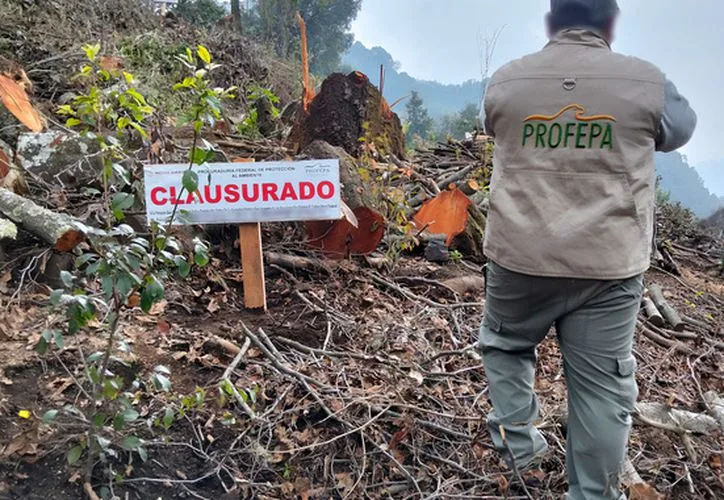
Cancún, Quintana Roo — Mexico’s environmental enforcement agency is escalating its fight against illegal deforestation in Quintana Roo, deploying a strategy that includes immediate closures, machinery seizures, permit revocations, and a novel agreement to freeze land rights of properties tied to clandestine clearing.
The Federal Attorney’s Office for Environmental Protection (Profepa) announced the measures as part of a collaboration with the National Agrarian Registry (RAN). Under the agreement, Profepa will cross-reference databases in real time to instantly suspend the agrarian rights of ejidos — communal landholdings — where unauthorized clearing is detected.
The move aims to permanently block the regularization of illegally sourced timber and halt unauthorized land-use changes, particularly in the central and southern regions of the state.
New Enforcement Tools
José Funes Izaguirre, head of Profepa’s Quintana Roo office, said the initiative follows a directive from federal prosecutor Mariana Boy Tamborrell to take a tough stance on forest loss.
“The prosecutor instructed me to give special treatment to unauthorized deforestation, a problem that is widespread in the center-south of the state,” Funes Izaguirre said. “This gains strength because a few months ago, in Bacalar, the National Prosecutor’s Office and the National Agrarian Registry signed an agreement to link Profepa’s rulings when ejidos seek to regularize land.”
The mechanism prevents agrarian communities from obtaining legal certainty if they have been complicit in or negligent about environmental violations.
“If an ejido sold land to a group that is clearing without authorization, the agrarian authorities will impose obstacles to that regularization, linked to the Prosecutor’s rulings,” Funes Izaguirre explained. “This is unique; it has never been done before.”
Although the agreement applies nationwide, it was formally launched in the southern zone due to the vulnerability of its ecosystems and the pressure from various activities on the jungle. Funes Izaguirre noted that the prosecutor chose to sign in Bacalar because of the high deforestation in the area, where at least 30,000 hectares have historically been cleared by the Mennonite community.
More Environment
- Riviera Maya to Host Aquaponics Congress With Experts From More Than 10 Countries
- Isla Mujeres Seeks Volunteers to Rescue Blue Crabs on September 28 and 29
- Playa del Carmen Fire Calls Rise 4% on Carelessness and Uncontrolled Burns
- Cozumel Releases Nearly 7,000 Sea Turtle Hatchlings in 2026 Nesting Season
- Semarnat Rejects 954-Room Megahotel at Punta Maroma in Playa del Carmen
More Quintana Roo
- New Quintana Roo Press Group Leader Calls for Consensus Journalist Protection Law
- Vehicle Theft in Quintana Roo Falls 24% as Motorcycles Account for 77% of Cases
- UQRoo Cancún Union Workers Allege Rigged Election, Demand Full Rerun
- Quintana Roo Artisans Win Dedicated Law to Protect and Promote Their Craft
- Mundo Maya Nations Agree on Multi-Destination Tourism Route