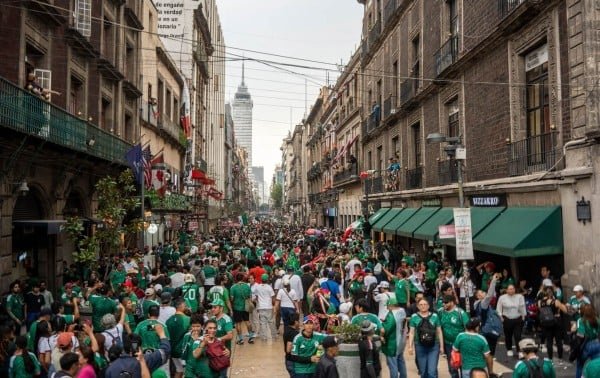
Mexico City — Mexico is betting that the World Cup and what officials call the “Trump effect” will help it break into the top five most visited countries in the world, as the nation posts record tourism numbers while the United States sees a decline.
Mexico received a record 48 million overnight tourists last year, a 6 percent increase that surpassed its pre-pandemic high of 45 million in 2019. The growth comes as the United States, under President Donald Trump, has tightened visa policies and imposed new fees, causing a 6 percent drop in foreign visitors to 68 million — the only decline among the six most visited countries, according to UN tourism data.
“We set a very ambitious goal,” President Claudia Sheinbaum said earlier this year about her administration’s target to make Mexico the fifth most visited country by the end of her term in 2030. Currently, Mexico ranks sixth, behind France, Spain, the United States, Italy and Turkey.
The joint World Cup hosted by the United States, Canada and Mexico — the largest in history with 104 matches and 48 teams — is a key driver. Mexican authorities estimated that 5.5 million people would visit the country during the six-week tournament, generating billions of dollars in economic activity. Mexico’s final match is Sunday in Mexico City against England.
“Mexico maintains its position as a friendly country to the world,” said Gabriela Cuevas, the Mexican government’s representative for the World Cup.
Since Trump took office in January 2025, his administration has made travel to the United States more difficult with higher fees, visa hurdles and aggressive rhetoric toward certain countries. Mexico has capitalized by easing entry for citizens of select nations, particularly from Latin America.
“You go where you are treated well,” said Josefina Rodríguez Zamora, Mexico’s tourism secretary, noting a 9 percent increase in Canadian visitors, who appear to be boycotting U.S. travel amid tensions with the Trump administration.
For the first time, the busiest international route to Mexico was not from a U.S. city but from Canada: the Toronto-Cancún flight surpassed Dallas-Cancún last year, and Montreal-Cancún flights have increased significantly.
Mexico has also simplified entry for Colombians, reducing the visa rejection rate from 8 percent to 2 percent. Colombia, with 54 million people, is Mexico’s third-largest tourism market. During the group stage, Colombia played two of its three matches in Mexico.
Erika Leon, 47, and Orlando Pérez, 57, bankers from Bogotá, said they were worried about the scrutiny other Colombians had described before the World Cup, but found entry easy. “Everyone was very friendly,” Leon said. Neither had a U.S. visa nor wanted one, preferring Mexico over the United States, where the Trump administration has tightened visa requirements and even demanded bonds of up to $15,000 from some visitors.
Ahmed Ben Dahmen, 32, a Tunisian IT worker from Montreal, traveled to Monterrey, Mexico, to watch his team’s first two matches and boycotted the third in the United States. “If President Trump doesn’t want to see Tunisians or Colombians, then we don’t go,” he said, adding that he was happy to spend his money in Mexico instead.
Some fans cited lower costs. Carlos Londoño Garcés, 58, a lawyer from Medellín, said his $3,000 ticket to see Colombia play in Miami cost twice as much as his ticket for the first match in Mexico.
To facilitate travel, Rodríguez Zamora said the government has been digitizing the visa application process. In February, Mexico reinstated an electronic visa for Brazilians, allowing air travelers to apply online in advance, unlike the United States, which requires a physical visa.
She expressed hope that Latin Americans whose teams play in the United States would instead gather at large viewing parties across Mexico. “They will visit us before going to the United States,” she said. “The Latin market is waiting to experience a party, and they will find that in our country.”
Not everyone shares her optimism. Enrique de la Madrid, a former tourism secretary and opposition party member, called the World Cup an “extraordinary” opportunity but a one-time event. He noted that Sheinbaum’s predecessor had eliminated a major tourism promotion agency, and that the number of foreign visitors arriving by air — who spend more than those crossing by land — fell slightly last year. Several host cities have lowered their expectations for hotel occupancy and visitor numbers.
To displace Italy or Turkey from the top five, de la Madrid said, Mexico would need to attract 12 million more visitors annually. “We won’t reach fifth place if we don’t put in the money and strategy that other countries do,” he said.
Security remains a concern. After security forces killed a major cartel leader in February and cartel members responded with a brief wave of violence, tourism suffered a momentary setback. Authorities quickly moved to reassure visitors. Sheinbaum has repeatedly highlighted a decline in the national homicide rate during her administration.
Rodríguez Zamora said the government will continue working on security and its perception. She expects the World Cup to help, especially with foreign visitors. “They wouldn’t come if they had a bad experience,” she said. “Quite the opposite.”
More Tourism
- Hotels in Cancún and Puerto Morelos Restore Coastal Dunes With Native Plants
- Quintana Roo Gains Power to Inspect Tourism Service Providers
- Quintana Roo Hoteliers Urge Action to Protect Mexican Caribbean Tourism Competitiveness
- Dolphin Swims Continue in Puerto Aventuras as Cancún Dolphin Debate Simmers
- Tulum Airport International Traffic Plummets as Aeroméxico and Volaris Halt Flights