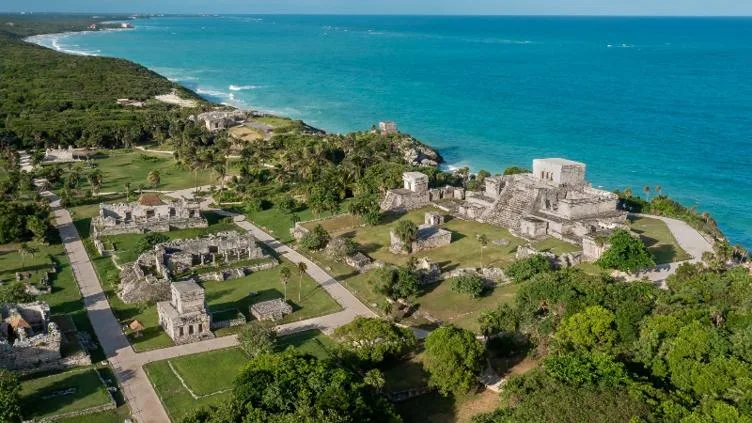
TULUM, Quintana Roo — The federal government has formally published the new entry fees for Parque del Jaguar, Tulum National Park and the Tulum Archaeological Zone, making official a set of reductions and exemptions announced during President Claudia Sheinbaum’s recent visit to Quintana Roo.
The decree, published in the Diario Oficial de la Federación, takes effect July 20, 2026, and will apply during fiscal years 2026 and 2027. It establishes free access to Parque del Jaguar for Mexican citizens, a reduced fee for foreign visitors, and a unified ticket for the Tulum National Park and archaeological zone.
Under the new structure, Mexican citizens will enter Parque del Jaguar free of charge, while foreign visitors will pay 100 pesos. For those visiting both Tulum National Park and the Tulum Archaeological Zone, the government created a single combined payment of 80 pesos for Mexican visitors from Monday to Saturday and 165 pesos for foreign visitors.
The decree breaks that combined ticket into two parts. For Mexican visitors, the 80-peso payment consists of 30 pesos for Tulum National Park and 50 pesos for the archaeological zone. For foreign visitors, the 165-peso payment consists of 65 pesos for Tulum National Park and 100 pesos for the archaeological zone.
The new pricing is part of the federal government’s response to months of complaints over high costs and complicated access around Tulum’s beaches, archaeological zone and Parque del Jaguar. The decree states that the overlapping fees charged for natural protected areas and the archaeological zone had become an economic burden for visitors, particularly foreigners, and that the reduction is intended to encourage visitation, strengthen Tulum’s competitiveness and support regional economic activity.
For residents of Tulum municipality, the change is more significant. People who can prove they live in Tulum will receive a 100 percent fiscal credit for the rights normally charged for Tulum National Park and the archaeological zone, meaning they will not pay to enter those areas.
The decree also preserves existing free-entry categories already recognized in federal law. These include minors, older adults, people with disabilities, pensioners, retirees, teachers, students and accredited federal tour guides working in their professional capacity. Members of Indigenous communities in neighboring municipalities are also exempt under the established requirements.
Additional exemptions apply to certain people whose work or residence is tied to the protected areas, including workers carrying out authorized activities inside the area, crews of nautical and aquatic recreation vessels, public and cargo transport, vehicles passing through paved roads, and permanent residents of communities inside, adjacent to or within the area of influence of the protected natural areas who are carrying out non-profit recreational activities.
Sunday access also changes. Mexican visitors will enter Tulum National Park free of charge on Sundays, while Mexican citizens and foreign residents of Mexico can visit the Tulum Archaeological Zone free on Sundays, consistent with the existing national policy for archaeological sites and museums.
The decree also clarifies the federal framework behind the fees. Tulum National Park was decreed in 1981 to protect 664.32 hectares of ecosystems and natural resources. The Jaguar Flora and Fauna Protection Area was created in 2022 with a surface area of 2,249.71 hectares. The Tulum-Tancah Archaeological Monuments Zone was declared in 1993 to protect one of the most important Maya settlements on the Caribbean coast from the Late Postclassic period.
Parque del Jaguar brings several of these areas together as a combined conservation, cultural and recreational space. The federal decree describes it as integrating Tulum National Park, the Mexican Caribbean Biosphere Reserve, the Jaguar Flora and Fauna Protection Area and the Tulum archaeological zone, with the goal of protecting natural and archaeological heritage while supporting sustainable tourism.
The new prices follow Sheinbaum’s broader Tulum Renace announcements, which also included free public beach access, improvements to park entrances, an eco-friendly parking area at the southern access point, expanded visitor facilities and a promotional campaign to bring more tourists back to Tulum.
For visitors, the most practical change is that the cost structure should become easier to understand. Instead of facing multiple overlapping charges, visitors entering the archaeological zone and national park will make a single payment, while those going only to the beaches through Parque del Jaguar are expected to have free access, paying only for optional internal transportation if they use it.
The real test will be implementation. Tulum’s access problems have often been less about what the law says and more about what visitors encounter at gates, parking areas, beach paths and ticket counters. The publication of the decree gives residents, tourism operators and visitors a formal reference point for what should be charged, who should enter free and when the new rules apply.
More Culture
- Children’s Drawings on Climate Change Take Center Stage at Cancún Environmental Art Exhibition
- Maya Women in Mérida’s Outlying Communities Launch Stingless Beekeeping Projects
- Independent Theater Brings Two New Productions to Cancún in November
- Mayan Myth Play ‘Los Niños de la Lluvia’ Comes to Cancún in Free Staged Reading
- Cancún to Host National Climate Change Colloquium Blending Art and Science
More Tulum
- Quintana Roo Tourism Falls 7% as Cancún and Tulum Airports Lose 800,000 Visitors
- Mexican Caribbean Destinations and Resorts Win Across 2026 World Travel Awards
- Why a Councilman Wants Tulum Out of the Airport’s Name
- Zamna Tulum 2027: Dates, Lineup and Ticket Details
- Cancun Tourism Slumps 7% as Industry Leaders Urge Marketing Overhaul