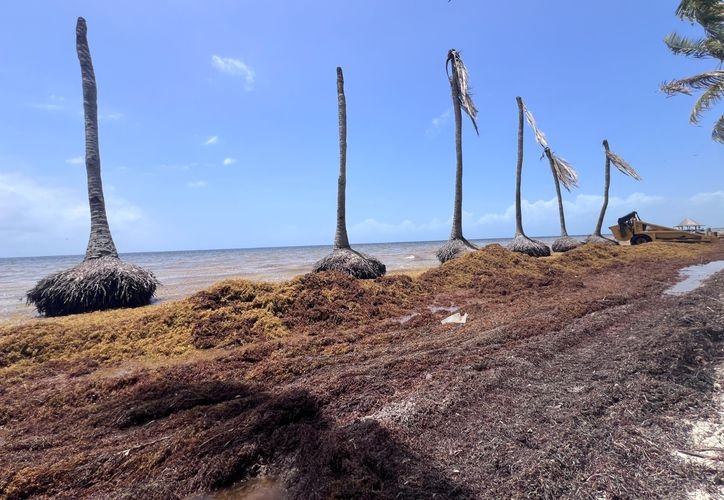
Cancún, Quintana Roo — A French-funded international initiative will be launched in Cancún on Sept. 29, 2026, bringing together scientists and officials from Mexico, Cuba, the Dominican Republic and France to coordinate a regional response to the growing problem of sargassum in the Caribbean.
The project, known as CARIBS — formally the France Team Fund: Regional Cooperation for Sargassum Management and Capacity Building in the Caribbean Basin — will be introduced during the Sargassum Cooperation Days, an international event scheduled to run from Sept. 28 to 30 in Cancún.
Financed by France’s Ministry for Europe and Foreign Affairs through its embassies in Mexico, the Dominican Republic and Cuba, the initiative is implemented in Mexico by the French National Research Institute for Sustainable Development (IRD). Scientific responsibility and technical coordination are led by the Center for Research and Advanced Studies (Cinvestav) in Mérida.
Erika Vázquez Delfín, the project’s lead researcher in Mexico, said the strategy focuses on three main objectives: improving monitoring tools and expanding them to understudied areas; developing proposals for sustainable uses of sargassum; and promoting ocean culture and community participation through citizen science.
To support the work in Mexico, organizers have brought together a network of academic institutions, including Cinvestav Mérida’s applied phycology, coastal processes, physical oceanography and remote sensing laboratories; the Renewable Energy Unit of the Yucatán Scientific Research Center (CICY); oceanography and environmental biotechnology laboratories at Ecosur Chetumal; and the Autonomous University of Yucatán, among others.
The initiative builds on regional assessments carried out between 2024 and 2025, including a sargassum event study led by Cinvestav Mérida, an actor-mapping exercise developed with the Digital Transformation and Telecommunications Agency, and the ResAgroSargazo project in the Dominican Republic.
The announcement comes as Quintana Roo faces one of its most intense sargassum seasons in years. More than 108,000 metric tons have been removed from local beaches in 2026, and researchers have tracked sargassum concentrations of more than 90,000 metric tons moving through the western Caribbean each day, highlighting the strain on coral reefs, mangroves and the region’s tourism economy.
More Environment
- Activists File Complaints Over Heavy Machinery on Cancún’s Playa Delfines Dune
- Semarnat Denies Permit for Beach Restoration Project in Puerto Morelos
- Cancún Hoteliers Push to Reactivate Beach Recovery Trust
- Experts Warn of Climate Crisis in Mexican Caribbean, Urge Urgent Action
- Scientists Say Sargassum Must Be Stopped in the Atlantic, Not on Cancún’s Beaches
More Cancun
- Same-Sex Couples in Cancún Face Hurdles Certifying Concubinage
- Cancún–Isla Mujeres Boat Cooperatives Sink Under Heavy Losses as Only 20 of 130 Vessels Stay Active
- Vacation Rental Host Confronts Visitax Charge at Cancún Airport
- Graffiti Artists Erase Cancún’s ‘Wall of Corrupt Politicians’ as Activists Prepared to Restore It
- Cancún Named World’s Most Active City in World Wellness Weekend 2026