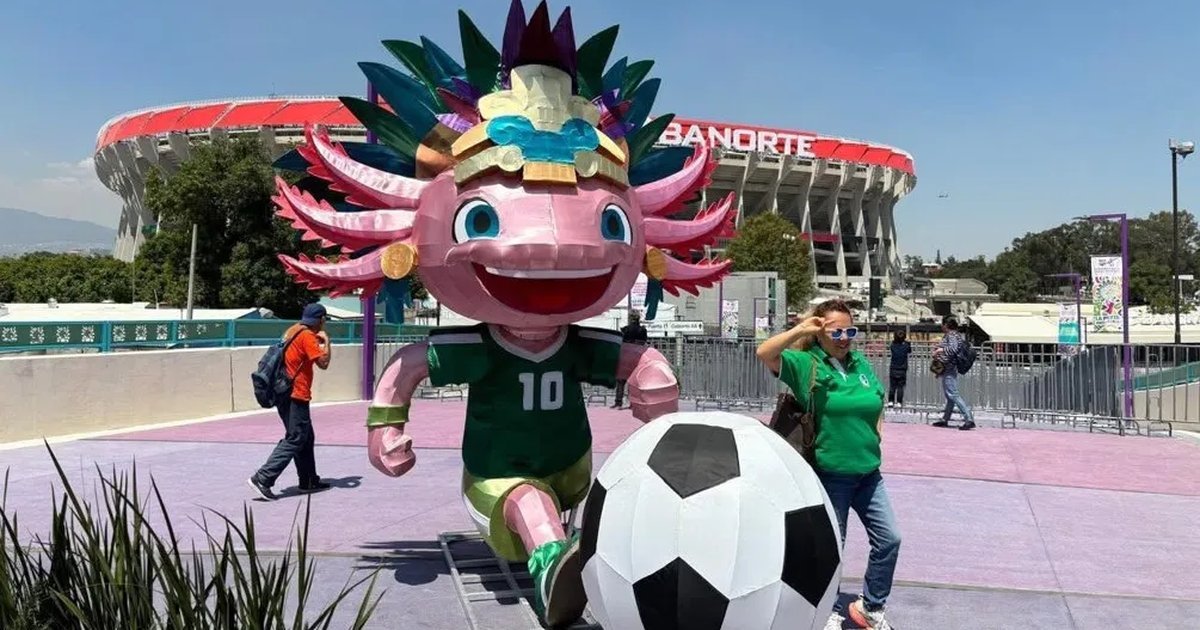
Mexico City — FIFA has ordered the removal of a giant axolotl figure installed at the entrance of Estadio Banorte, saying the mascot violates commercial agreements for the 2026 World Cup, the Mexican Institute of Industrial Property (IMPI) confirmed.
The figure was part of a urban renewal project promoted by Mexico City Mayor Clara Brugada’s administration ahead of the tournament. During the World Cup, the stadium will be renamed Estadio Ciudad de Mexico under FIFA’s branding rules.
Under the commercial agreements between the city government and FIFA, any reference to Brugada’s administration symbol — the axolotl — must be replaced by Zayu the Jaguar, the official mascot of the 2026 World Cup.
IMPI Director Carolina Perez Luna said in an interview that the restriction covers any symbol or mascot that attempts to visually associate itself with the World Cup without official authorization from FIFA.
“This is a very important and relevant issue that we have been working on, not only with FIFA but also with other institutions and all levels of government,” Perez Luna said.
She emphasized that associating the axolotl with the tournament was never an option. “Since 2024, they have registered 357 trademarks for this World Cup, including FIFA World Cup, World Cup 2026, and, of course, the mascots.”
With two weeks until the opening match between Mexico and South Africa, the city government has not yet removed the figure, despite FIFA having officially handed over the three stadiums that will host World Cup matches: Estadio Azteca (Mexico City), Estadio BBVA (Monterrey, Nuevo Leon), and Estadio Akron (Guadalajara, Jalisco).
The restriction on the anthropomorphic figure stems from controversy over the visual strategy promoted by Brugada to transform public spaces in the capital. The administration defends the use of purple as an emblem of feminist struggles and urban renewal. However, citizen groups and specialists in environmental psychology and urban sociology have pointed to causes of rejection, saturation, and discomfort expressed by sectors of the population.
The debate has intensified alongside the “axolotlization” of spaces and the expansion of purple infrastructure ahead of the World Cup. Studies such as “Public Space and Social Identity” by Sergi Valera argue that citizens’ attachment to stable urban codes generates resistance when visual changes occur abruptly.