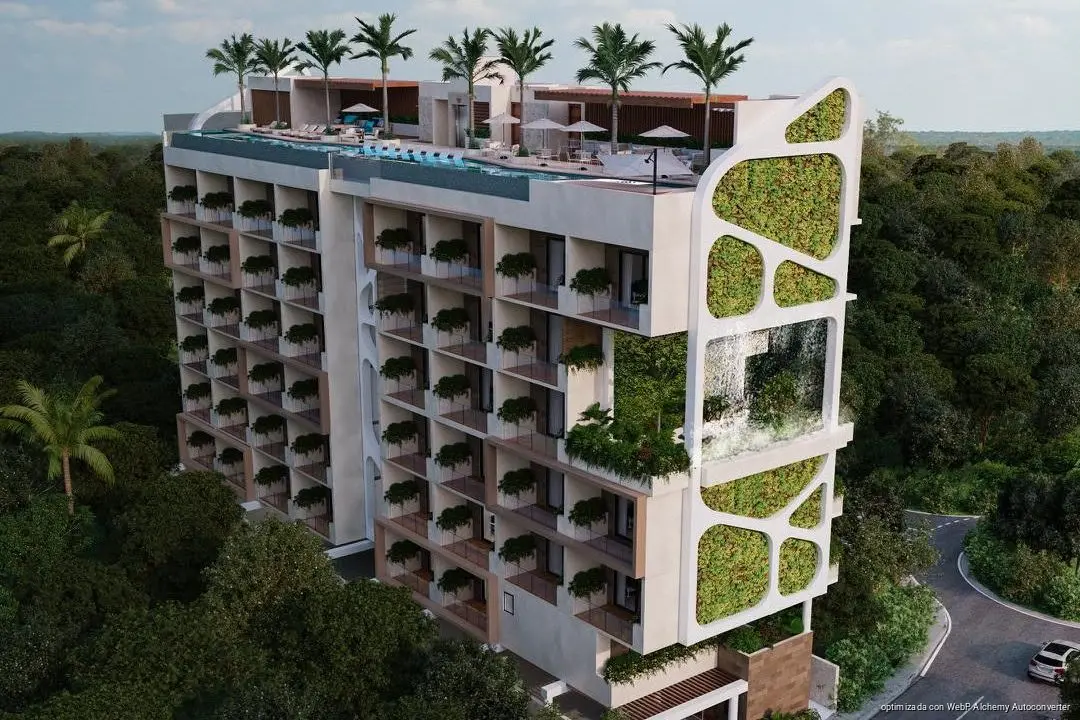
Cancún, Quintana Roo — A federal court has voided the state environmental authorization granted to the Alux 33 condominium project in Puerto Morelos and ordered Quintana Roo’s Environment and Ecology Department (SEMA) to acknowledge that it has no legal authority to evaluate the development, because the site sits on coastal wetland reserved for federal jurisdiction.
Under the ruling in indirect amparo case 959/2025 G-1, handed down by the Ninth District Court, SEMA must revoke the environmental impact resolution contained in document SEMA/DS/SGPA/DIRA/1522/2025, file MIAO-011-VI-25-0109, dated June 24, 2025, and issue a new one declaring that it lacks jurisdiction and refraining from exercising federal powers.
The ruling states that SEMA’s Environmental Impact and Risk Directorate “is not legally competent” to authorize a project on land containing mangroves, citing Article 28, Section X of the General Law on Ecological Balance and Environmental Protection (LGEEPA).
The advocacy group Defending the Right to a Healthy Environment (DMAS) noted that SEMA itself had previously issued a technical opinion warning that the project failed to comply with standard NOM-022-SEMARNAT-2003 on the protection of coastal wetlands, citing the removal of mangrove vegetation and possible violations of the General Wildlife Law.
Those findings were reinforced by statements from the National Commission of Protected Natural Areas (Conanp) and the Environment and Natural Resources Department (Semarnat), which denied the project’s federal environmental impact authorization.
Despite those objections, SEMA issued the state permit and the Puerto Morelos municipal government granted construction license PM-1616, which had already been annulled by the Third District Court in amparo case 515/2025 for failing to prove that federal authorization existed.
After the ruling, DMAS demanded that SEMA comply with the judgment in full once it becomes final and said the case should serve as a precedent for reviewing other environmental impact procedures handled by the state agency.
“Quintana Roo’s environment cannot be left subject to administrative interpretations that contravene federal law,” the organization warned, calling for an audit of SEMA permits issued for projects involving mangroves, wetlands, coastal ecosystems or federal maritime-terrestrial zones.
According to the case file, several other developments are in the same position as Alux 33, including Inna, Musa del Puerto, Uva de Mar, Sole Blue, Soulam, Bella Mare, Wilma and Piedra del Mar, among others, all located along the Puerto Morelos coastal strip.
Federal environmental prosecutors (Profepa) shut those projects down between May and June 2025 for lacking a federal environmental impact statement. Despite the closure notices, construction and sales continued into 2026, and in several cases the developers later obtained authorizations from SEMA itself.
More Environment
- Yucatán Officials Rule Out More Brain-Eating Amoeba Infections at Mérida’s Plaza La Isla
- Tropical Storm Isaias Forms in Gulf of Mexico, Forecast to Hit US as Category 2 Hurricane
- Cozumel Tightens Crocodile Response Protocols After Sightings
- Sargassum Barrier Reaches Puerto Aventuras as Navy Support Takes Shape
- Why Quintana Roo’s Sewer Gap Is Polluting Cenotes and Coasts
More Puerto Morelos
- Puerto Morelos Launches Biometric CURP Registration Drive
- Volvo EX30 Fire Snarls Traffic at Puerto Morelos Highway Entrance
- El 19, 3 Others Arrested in Puerto Morelos Extortion Case
- Park Hyatt to Open in Riviera Maya on December 3 With 148 Rooms
- Canadian Woman in Mental Crisis Breaches Puerto Morelos City Hall and Robs Office