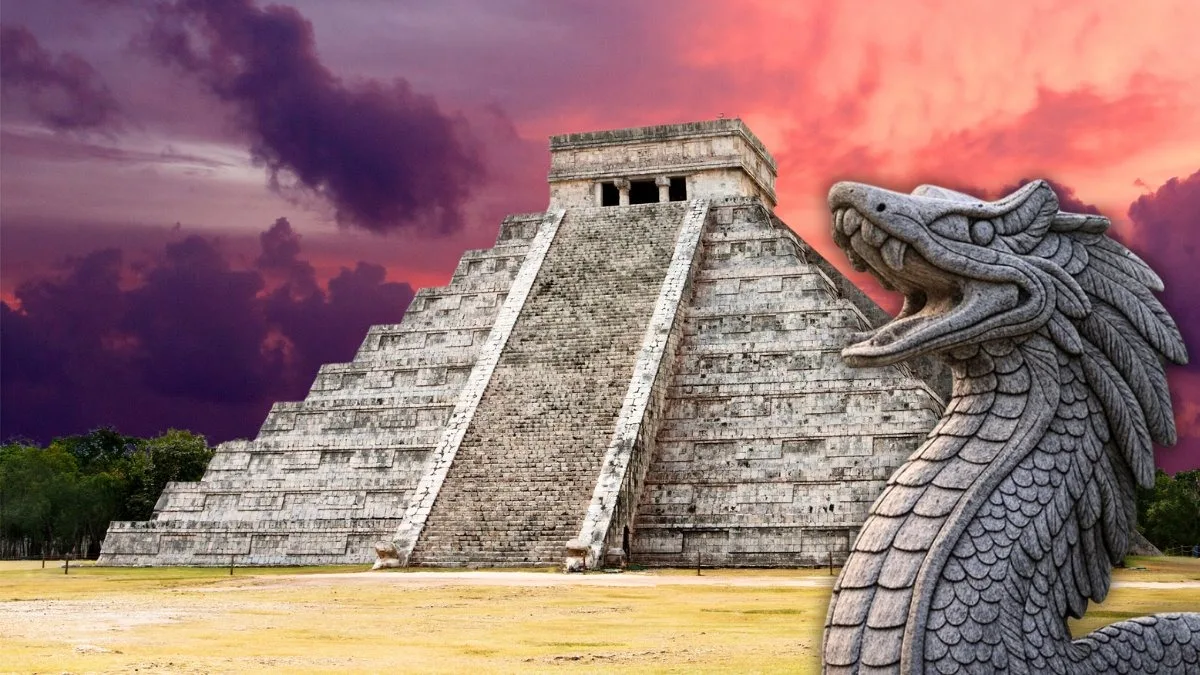
Chichén Itzá, Yucatán — The spring equinox brings one of the most spectacular astronomical displays at Mexico’s ancient Maya city of Chichén Itzá, where a precise play of light and shadow creates the illusion of a serpent descending the pyramid of Kukulkán.
During both the spring and autumn equinoxes, sunlight projects seven triangular shadows along the northern staircase of the pyramid, also known as El Castillo. As the sun moves, these triangles appear to form the body of a serpent that converges with carved serpent heads at the base of the structure.
This optical phenomenon represents the descent of the feathered serpent deity Kukulkán—known as Quetzalcoatl in Toltec culture—who was believed to fertilize the earth and initiate the agricultural cycle for the Maya harvest.
The Pyramid of Chichén Itzá
Founded in the 6th century AD, Chichén Itzá developed into one of the most important Maya cities during the postclassic period. The site became a center for astronomy, military strategy, religion, commerce, agriculture, and politics, forming alliances with other cities like Uxmal and Mayapán.
The pyramid of Kukulkán stands approximately 55 meters wide at its base and rises 24-30 meters high. Its four sides each feature 91 steps, plus one additional step leading to the rectangular temple at the summit—totaling 365 steps, one for each day of the solar year.
The structure demonstrates the Maya’s precise astronomical knowledge, with the equinox phenomenon occurring around 3 p.m. when sunlight aligns perfectly with the pyramid’s northern staircase.
Hidden Jaguar and Cenote Discoveries
Another equinox phenomenon occurs inside the pyramid’s temple, where sunlight causes a red jaguar throne embedded with jade spots to glow brightly.
The name Chichén Itzá translates to “at the edge of the well where the water sages live,” referencing the cenotes that sustained the city. In 1997, researchers discovered a hidden cenote beneath the pyramid, later confirmed in 2015 by Mexico’s National Autonomous University (UNAM). The cenote lies approximately eight meters below the structure, with its entrance intentionally blocked by stones—possibly because it represented the center of the world in Maya cosmology.
The network of cenotes, including the Xtoloc water source, enabled the city’s development. The Sacred Cenote was also used for ritual sacrifices.
Beyond the Pyramid
Chichén Itzá contains numerous other significant structures, including the largest ball court in Mesoamerica measuring 70 meters wide and 168 meters long. Other notable features include El Caracol (believed to be an observatory), the Temple of the Jaguar, the Tzompantli (skull wall), the Temple of the Warriors, and the Forest of a Thousand Columns.
The National Institute of Anthropology and History (INAH) has studied the cultural connections between Maya and Toltec civilizations evident at the site, as well as theories about the city’s abandonment following a civil war.
The 2026 spring equinox occurs on March 20. INAH will broadcast the spring arrival from another archaeological site, Xochicalco in Morelos, beginning at 9 a.m.
Discover more from Riviera Maya News & Events
Subscribe to get the latest posts sent to your email.