Cancún, Quintana Roo — The Quintana Roo Mobility Institute (IMOVEQROO) will begin charging fares on the MOBI Villas del Mar 3–Puente Nichupté route on Tuesday, Nov. 10, after the service completes its free-operation period on Monday, Nov. 9.
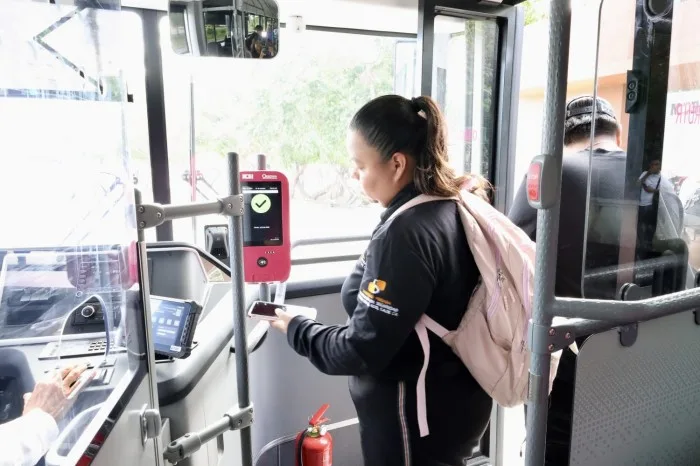
The change affects riders from 128 neighborhoods in northern Cancún who use the connection to reach the Hotel Zone via Kabah Avenue and the Nichupté Bridge. Passengers must have an electronic payment method before boarding, because drivers will not accept cash.
Rafael Hernández Kotasek, head of IMOVEQROO, said the standard fare will be 18 pesos, while students and older adults holding a Tarifa Social credential will pay 10 pesos. People with permanent disabilities can ride free under the Tarifa Cero program with the corresponding credential.
How to pay
Riders can pay with a MOBI card, a QR code from the MOBI app, contactless bank cards or the Tarifa Social credential. The area has 109 locations for topping up, including 39 OXXO stores, 11 GoMart stores and 46 SIX shops.
However, recharges using a bank card through the app and the website remain disabled because of a failure by the service’s outside provider.
Route details
The route began operating on Monday, Nov. 2, as part of the Quintana Roo government’s expansion of the MOBI system. It serves 86,287 people and connects 32,775 homes, 78 schools and 3,019 businesses.
The service covers 62.72 kilometers with 20 buses in operation. Officials say it cuts travel times by as much as 50 minutes on trips such as the run from Villas del Mar 3 to the Cancún Institute of Technology, since riders no longer need to transfer or pass through Kilometer 0 of Kukulcán Boulevard.
Under the transfer system, passengers can make up to four trips within three hours while paying only the full fare for the first leg, provided they use the same electronic payment method each time they board.
More Government
- Isla Mujeres Offers Prostate Cancer Screening for Men Over 40
- 28 Children in Quintana Roo Shelters Are Eligible for Adoption
- Cancún Residents Say 3 Million Peso Park Won in 2023 Was Never Built
- Cancún Plants 3,531 Trees, Keeps Sights on 11,000 Target by 2027
- Cozumel Adds 25 Wells to Boost Drinking Water Supply
More Cancun
- Cancún Searching Mothers Reopen Outbound Lanes but Keep Hotel Zone Blockade
- Cancún’s El Parián Market Endures as a Working-Class Hub After 48 Years
- Quintana Roo to Build Three Margarita Maza High Schools in Cancún by 2027
- Unicaribe Graduates Tell Cancún Engineering Students AI Is Reshaping the Job Market
- Cancún, Playa del Carmen and Chetumal Account for 81% of Quintana Roo’s Disappearances